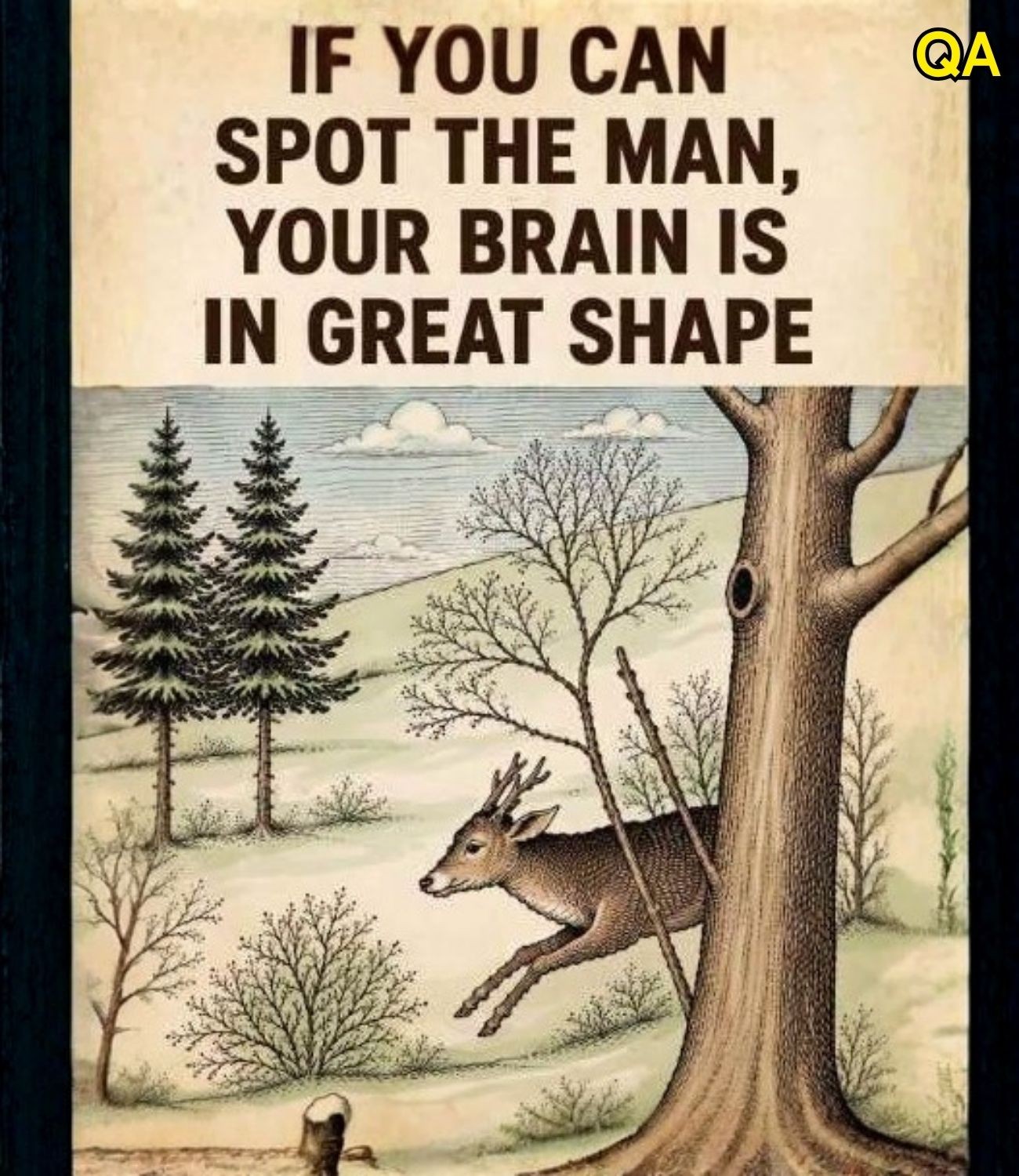
Imagine looking at a peaceful winter forest. Tall trees stretch upward through a blanket of snow, their branches creating intricate patterns against the pale landscape. In the foreground, a deer stands clearly in view, immediately becoming the most recognizable feature in the scene.
At first glance, there seems to be nothing unusual about the picture.
But look again.
Somewhere among the tree trunks, branches, shadows, and snow is another image: a human face. It is not drawn separately or placed into the scene like a traditional portrait. Instead, the face appears to emerge from the natural shapes already present in the forest.
That is what makes this type of hidden-image puzzle so fascinating.
The deer provides an obvious visual anchor, while the human face requires viewers to slow down and reconsider what they are seeing. The challenge is therefore not simply finding something that has been concealed. It is learning to look at a familiar scene differently.
This intriguing effect has connections to psychology, visual perception, artistic traditions, and humanity’s long fascination with finding recognizable patterns in nature.
The Deer Is the First Thing Most People Notice
When viewers first encounter the snowy forest image, the deer naturally attracts attention.
Its silhouette is easy to identify. The head, body, legs, and recognizable posture create a complete visual object that the brain can process almost immediately.
This is an example of how human perception prioritizes recognizable forms.
When looking at a complicated image, our brains do not treat every individual detail equally. Instead, we organize visual information into meaningful objects and patterns.
The deer provides an obvious answer to the question, “What am I looking at?”
Once that answer has been established, attention may move elsewhere or become less sensitive to subtle shapes.
The hidden face, by comparison, does not have a simple outline. Its features are distributed across different parts of the forest.
A tree trunk might contribute to one side of the face. A branch may appear to form part of an eyebrow or another feature. A darker area could suggest an eye, while snow-covered sections may contribute to the lighter portions.
Individually, these elements look completely ordinary.
Together, they can create the impression of a face.
Where Should You Look for the Hidden Face?
If you want to solve the puzzle yourself, resist the temptation to stare only at the deer.
Instead, examine the surrounding forest carefully.
Look between the tree trunks.
Study the branches.
Pay attention to areas where light and shadow meet.
Then examine the snow-covered sections and ask whether several apparently unrelated shapes could form a larger pattern.
The important point is that the face is not necessarily represented by one obvious object.
It is created through relationships between objects.
This is why hidden-image puzzles can be surprisingly difficult. A viewer may spend considerable time searching for a complete face while overlooking the fact that its features are scattered throughout the composition.
Try stepping back from the image mentally. Rather than asking, “Where is the face?” ask, “Can these shapes be interpreted as the outline of a face?”
That change in perspective can make a major difference.
Why Does the Brain Miss Something That Is Clearly Visible?
The answer lies partly in the way human vision processes information.
Seeing is not simply a matter of receiving an image through the eyes. The brain constantly interprets visual information, using previous knowledge and expectations to decide what objects are present.
This process is extremely useful in everyday life.
If you see four legs, a body, and the familiar shape of a head, your brain can quickly recognize an animal without requiring you to consciously analyze every detail.
However, the same efficiency can create interesting effects in optical illusions.
When a scene appears to contain an ordinary forest and a deer, the brain has a ready-made interpretation. It does not necessarily search every tree branch for an additional hidden portrait.
The face may therefore remain unnoticed even though the relevant shapes are technically within the viewer’s field of vision.
The Role of Gestalt Psychology
Hidden-image puzzles are closely related to ideas explored in Gestalt psychology, a field concerned with how people organize visual information.
One important principle is that humans tend to perceive patterns as organized wholes rather than as collections of unrelated pieces.
This helps explain why the hidden face becomes easier to recognize once someone has been told that it exists.
Before receiving the clue, the viewer may see individual tree trunks, branches, shadows, and snow.
After receiving the clue, those same elements can suddenly become parts of a larger structure.
The physical image has not changed.
The interpretation has changed.
This is one of the most fascinating characteristics of visual perception.
Why Recognition Can Happen So Suddenly
Have you ever struggled with a puzzle for several minutes and then suddenly seen the answer?
Hidden-image challenges often produce exactly this experience.
At first, the image seems confusing. You inspect individual details but cannot find the intended object.
Then something changes.
Perhaps you notice the outline of an eye. Once that feature becomes recognizable, another shape suddenly appears to form a cheek or forehead. A few seconds later, the entire face seems obvious.
This sudden transition is sometimes described as an “aha” moment.
The brain has effectively shifted from one interpretation of the visual information to another.
Once the new interpretation becomes established, it can be surprisingly difficult to return to the original way of seeing the picture.
Pareidolia and the Search for Familiar Patterns
Another scientific concept relevant to this puzzle is pareidolia.
Pareidolia refers to the tendency to perceive familiar patterns, especially meaningful forms such as faces, in ambiguous or random visual information.
People may see faces in clouds, landscapes, wood grain, shadows, rocks, or other everyday objects.
The snowy forest puzzle takes advantage of this natural tendency.
The shapes within the landscape can be interpreted as facial features even though they were not necessarily created as a literal portrait.
Human faces are especially powerful visual patterns for the brain.
From infancy, humans become highly sensitive to facial arrangements. Two eyes, a nose, and a mouth form such a familiar configuration that even simplified representations can be enough to suggest a face.
That makes a hidden human face particularly effective in an optical illusion.
Why Faces Are So Powerful
A face carries enormous amounts of information.
Humans instinctively pay attention to faces because they can communicate identity, emotion, attention, and social information.
This sensitivity also means that we can sometimes detect face-like patterns where none were intentionally created.
A few strategically arranged shapes may be enough to trigger the impression of a face.
In the forest puzzle, the face becomes visible when the viewer begins grouping natural features together.
This is why someone who has already found it may wonder how anyone could miss it.
Once the brain has learned the correct interpretation, the visual arrangement becomes much easier to recognize.
The Cultural Fascination With Faces in Nature
The idea of discovering human forms in nature is much older than modern optical puzzles.
Throughout history, people have looked at landscapes and natural objects and interpreted familiar shapes within them.
Clouds have been described as animals, mountains have inspired stories about faces and figures, and unusual rock formations have become associated with legendary characters.
These interpretations often reflect local traditions and cultural imagination.
A natural formation can become meaningful because people give it a recognizable identity.
This does not necessarily mean that ancient observers believed every unusual shape had a literal human origin. Rather, it shows how naturally people connect the unfamiliar with familiar visual patterns.
The hidden face in the snowy forest belongs to this broader tradition of finding meaning in nature.
Art and the Illusion of Seeing Something Else
Artists have also explored the relationship between objects and perception for centuries.
Some artworks deliberately contain multiple images within one composition. A landscape may reveal a portrait when viewed from a different angle, while ordinary objects may form another recognizable figure when considered together.
This technique encourages viewers to question their first interpretation.
The snowy forest puzzle works in a similar way.
The trees remain trees.
The deer remains a deer.
The snow remains snow.
But the arrangement of these elements creates another possible interpretation.
That duality is what makes the image engaging.
Myth Versus Science
It can be tempting to describe an unusual hidden face in nature as mysterious or even supernatural.
Stories surrounding strange landscapes sometimes suggest that unusual formations carry special meanings or represent figures from folklore.
Those stories can be culturally fascinating, but they should be distinguished from scientific explanations.
From a scientific perspective, the perception of faces in ambiguous patterns can be explained through normal visual processing and pareidolia.
There is no need to assume that a mysterious force created the face.
The fascinating part is that the human brain can construct a meaningful interpretation from ordinary visual information.
In other words, the mystery is often not in the forest itself but in how we perceive it.
How to Improve Your Observation Skills
Hidden-image puzzles can also be a fun way to practice careful observation.
Instead of immediately focusing on the largest or most recognizable object, try scanning an image systematically.
Start with the foreground.
Then move toward the middle distance.
Examine the background.
Look at negative spaces between objects rather than only the objects themselves.
You can also slightly change the distance between your eyes and the screen. Sometimes an image becomes easier to interpret when viewed from farther away because individual details merge into larger patterns.
Another useful technique is to temporarily stop searching for the expected object.
Rather than looking specifically for “a face,” study the overall arrangement of light and dark areas.
This can make hidden structures easier to recognize.
The Deer and the Face Create a Clever Visual Contrast
The success of this puzzle depends heavily on the contrast between the obvious and the subtle.
The deer has a coherent shape.
The face does not.
The deer exists as a recognizable subject in the foreground, while the face is distributed across the environment.
This creates two different levels of visual attention.
The first level says, “There is a deer.”
The second asks, “What else is here?”
That second question is where the puzzle begins.
The viewer must overcome the initial interpretation and become more attentive to the surrounding landscape.
What Happens After You Find It?
Perhaps the most enjoyable part of a hidden-image puzzle is what happens after the discovery.
Once the face becomes visible, the forest can suddenly seem completely different.
A branch that looked meaningless may now appear to have a specific purpose.
A shadow may suddenly resemble an eye.
A patch of snow may seem to define part of the forehead or cheek.
The image has not changed.
Only the viewer’s perception has.
This is a powerful reminder that seeing and understanding are not always the same thing.
Final Reflection: Why Hidden Images Fascinate Us
The snowy forest puzzle may appear to be a simple visual challenge, but it reveals something much more interesting about human perception.
We are naturally drawn to recognizable objects. We organize complicated scenes into patterns, search for familiar forms, and use previous knowledge to make sense of what we see.
That ability is essential to everyday life, yet it can also make us overlook subtle details.
The deer captures attention because it is immediately recognizable. The hidden human face requires a different kind of observation: patience, curiosity, and a willingness to reconsider the first interpretation.
Perhaps that is why optical illusions remain so popular.
They remind us that the world we see is not always as straightforward as it initially appears. Sometimes the most interesting discovery is hiding in plain sight, waiting for us to slow down and look again.
So, before moving on, take another look at the snowy forest.
Can you spot the human face among the trees, branches, shadows, and snow—or did the deer capture your attention first?