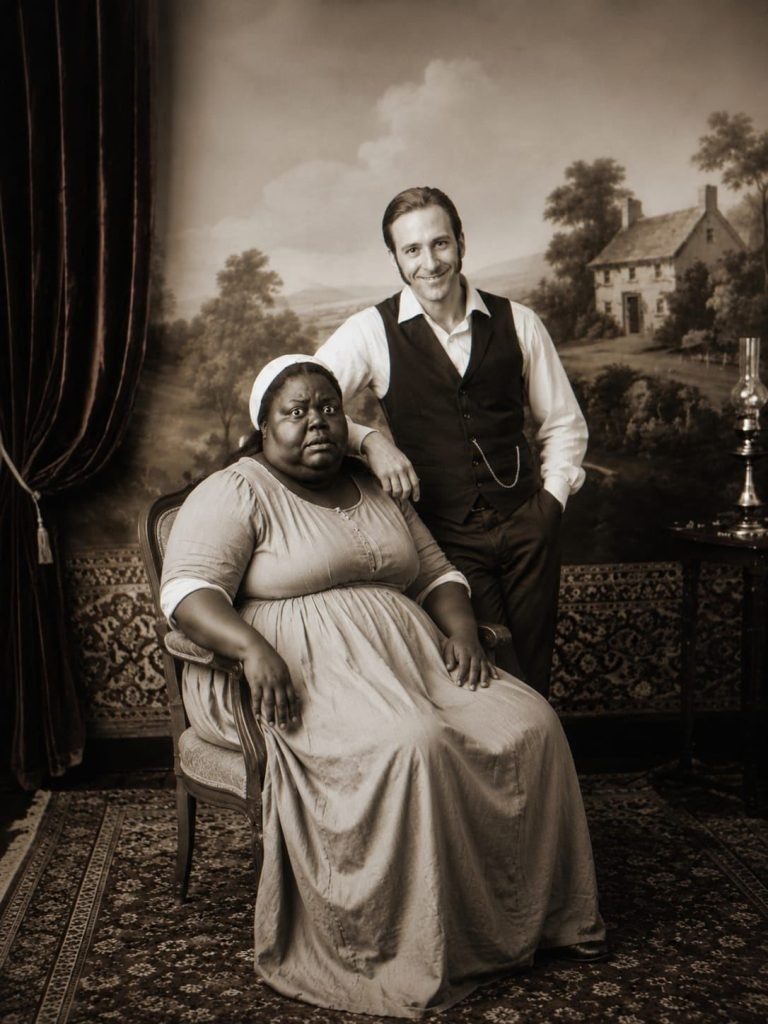
Everyone Rejected Her at the Auction — Then One Farmer Made a Decision That Changed Her Story
The crowd had already made up its mind.
When Benedita appeared before the buyers, people did not see a person with a future.
They saw a problem.
She was unusually tall, nearly two meters by some later retellings, and physically powerful. In the eyes of the people gathered at the market, those qualities were not necessarily advantages.
They were reasons to hesitate.
No one seemed willing to take the risk.
Then, as the bidding fell lower and lower, one man finally spoke.
His name was Joaquim Lacerda.
He offered a remarkably small amount.
The crowd laughed.
But that moment, according to the story that has circulated online in recent years, would become the beginning of an extraordinary chapter in Benedita’s life.
There is an important complication, however.
The surviving online versions of this story provide few verifiable primary sources for Benedita herself, and many of the detailed accounts appear to be modern retellings rather than documented nineteenth-century records.
What can be established with much greater confidence is the historical setting.
In 1857, Brazil was still a slaveholding society. Enslaved people were legally treated as property, and the coffee-growing region around Vassouras was deeply connected to the country’s plantation economy.
That reality makes the story worth examining—not simply as a dramatic tale about one unusual woman, but as a reminder of the human lives that existed behind a system that reduced people to transactions.
Vassouras and Brazil’s Coffee Economy
During the nineteenth century, Vassouras became one of the important centers of Brazil’s coffee-producing region.
Coffee wealth transformed the Paraíba Valley.
Large plantations expanded, fortunes were built, and the region became closely associated with Brazil’s nineteenth-century coffee economy.
But that prosperity depended heavily on enslaved labor.
Thousands of enslaved people worked on plantations throughout the region.
They cultivated crops, processed coffee, maintained properties, performed domestic labor, and carried out countless tasks that sustained the plantation economy.
Their labor created wealth for others while their own freedom was denied.
That context is essential when looking at any story involving an alleged slave auction in Vassouras.
An auction was not simply a business transaction.
For the person being sold, it could mean separation from family, loss of community, uncertainty about the future, and the removal of control over almost every part of life.
The Woman Called Benedita
According to the modern retellings of the story, Benedita stood out immediately.
She was described as exceptionally tall and physically strong.
But the same strength that might be admired in another setting supposedly worked against her at the auction.
Potential buyers were said to believe that she would be difficult to control.
That detail is revealing even if the specific story itself cannot be independently verified.
Under slavery, a person’s value was often assessed according to the economic benefit an enslaver believed they could obtain from that person’s labor.
Physical ability could increase someone’s value.
But perceived resistance could work in the opposite direction.
The system demanded obedience.
A person who resisted that system could be labeled difficult, troublesome, or undesirable.
In other words, the qualities that made Benedita remarkable as a human being could be interpreted as disadvantages by people who viewed her primarily through the logic of ownership.
The Bidding Began to Collapse
The story says that when Benedita was presented, interest quickly disappeared.
One offer was followed by another lower offer.
Eventually, the bidding reached a point where almost nobody wanted to participate.
Then came Joaquim Lacerda’s offer.
It was reportedly so small that other people laughed at him.
Why would anyone pay even that amount for someone everyone else had rejected?
The story gives Joaquim a distinctive role.
Where others supposedly saw risk, he saw strength.
Where others saw someone difficult to control, he saw someone with unusual physical ability.
That interpretation makes for a powerful story.
But it is important not to turn it into something it was not.
Even if the auction occurred exactly as later retellings describe, purchasing an enslaved person did not make Joaquim a liberator.
He was participating in the same system that denied Benedita her freedom.
A different attitude from one individual could change circumstances, but it could not erase the injustice of slavery itself.
The Most Important Part of the Story May Be What We Cannot Know
One of the difficulties with stories like this is that modern retellings often provide extremely specific details.
They may describe exactly what someone looked like.
What they thought.
What they said.
How the crowd reacted.
What happened afterward.
But unless those details come from contemporary documents, diaries, newspapers, court records, letters, or other reliable sources, we cannot know whether they actually happened.
That distinction matters.
Historical storytelling can make the past feel vivid, but vividness is not the same thing as evidence.
The online versions of the Benedita story appear to have spread widely in 2026, with multiple sites repeating substantially similar details.
That repetition can make a story appear well documented even when the underlying evidence is difficult to locate.
So the safest way to understand Benedita’s story is as a modern historical narrative set within a very real historical context, rather than as a fully verified biography.
What Is Historically Certain?
The broader reality surrounding the story is not in doubt.
Slavery existed in Brazil throughout the nineteenth century.
Enslaved Africans and their descendants were bought, sold, inherited, transferred, and forced to work under a system backed by law and economic power.
Vassouras was deeply connected to that system.
Historical research also documents cases in which enslaved people sought freedom, resisted their conditions, negotiated for manumission, or challenged the authority of enslavers.
One academic study of nineteenth-century records, for example, documents individual cases of manumission in Brazil and shows how complicated the relationships between enslaved people and enslavers could become.
And the system lasted for generations.
Brazil did not abolish slavery until May 13, 1888, when Princess Isabel signed the Lei Áurea, the law that formally ended slavery in the country.
That was more than 30 years after the alleged 1857 auction.
Why Stories Like This Continue to Spread
There is something naturally compelling about the basic structure of the Benedita story.
A person is rejected by everyone.
One individual sees something others overlook.
A seemingly insignificant decision changes the direction of a life.
It is a familiar storytelling pattern because it reflects something people like to believe about human potential.
We want to believe that someone can look beyond labels.
We want to believe that a person’s worth is greater than the judgment placed upon them.
And we especially want stories in which someone who has been dismissed eventually proves everyone else wrong.
But historical stories require another layer of thought.
In this case, Benedita was not simply an overlooked worker waiting for someone to recognize her potential.
She was, according to the story, a person living inside a system that denied her basic freedom.
That distinction should never be lost beneath the inspirational message.
Strength Meant Something Different Under Slavery
There is also an important contradiction in the story.
Today, physical strength is often associated with athletic achievement, health, or personal accomplishment.
In a slaveholding society, however, physical strength could be treated as an economic asset.
A person’s body could be evaluated according to how much labor others believed they could extract from it.
That is one of the most disturbing aspects of slavery.
Human characteristics became commodities.
Age became a number in a transaction.
Physical ability became part of a valuation.
Family relationships could be disrupted by sale.
And an individual’s future could be determined by someone else’s financial decision.
Seen in that context, the alleged auction becomes less a story about a bargain and more a window into the dehumanizing logic of slavery.
What If Joaquim Really Did See Something Others Missed?
Perhaps he did.
Perhaps he genuinely recognized Benedita’s strength.
Perhaps he believed she could contribute something valuable to his property.
Perhaps he simply saw an opportunity to acquire labor at a very low price.
Without reliable contemporary evidence, we cannot know his precise motivation.
And that uncertainty matters.
It is tempting to turn Joaquim into a heroic figure because it makes the story more satisfying.
But history rarely gives us such clean characters.
A person can make a decision that changes another person’s circumstances while still participating in an unjust institution.
The two facts can exist at the same time.
Benedita’s Humanity Comes First
The most important part of any story about slavery should not be the price paid.
It should not be the dramatic auction.
And it should not be the person who supposedly saw hidden potential.
It should be the humanity of the person whose life was being controlled.
Benedita was more than her height.
More than her strength.
More than whatever reputation others may have assigned to her.
More than the price someone was willing to pay.
And whether every detail of the modern story can eventually be verified or not, that fundamental truth remains.
People who lived under slavery had families, memories, fears, ambitions, personalities, and hopes.
Historical records often preserve the names of owners, plantation statistics, transactions, and legal documents.
They do not always preserve the inner lives of the people who endured the system.
That absence should make us more cautious—not less interested.
The Price of a Human Life
The idea that someone could be assigned a monetary value is perhaps the most disturbing element of the story.
A number written in an account book could determine where someone lived.
Who controlled their labor.
Whether they remained near family.
Whether they could leave.
Whether they had any meaningful control over their own future.
Today, the reported price attached to Benedita’s story may be what attracts attention.
But that number should ultimately make us think about something much larger.
What does it mean when an entire society gives a price to a human being?
That is the question that reaches beyond this one story.
A Story That Needs to Be Told Carefully
There is a temptation when sharing historical stories online to make them increasingly dramatic.
A few details become more vivid with every retelling.
A conversation is added.
A reaction becomes certain.
A character’s motivation becomes obvious.
Eventually, a story can sound like a perfectly documented historical account even when much of it comes from modern storytelling.
The Benedita narrative is a good example of why historical curiosity should be paired with skepticism.
The setting is historically plausible.
The existence of slavery in Vassouras in 1857 is firmly established.
But the specific details surrounding Benedita and Joaquim Lacerda require stronger primary-source evidence before they can responsibly be presented as established fact.
That doesn’t make the story meaningless.
It simply changes how we should tell it.
Remembering the People Behind the Records
The history of slavery is sometimes presented through statistics.
Millions enslaved.
Decades of forced labor.
Years of economic expansion.
Dates of abolition.
But statistics can make people disappear.
Behind every number was an individual.
Someone who had a name.
Someone who once had hopes for the future.
Someone who may have loved, feared, laughed, argued, dreamed, and remembered.
That is why stories about individual people can be valuable—even when the evidence surrounding a particular story needs to be examined carefully.
They encourage us to look beyond the economic history and ask what life actually meant for the people who lived through it.
The Real Lesson of Benedita’s Story
Perhaps the strongest lesson is not that one farmer recognized a hidden talent.
It is that a person’s worth cannot be determined by the judgment of a crowd.
In the story, the crowd saw someone undesirable.
Joaquim supposedly saw strength.
But today, we can look at the same scene from another perspective.
Benedita should never have needed someone to recognize her value in order to possess it.
Her humanity existed before anyone placed a bid.
It existed regardless of her height, her physical strength, her reputation, or her usefulness to someone else.
That is the deeper lesson hidden beneath the dramatic story.
The most important thing about a human being has never been their market value.
A Memory From a Dark Chapter of History
The story of Benedita should therefore be approached with both curiosity and caution.
The specific account may remain difficult to verify.
But the world in which the story is set was real.
Vassouras was part of a powerful coffee economy built in significant part on enslaved labor.
Brazil’s system of slavery was real.
The buying and selling of human beings was real.
And the consequences lasted long after individual transactions were forgotten.
If Benedita’s story has survived only through modern retellings, that is itself a reminder of how much of history can disappear.
Some lives leave behind detailed archives.
Others survive only as fragments.
A name.
A place.
A transaction.
A story repeated decades or centuries later.
And sometimes, our responsibility is not to make those fragments more dramatic.
It is to handle them carefully.
Because behind every historical record is the possibility that there was once a real person whose life was far more complicated—and far more human—than the surviving evidence can fully reveal.