My Son-in-Law Handed Me a $640 Bill After I Helped With My Newborn Grandchild — So I Paid It and Taught Him a Lesson
I never expected betrayal to arrive in the form of a handwritten bill sitting beside my morning coffee.
For two weeks, I had stayed at my daughter’s home to help care for her newborn baby.
I cooked meals.
I cleaned the kitchen.
I folded laundry.
I held the baby when my daughter needed to sleep.
And whenever my exhausted daughter needed an extra pair of hands, I was there.
I never asked for anything in return.
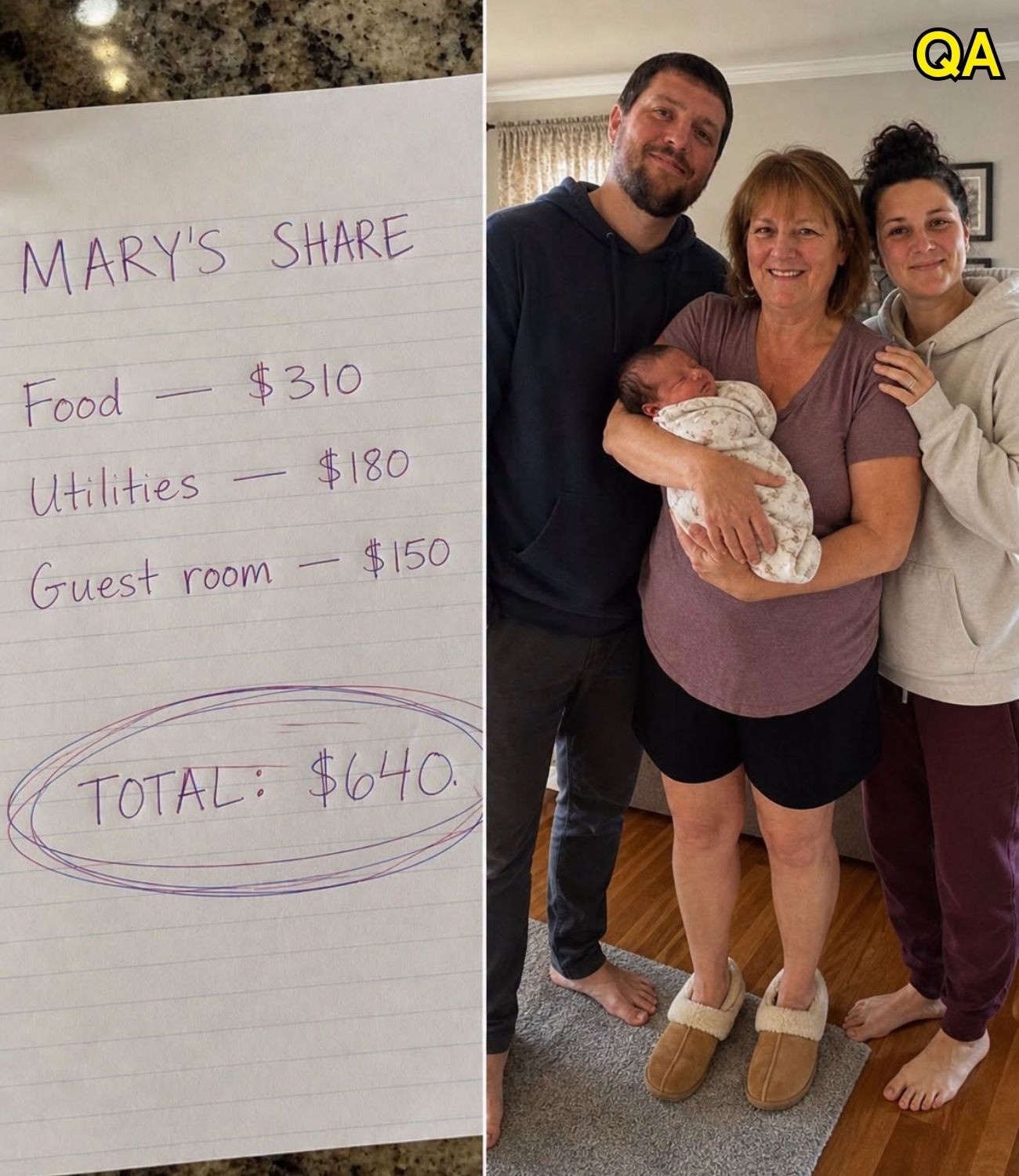
Then one morning, my son-in-law placed a piece of paper on the table.
At the top was a number that made me stare twice.
$640.
Underneath it were several expenses he claimed represented my “share” of the household costs.
I looked at him, waiting for a smile or an explanation.
There wasn’t one.
“Your share,” he said simply.
For a moment, I didn’t know what to say.
I had come to their home because they needed help.
I had spent fourteen days putting my own life on hold so my daughter could recover and adjust to motherhood.
And now I was being presented with a bill.
What happened next changed the way I looked at our family forever.
Why I Went to Help My Daughter
My daughter had given birth to her first child only a few weeks earlier.
Like many new parents, she was overwhelmed.
The excitement of welcoming a baby had quickly been mixed with sleepless nights, endless laundry and the constant uncertainty that comes with caring for a newborn.
When she called and asked whether I could stay for a while, I didn’t hesitate.
“Of course,” I told her.
I packed a suitcase and drove to their house.
I wasn’t going there as a guest.
I was going there as a mother helping her daughter.
I knew those first weeks could be exhausting, and I wanted to make things easier wherever I could.
My daughter needed rest.
Her husband needed time to work.
And the baby needed someone who could step in when the parents were running on almost no sleep.
So I did what I thought any loving mother would do.
I helped.
Two Weeks of Helping Around the House
My days quickly developed a routine.
The baby often woke during the night, so mornings started slowly.
While my daughter slept, I would make breakfast and take care of whatever needed to be done around the house.
There were bottles to wash, clothes to fold and dishes that somehow seemed to multiply overnight.
I cooked simple meals so they wouldn’t have to think about dinner.
Sometimes I would hold the baby while my daughter took a shower.
Other times, I would walk around the living room with the baby until the crying stopped.
None of it felt like work.
This was my grandchild.
I wanted to be there.
I also wanted my daughter to know that she wasn’t alone.
When you’re exhausted, even small things can feel enormous.
A clean kitchen can feel like a luxury.
A hot meal can feel like a gift.
An uninterrupted hour of sleep can feel priceless.
That’s what I thought I was giving my daughter.
Time.
Rest.
Support.
I never imagined someone would put a price tag on it.
The Morning Everything Changed
The morning my son-in-law gave me the bill started normally.
I had made coffee and was sitting at the kitchen table when he walked into the room.
He placed a piece of paper in front of me.
I assumed it was something related to the baby or the household.
Then I saw the total.
$640.
I looked at him.
“What is this?”
He explained that because I had stayed in their home for two weeks, I had supposedly used additional household resources.
The amount included things he believed I should contribute toward.
Food.
Utilities.
Household expenses.
I listened quietly.
I couldn’t understand how we had reached this point.
If he had asked me before I came whether he expected me to contribute financially, I would have understood the situation.
But he hadn’t.
There had been no conversation.
No agreement.
No warning.
Just a bill.
And now he expected me to pay it.
I Asked Him One Question
I could have argued.
I could have reminded him of everything I had done.
I could have listed every meal I had prepared and every load of laundry I had folded.
I could have told him how many times I had gotten up with the baby.
Instead, I asked one question.
“Do you really think I owe you this money?”
He shrugged.
“You stayed here for two weeks,” he said. “Things cost money.”
His response hurt more than the bill.
I realized that we weren’t having a disagreement about groceries or electricity.
We were talking about how he viewed my presence in their home.
To him, my help had become an expense.
To me, it had been an act of love.
Why I Didn’t Argue
My daughter was upstairs with the baby.
I didn’t want her to wake up and hear an argument.
She was already exhausted enough.
So I took a breath.
I picked up the piece of paper.
And I said something that surprised even me.
“Fine.”
He looked relieved.
Perhaps he thought the conversation was over.
Perhaps he expected me to complain but eventually accept the situation.
I didn’t say anything else.
I simply paid the bill.
Every dollar.
Then I packed my suitcase.
Leaving Was the Hardest Part
Before I left, I went upstairs to say goodbye to my daughter.
She looked exhausted.
The baby was sleeping peacefully beside her.
I hugged her and told her I loved her.
She asked whether everything was okay.
I smiled.
“Everything is fine,” I said.
I didn’t tell her about the bill.
Not then.
I didn’t want to add another burden to her shoulders.
I kissed the baby’s forehead and walked downstairs.
My son-in-law was standing near the kitchen.
The $640 had been paid.
But something else had changed.
I no longer felt like a member of the household.
I felt like a customer who had just settled an account.
So I picked up my suitcase and left.
The Lesson Wasn’t About the Money
On the drive home, I thought about the bill.
At first, I was angry.
Then I was hurt.
Eventually, I realized something important.
The $640 wasn’t the real issue.
If money had genuinely been a concern, we could have discussed it.
If they were struggling financially, I would have helped.
If he had said, “We’re having trouble covering groceries this month,” I would have opened my wallet without hesitation.
That wasn’t what happened.
He had chosen to assign a monetary value to my help after I had already given it.
And that told me something.
Sometimes a painful experience isn’t really about what someone asks you to give.
It’s about what their request reveals about how they see you.
I Decided Not to Fight
For several days, I didn’t contact my son-in-law.
I needed time to think.
I also needed to decide whether I should tell my daughter what had happened.
Eventually, I realized she deserved to know.
But I didn’t want to turn her against her husband.
That wasn’t my goal.
Instead, I told her exactly what happened without exaggerating anything.
I showed her the bill.
She stared at it for a long time.
Then she looked at me.
“Mom, I didn’t know about this.”
Her voice sounded different.
She was embarrassed.
I could see that she was struggling to process what had happened.
I told her she didn’t need to apologize for something she hadn’t done.
“I didn’t help you because I expected anything,” I said. “I helped because you’re my daughter.”
She started crying.
And suddenly the whole situation felt even sadder.
My Daughter Had a Difficult Conversation With Her Husband
Later, my daughter confronted her husband.
I wasn’t there for the conversation.
I didn’t want to be.
Whatever happened between them was something they needed to work through themselves.
Eventually, she told me that he admitted the bill had been insensitive.
He said he hadn’t intended to hurt me.
He believed that because I had stayed in their home, contributing toward household expenses was reasonable.
But there was a problem with that explanation.
Reasonable expectations should be discussed beforehand.
You don’t invite someone into your home to help your family and then surprise them with a bill afterward.
Especially when that person is your wife’s mother.
An Apology Came Later
Several days passed before my son-in-law contacted me.
He apologized.
Not for the $640 itself, but for the way he handled everything.
He admitted that he should have spoken to me before I came.
He also acknowledged that my time and help had been valuable, even though he had failed to recognize it at the time.
I appreciated the apology.
But forgiveness didn’t mean forgetting.
Something had changed.
Trust rarely disappears in one dramatic moment.
Sometimes it disappears quietly.
One careless comment.
One unexpected demand.
One moment when you realize someone sees a relationship differently than you thought.
I Gave Him the $640 Back
A few weeks later, I returned the money.
Not because I regretted paying the bill.
And not because I wanted to punish him.
I returned it because I wanted to make one point clear.
I didn’t want money to become the measure of my relationship with my daughter or my grandchild.
I told him:
“Keep the lesson, but give me the money back.”
He looked confused.
I explained that I didn’t want compensation for helping my own family.
What I wanted was respect.
That’s something money can’t buy.
Family Help Should Come With Communication
The experience taught me something that applies far beyond my own family.
Helping relatives can be complicated.
People have different expectations about money, household responsibilities and boundaries.
One person may see a two-week stay as family support.
Another may see it as additional household expenses.
Neither perspective automatically makes someone a bad person.
The real problem begins when expectations are never discussed.
If you are inviting someone to stay with you, talk about the practical details beforehand.
If there are expenses they will be expected to cover, say so.
If someone is helping you with childcare or household responsibilities, make sure both sides understand what is expected.
Clear communication can prevent resentment.
And it can prevent a $640 bill from appearing beside someone’s morning coffee.
What I Learned From the Experience
I still love my daughter.
I adore my grandchild.
And I hope my relationship with my son-in-law continues to improve.
But I also learned that being generous doesn’t mean having no boundaries.
For years, I believed that helping family meant simply giving whatever was needed.
Now I understand that healthy relationships require something else too.
Communication.
Respect.
And appreciation.
You can love someone deeply while still telling them when they’ve crossed a line.
You can forgive someone without pretending that their actions didn’t hurt you.
And sometimes, the most important lesson isn’t the one you teach another person.
It’s the lesson you learn about yourself.
A $640 Bill I’ll Never Forget
Looking back, I don’t remember the exact groceries I bought during those two weeks.
I don’t remember how many loads of laundry I folded.
I don’t remember how many times I walked through the hallway at night carrying a crying baby.
But I remember that piece of paper.
I remember the number.
And most importantly, I remember what it made me realize.
Helping someone you love should never be confused with being obligated to accept disrespect.
Family relationships are valuable, but they aren’t strengthened by keeping score of every meal, every utility bill or every favor.
If someone needs financial help, talk about it.
If someone needs boundaries, establish them.
If someone needs appreciation, don’t assume they already know they’re valued.
And if a disagreement happens, have the difficult conversation before resentment has a chance to grow.
Because in the end, the $640 was easy to pay.
What mattered far more was understanding what that bill had revealed — and making sure the same mistake never happened again.