The Family Dinner Question That Left Everyone Speechless
When I was about six years old, I thought family dinners were the perfect place to share important information.
I had not yet learned that words can sometimes sound very different to adults than they do inside a child’s head.
In my mind, there was nothing complicated about family conversations. Everyone was gathered around the same table, the food was being passed around, people were laughing, and Grandpa was telling another one of his famously long fishing stories.
So naturally, I believed it was my turn to contribute.
I had no idea that my innocent comment was about to become one of those family stories everyone would remember for years.
A Typical Family Dinner
Holiday dinners in my family were always noisy.
There was usually far too much food on the table, several conversations happening at once, and at least one person trying to convince everyone else that they needed another serving.
Grandpa loved telling stories.
He could turn a simple fishing trip into a twenty-minute adventure involving weather, boats, strange neighbors, and fish that somehow seemed to become larger every time he retold the story.
That evening was no different.
Everyone was gathered around the table while Grandpa continued one of his favorite fishing stories.
I sat quietly in my chair, listening for a while.
But children have a limited attention span, especially when adults are discussing the same story for what feels like forever.
Eventually, my mind wandered.
I started thinking about something I had noticed.
And because I had recently learned that family dinners were a good time to share things, I decided that I had something important to contribute.
The Question That Changed the Room
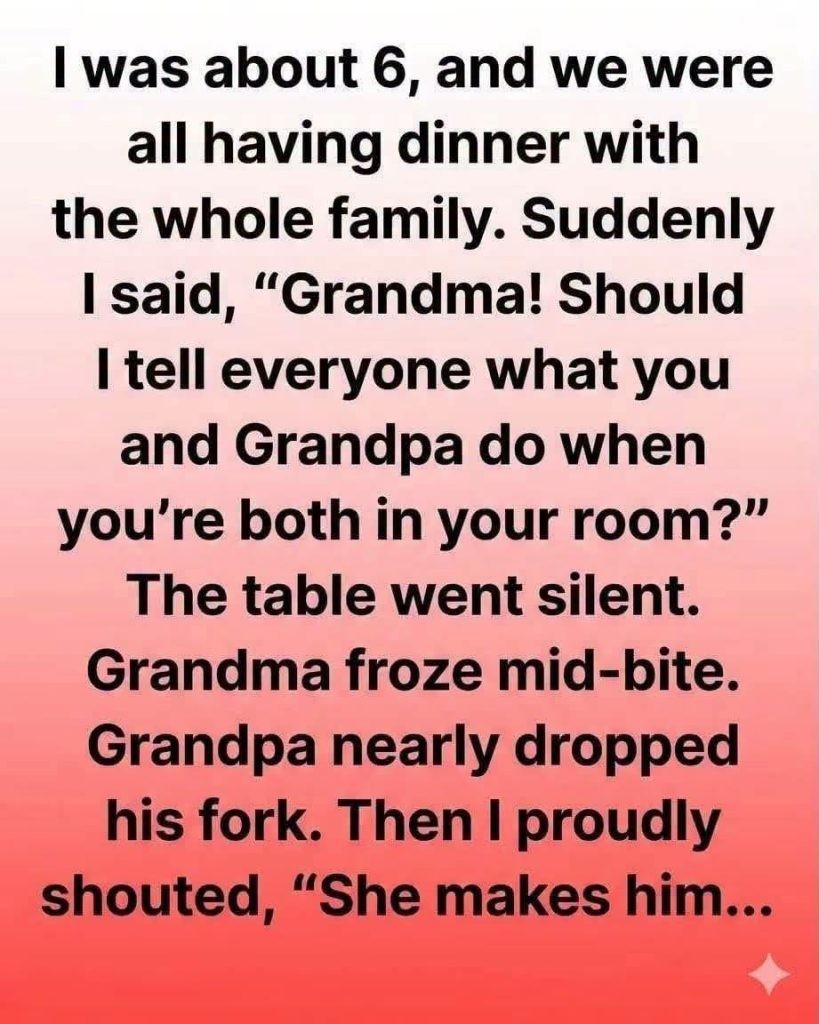
Right in the middle of Grandpa’s story, I suddenly spoke.
“Grandma,” I said proudly, “should I tell everyone what you and Grandpa do when you’re alone in your room?”
The effect was immediate.
Grandpa stopped talking.
My parents stopped eating.
Everyone suddenly looked at me.
Even the conversations happening at the other end of the table seemed to disappear.
For a few seconds, nobody knew what to say.
I remember looking around the table and wondering why everyone had suddenly become so interested in what I was saying.
To me, it was a completely ordinary question.
To the adults, apparently, it sounded much more mysterious.
Grandma looked at me carefully.
“What do we do?” she asked.
Grandpa had the expression of someone who was trying very hard to figure out what was coming next.
I simply smiled.
I had no idea I was creating one of the biggest moments of suspense the family had experienced all evening.
The Innocent Answer
Then I gave them the answer.
“She makes him fold the laundry.”
For one second, nobody moved.
Then the entire table erupted in laughter.
Grandma laughed.
My parents laughed.
My siblings laughed.
And even Grandpa, who had looked so concerned moments earlier, started laughing.
I sat there confused.
I couldn’t understand why everyone found my answer so funny.
From my perspective, I had simply answered the question.
Grandma made Grandpa fold the laundry.
That was it.
There was nothing mysterious about it.
But the way I had introduced the subject had created an entirely different impression.
Grandpa Had the Perfect Response
Once everyone had calmed down, Grandpa looked at me and laughed.
“Well, she’s not wrong,” he said.
That made everyone laugh again.
Grandma simply shook her head.
The moment could easily have become awkward or uncomfortable, but instead, my grandparents treated it as exactly what it was: an innocent misunderstanding created by a child who had not yet learned how adults interpret certain words.
Nobody scolded me.
Nobody made me feel embarrassed.
Instead, everyone laughed together.
And that reaction is probably why I remember the story so clearly today.
Why Children Can Surprise Adults
Children often communicate with remarkable honesty.
They do not always understand why certain subjects require context.
They simply say what they see.
They may hear adults talking about something and interpret it literally.
They may notice a small detail that everyone else has ignored.
And sometimes, they say something at exactly the wrong moment.
The result can be unintentionally hilarious.
In my case, the phrase “what you do when you’re alone in your room” sounded mysterious because adults naturally filled in the missing information themselves.
I had no such assumptions.
I was simply talking about laundry.
That difference between what I meant and what everyone else heard created the entire joke.
The Power of Context
Looking back, the funniest part of the story is not really what I said.
It is what everyone thought I might say.
The sentence itself created a question.
My family had no idea what I was about to reveal, so their imaginations filled the silence.
Then the completely ordinary answer arrived.
Laundry.
That sudden change from suspense to something mundane made the situation even funnier.
It is a good example of how much context affects communication.
The same sentence can sound completely different depending on the situation, the speaker, and the listener.
A child may say something innocently.
An adult may hear something completely different.
And sometimes, that gap creates an unforgettable family story.
My Grandparents Turned It Into a Memory
What I appreciate most about the moment now is how my grandparents handled it.
They could have become upset.
They could have told me not to say things like that.
Instead, they laughed.
Their reaction taught me something without turning the experience into a lecture.
They showed me that misunderstandings do not always need to become serious problems.
Sometimes the best response is simply to laugh, explain what happened, and move on.
That lesson has stayed with me far longer than I expected.
Family Stories Often Begin With Small Moments
Families tend to remember unusual moments.
Not necessarily the expensive holidays.
Not necessarily the carefully planned celebrations.
Often, the memories that survive are the little moments nobody planned.
A child says something unexpected.
Someone spills a drink.
A grandparent tells the same story for the hundredth time.
Someone mishears a sentence and responds with something completely unrelated.
These moments become stories.
Years later, people retell them at new family gatherings.
The details may change slightly.
The laughter may become part of the story itself.
Eventually, the original moment becomes a piece of family history.
What I Learned From That Dinner
At six, I did not understand why everyone reacted so dramatically.
As I grew older, however, the memory began to make more sense.
I learned that communication is not simply about what you intend to say.
It is also about how other people understand your words.
A sentence can be technically innocent while still sounding mysterious when the listener does not know the context.
That is especially true when children are involved.
They often provide the missing context only after everyone else has already imagined something completely different.
Why Humor Can Bring Families Closer
Looking back, I am grateful that my family chose laughter.
That moment could have become embarrassing.
Instead, it became a shared memory.
Every time the story was retold, Grandpa’s reaction became part of the joke.
Grandma’s expression became another detail.
And my completely innocent confidence became the final ingredient.
The story grew into something bigger than the original moment.
It became one of those memories that could make everyone laugh even years later.
The Smallest Moments Can Become the Best Stories
There is something wonderful about family memories that happen without planning.
Nobody at that dinner knew they were creating a story that would be remembered for years.
Grandpa was simply telling a fishing story.
Everyone was eating dinner.
I was simply trying to participate in the conversation.
And then one sentence changed the entire mood of the table.
The funny part was not that I intended to create suspense.
I didn’t.
I was simply six years old.
That innocence made the moment even more memorable.
A Lesson About Seeing Things Differently
Today, I can see the situation from both perspectives.
From my childhood perspective, the statement was completely ordinary.
From the adults’ perspective, the wording created an entirely different expectation.
Neither side was really wrong.
We were simply hearing the same words through completely different experiences.
That is something worth remembering outside family dinners too.
People do not always interpret our words exactly as we intend them.
Sometimes they lack context.
Sometimes they make assumptions.
Sometimes a simple explanation can completely change how a sentence is understood.
And sometimes, the misunderstanding is funny enough to become a story.
The Memory That Still Makes Us Laugh
Years have passed since that holiday dinner, but the story has never completely disappeared.
It became one of those family legends that occasionally returns during gatherings.
Someone mentions Grandpa’s fishing stories.
Someone remembers my question.
And eventually someone says, “Remember when she asked what Grandma and Grandpa did alone in their room?”
Everyone laughs.
Then comes the answer.
“She made him fold the laundry.”
And somehow, it is still funny.
Not because anything inappropriate happened, but because a six-year-old accidentally created several seconds of suspense at the dinner table with absolutely no idea what everyone was thinking.
Sometimes the Best Memories Are the Unexpected Ones
Family life is filled with moments that seem insignificant when they happen.
A strange question.
A funny misunderstanding.
An unexpected comment from a child.
A joke that nobody planned.
Yet these are often the memories that remain the longest.
My grandparents could have reacted differently that night.
Instead, they chose humor.
And that choice transformed an awkward moment into something warm and memorable.
It reminded me that laughter can turn an ordinary misunderstanding into a story worth telling again and again.
Perhaps that is why family stories are so special.
They do not have to be dramatic.
They do not need perfect endings.
Sometimes all they need is a crowded dinner table, a child who speaks without overthinking, and a family willing to laugh together.
And every time I remember that evening, I think about how one innocent question about laundry managed to become a family classic.