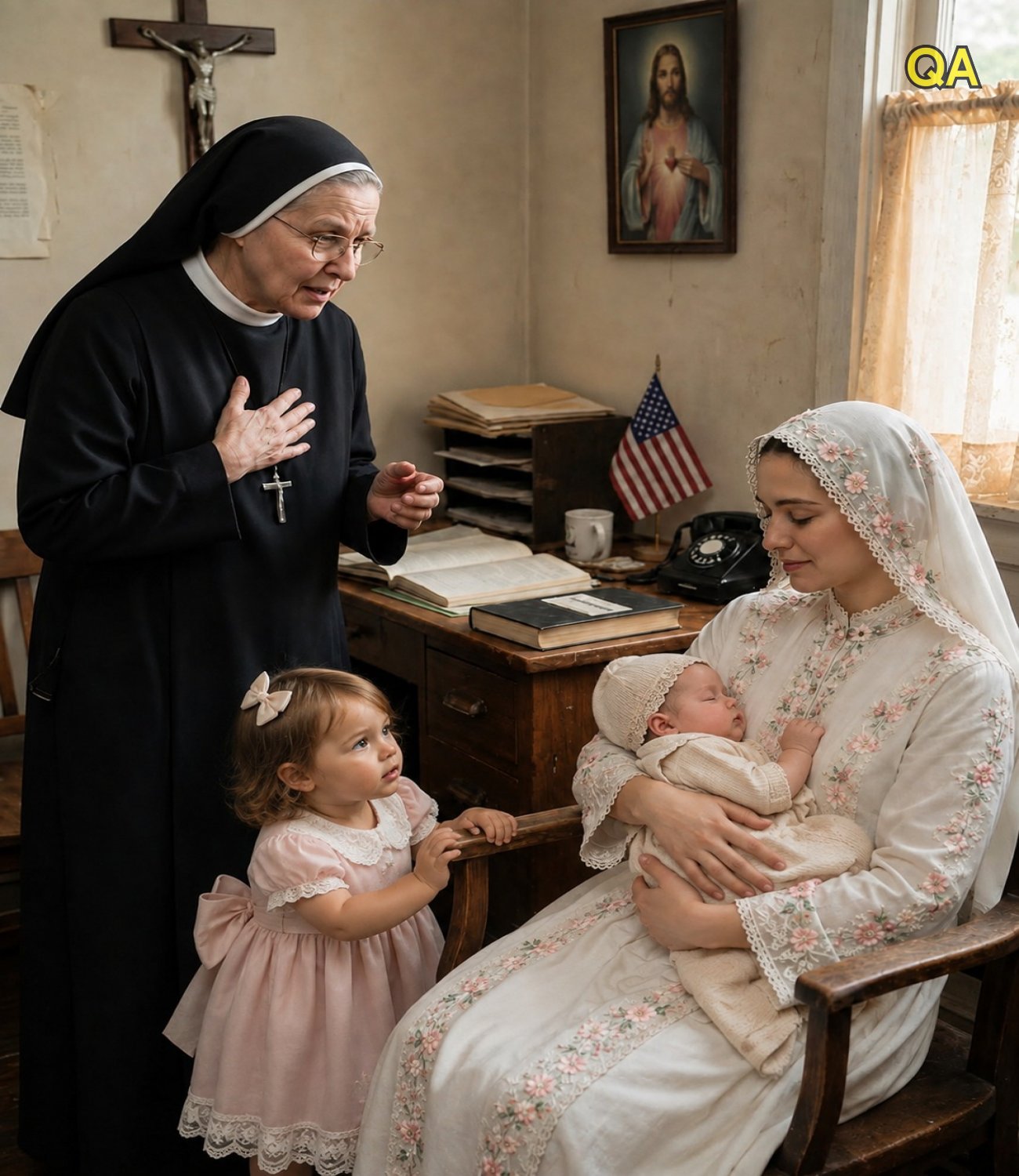
Chapter 1: The Strip of Medical Tape
Mother Caridad held the strip of medical tape beneath the desk lamp and turned it carefully between her fingers. There was nothing extraordinary about it. It was no longer than the first joint of her thumb, with one edge folded over as though it had been pulled hastily from someone’s skin. Yet the faint medicinal scent brought back a memory she could not immediately place—a white room, a metal tray, Doctor Paloma speaking in a calm voice while rain tapped against the infirmary windows.
Mother Caridad set the tape on a clean handkerchief and reached for the telephone, pausing before lifting the receiver. For three years, she had tried to protect Sister Esperanza from gossip. She had answered every question from the bishop’s office with carefully chosen words, arranged baptisms quietly, and made certain that little Tomás and Miguel were raised in warmth rather than suspicion. But beneath all those practical decisions lived a truth she had barely admitted to herself: she was afraid. Not of Esperanza, and not even of scandal, but that someone she trusted had been hiding something from her inside the very walls she had spent her life guarding.
She dialed Doctor Paloma’s number. The doctor answered after the fourth ring.
“Paloma speaking.” “It is Mother Caridad.”
A small silence followed.
“Mother,” the doctor said, her voice brightening with professional warmth. “Is one of the sisters unwell?” “I need you to come to the convent.” “Of course. What has happened?”
Mother Caridad looked toward the open doorway. In the corridor beyond, she could hear soft footsteps, the clink of cups from the kitchen, and Sister Esperanza singing quietly to one of the children.
“She believes she is pregnant again.”
This time, Doctor Paloma did not answer immediately. Mother Caridad felt her fingers tighten around the receiver.
“Doctor?” “I heard you,” Paloma said. There was something in her tone now—not surprise, but weariness. “You do not sound shocked.” “I am a physician. I try not to react before examining a patient.” “That is not what I meant.”
Another silence passed before Paloma exhaled.
“I can be there before noon.” “Please come sooner.” “I will.” “And Paloma?” Mother Caridad added before the line could close. “Yes?” “I found something in my office. A strip of medical tape.”
The doctor’s breathing seemed to change.
“Where?” “Near the chair where Esperanza was sitting.” “That may mean nothing.” “Perhaps,” Mother Caridad said, looking at the tape again. “But you recognize why I am asking.” “I will come at once,” Paloma said, and the line went dead.
Chapter 2: Pieces of a Lost Memory
Sister Esperanza sat at the long kitchen table with Miguel on her lap and Tomás beside her. Sunlight poured through the high windows, warming the stone walls and turning the steam above a pot of milk into pale ribbons. Sister Lucía stood near the stove, slicing bread while keeping an affectionate eye on the children. Tomás had decided that his wooden spoon was a horse, galloping it across the table with soft clicking sounds.
“No riding near the milk,” Lucía warned. “Horse thirsty,” Tomás replied. “Then the horse must wait until after breakfast.”
Esperanza smiled and kissed the top of his head.
“He is learning patience.” “He is learning how to negotiate,” Lucía replied.
Miguel stirred against Esperanza’s shoulder. His fingers curled around a fold in her habit. Sister Lucía placed two slices of bread on a plate and sat across from Esperanza.
“You look pale.” “I did not sleep well.” “Because of the baby?”
Esperanza glanced down at her stomach. There was no visible change yet, but she had already begun touching it unconsciously, as if protecting something hidden.
“I suppose so.” “Are you frightened?” Lucía lowered her voice. “No.”
It was the same answer she had given each time before, but this morning it did not sound convincing, even to her. Lucía studied her face.
“You are allowed to be frightened.” “I know.” “Mother Caridad will find answers.” “She has been trying for years.”
Esperanza looked toward the kitchen door. Through it, she could see part of the cloister garden and the old infirmary wing beyond. A strange uneasiness passed through her. She remembered waking there once—or believed she remembered it. There had been a lamp above her, a cold cloth on her forehead, and someone saying, You are safe. But when had that happened? During her first pregnancy? Before either of them? The memory dissolved whenever she tried to hold it.
“Esperanza?” Lucía asked, breaking her trance. “Yes?” “You went somewhere far away.” “I was only thinking.” “About what?” “I do not know.” “That is a troubling answer.”
Esperanza looked down at Miguel.
“There are pieces missing. My memory.” “Pieces of what?” “There are mornings when I wake and feel as though I have forgotten a dream. Not an ordinary dream. Something important. I can almost see a room, or hear a voice, but then it vanishes.” “Has this happened recently?” “It has happened for years.” “Why have you never told anyone?” Lucía asked, her expression softening. “I thought it was exhaustion. Then Tomás was born. Then Miguel. There was always something more urgent.”
Chapter 3: The Doctor’s Secret
Doctor Paloma arrived before ten. Her gray motorcar stopped just beyond the convent gate, and Sister Beatriz hurried to admit her. Mother Caridad waited in the entry hall.
“You came quickly,” Mother Caridad said. “You sounded worried.” “I am worried.”
Paloma removed her gloves.
“Where is Esperanza?” “In the kitchen with the children.” “May I examine her in the infirmary?”
Mother Caridad nodded. As they walked, the doctor’s gaze moved over the corridors with a deliberate intensity, noting the locked linen room, the chapel passage, and the narrow staircase leading toward the unused guest quarters. Mother Caridad noticed.
“You are looking for something.” “I am remembering the layout.” “You have visited us for eleven years.” “I know.”
They reached the infirmary door. Mother Caridad took the handkerchief from her pocket and unfolded it, revealing the strip of tape. Doctor Paloma stared at it.
“Is it yours?” Mother Caridad asked. “It is ordinary surgical tape.” “That was not my question.”
Paloma’s eyes lifted.
“It could have come from my case during an earlier visit.” “It was fresh.” “How can you be certain?” “It still had adhesive on it.”
The doctor pressed her lips together.
“Mother Caridad, let me examine Esperanza before we create explanations from scraps.” “Very well.”
As Paloma reached for the door, Mother Caridad placed a hand near her.
“I have trusted you with the health of every woman in this convent. I would like to continue doing so.”
Paloma turned. There was no anger in her face, only sadness.
“You may find,” she said softly, “that trust and complete knowledge are not always the same thing.”
Moments later, Sister Esperanza and Lucía arrived with the children. The examination was gentle and brief. Doctor Paloma asked a series of questions, took her pulse, pressed her abdomen, and prepared a quick test. When she placed the test aside and met Esperanza’s gaze, the verdict was clear.
“It is positive.”
The room became very quiet. Esperanza lowered her eyes, her shoulders falling slightly under the weight of the confirmation. Mother Caridad moved toward her and took her hand.
“Are you unwell?” “No,” Esperanza’s voice trembled. “I am only tired of being surprised by my own life.”
Mother Caridad looked at Paloma.
“Doctor, we need to speak privately.” “No,” Esperanza said, standing unsteadily but with quiet determination. “If this concerns me, I will remain.”
Paloma closed her eyes for a moment, pulled the single wooden chair away from the wall, and sat down.
“This did not begin three years ago,” she began.
Chapter 4: The Letters of the Past
Six years ago, before Esperanza took her final vows, she had fallen seriously ill while caring for others during an outbreak. During her fevered delirium, she had spoken about a family she supposedly never had—specifically a sister named Elena. Mother Inés, the former Mother Superior who had passed away years prior, had investigated the claim and discovered that Esperanza’s birth name was Ana Valdés. Following her parents’ death, she had been separated from her younger sister, Elena, and raised by a relative who hid the truth out of fear of losing her.
“Did I meet her after she wrote?” Esperanza asked, her voice tight with disbelief. “Yes,” Paloma said. “During the weeks after your illness, in the old guest parlor.”
Mother Caridad’s head lifted sharply.
“I was never told.” “Mother Inés believed it should remain private until Esperanza decided what she wanted.” “What did I decide?” Esperanza whispered. “You wanted to help her.”
Doctor Paloma retrieved an old, worn notebook kept by Mother Inés, detailing how Elena and her husband, Gabriel, had struggled with fertility. Wanting to bridge the gap of their separated lives, Esperanza had initially agreed to act as a surrogate, though the first medical procedure six years ago had been unsuccessful. Afterward, Elena and Gabriel moved away, and while the official attempts supposedly stopped, Esperanza had mysteriously become pregnant with Tomás three years later, and later with Miguel, with no clear recollection of how it happened.
“Were you present when I became pregnant with Tomás?” Esperanza asked. “No,” Paloma said. “And Miguel?” “No.” “And this time?” “No.” “Then why did you sound as though you expected today’s result?”
Paloma reached inside her coat and removed an envelope that had arrived at her clinic two weeks prior containing a single typed sentence: Sister Esperanza may require your care again before the summer ends. At the bottom was a faint embossed seal belonging to Mother Inés—surrounding three small branches—proving that someone had kept old convent stationery and had been watching Esperanza closely enough to predict the future.
Chapter 5: The Final Truth in the Wall
After the examination, Mother Caridad took Esperanza to explore the long-abandoned guest parlor. Dust lay thick across the furniture, but near the far wall, a narrow line beneath the blue curtains appeared cleaner than the rest. Drawing the fabric aside, they discovered a small, forgotten storage alcove built into the thickness of the stone wall. Inside sat a dark wooden chest.
The chest opened without resistance, revealing a collection of documents tied with a blue ribbon: Esperanza’s original consent form, a letter of withdrawal from Elena, a statement signed by Doctor Paloma, and three sealed envelopes. The newest envelope contained a medical appointment card from a private clinic in the city, dated seven weeks earlier, listed under the name Ana Valdés. On the back, a handwritten note read: You asked me long ago to keep the truth until you were strong enough to choose it freely. I fear I waited too long.
Beneath the documents lay a photograph. It showed two young women standing outside a small house—Elena, possessing Esperanza’s gentle smile, standing beside Sister Esperanza herself without her habit, resting a hand over the curve of a pregnant belly. On the back, in Esperanza’s own handwriting, were seven words: I have chosen this. Please help me remember.
Mother Caridad turned the photograph over again. In the window of the house behind the two sisters, a third figure stood partly hidden by the curtain—a man wearing a ring with a dark stone. And beneath the photograph, written in a different hand, was a final, chilling line:
Ana remembered everything once before.