Chapter 1: The Shadow at the Altar
The morning of my wedding smelled of fresh white roses, sweet summer rain, and the faint scent of lavender from the cedar box I had found beneath my mother’s bed after she passed away. For six months, that small box had sat on my vanity. Inside were two sealed envelopes—one addressed to me, Clara, and the other to my younger sister, Paige.
My letter had been simple. My mother had written in her familiar, looping cursive: Marry with a clean heart, Clara. Do not let bitterness sit beside you at the altar.
Paige’s letter, however, had been handled differently. Mom had placed it inside a silk pouch stitched into the lining of an elegant white dress she had ordered before her illness took over. Her verbal instructions to me before she died had been cryptic: “If your sister ever wears white to your wedding, do not stop her. Let her step forward. Then give her this.”
At the time, I had felt a sting of resentment. It felt as if Mom was asking me to forgive Paige in advance for a betrayal that hadn’t even happened yet.
Paige had always been the storm in our family. While I was taught to be calm, patient, and quiet, Paige burned through every room she entered. She sucked the air out of celebrations, transformed family dinners into dramatic confrontations, and competed relentlessly for attention. When I graduated from college, she announced a short-lived engagement to steal the spotlight. When I bought my first apartment, she complained about how unfair the world was to her.
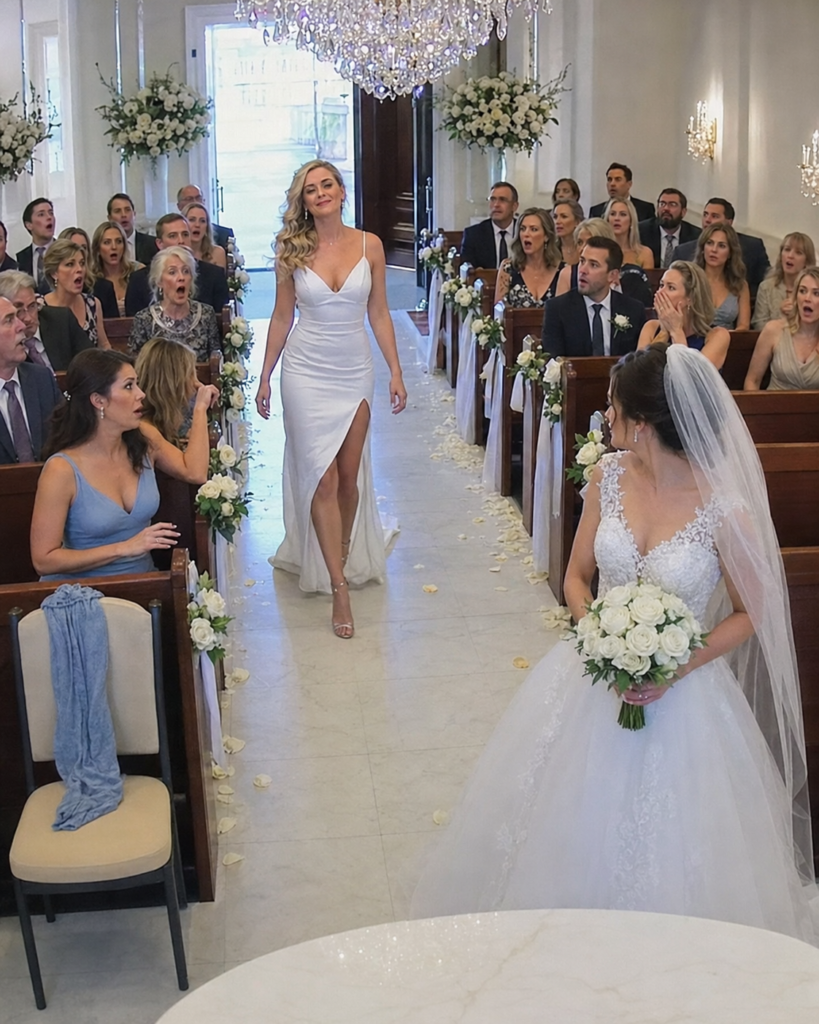
And today, as I stood near the altar of the small stone chapel wearing a soft, pale blue gown—Mom’s favorite color—the chapel doors swung open.
A collective gasp rippled through the pews.
Paige stood in the doorway. She was wearing an elaborate, floor-length white bridal gown. It was a deliberate, sharp declaration of war. She looked around the chapel, her chin raised high, expecting shock, anger, or tears from me. She wanted a scene. She wanted to force me into becoming the angry bride, to turn my wedding day into another chapter of our lifelong rivalry.
My father looked horrified, burying his face in his hands. Ethan, my groom, took a step forward, his knuckles white as he reached for my hand. “Clara,” he whispered softly, “do you want me to have security ask her to leave?”
“No,” I whispered back, my heart pounding steadily against my ribs. “Let her stay.”
I looked over at Pastor Reynolds, who gave me a knowing nod. He stepped away from the pulpit, reached into his robe, and pulled out the heavy parchment envelope I had handed him before the ceremony began.
Pastor Reynolds walked down the altar steps, stopping directly in front of Paige. The room was so silent you could hear the flickering of the altar candles.
“This is for you, Paige,” the pastor said gently, extending the envelope.
Paige stiffened. The defiant smirk on her face faltered for a fraction of a second. “What is this?” she hissed under her breath. “Is this Clara’s idea of a joke?”
“It is from your mother,” Pastor Reynolds replied.
Paige’s fingers trembled as she took the envelope. The heavy wax seal broke under her thumb. She pulled out the single sheet of paper, her eyes scanning the first line.
Instantly, the color drained from her face. Her shoulders slumped, and the tall, proud posture she had worn into the church vanished. The white dress, intended as a weapon to humiliate me, suddenly looked far too large for her trembling frame.
She covered her mouth with a hand, letting out a sharp, ragged breath. For the first time in her life, Paige looked small.
Chapter 2: The Letter in the Dust
The chapel remained frozen in silence. Paige stood in the center aisle, her eyes locked onto the paper as tears began to track down her cheeks, ruining her carefully applied makeup.
“Read it, Paige,” I said softly from the altar, my voice carrying clearly across the quiet room. “Read what Mom wrote to you.”
Paige swallowed hard. Her voice, usually loud and sharp, was barely a whisper when she began to read aloud.
“My sweet Paige,” she read, her voice shaking violently. “If you are reading this, it means you are hurting louder than you are loving.”
A soft murmur passed through the guests. My father slowly lifted his head from his hands, staring at his youngest daughter in disbelief.
Paige pressed the letter against her chest, closing her eyes for a long moment before forcing herself to look down at the page again.
“I know you, baby girl,” she continued reading, wiping her cheeks with the back of her wrist. “I know the face you wear when you feel forgotten. I know the loud jokes you make when your heart is breaking, and the way you sharpen your words before anyone can ask why you are bleeding.”
Paige let out a choked sob. The paper trembled so hard in her hands that the words seemed to dance across the page.
“You and Clara were never meant to be enemies,” Mom’s words echoed through the chapel. “But somewhere along the way, I watched you both start competing for love that was already yours. If you wore white to your sister’s wedding today, I know what people will think. They will think you wanted to steal her moment. Maybe part of you did. But another part of you wanted someone to stop you. Someone to finally see how lost you have been.”
The letter slipped from Paige’s fingers, floating softly down onto the red carpet of the aisle.
She stood there in her white gown, weeping openly. It wasn’t the dramatic, performative crying she usually used to get her way; it was the raw, broken weeping of someone whose deepest secret had been exposed to the light.
I stepped down from the altar, my pale blue dress rustling against the floorboards. I walked down the aisle until I stood directly in front of my sister.
“I didn’t know,” Paige sobbed, looking at me with red, swollen eyes. “I thought… I thought Mom only cared about you. You were always the good daughter, Clara. The responsible one. The one who never made trouble.”
“Mom worried about you every single day, Paige,” I told her quietly. “She knew you were in pain, even when you turned that pain into anger.”
Paige looked down at her white dress, her expression filled with a sudden, overwhelming shame. “I ruined your wedding. I came here to hurt you.”
“You walked in wearing a wound, Paige,” I said softly, bending down to pick up Mom’s letter and placing it back into her trembling hands. “That doesn’t mean my day is ruined. It just means we stop pretending our family was perfect.”
I turned toward the front row, where Mom’s soft blue silk scarf was laid neatly across an empty chair left in her honor. I picked up the scarf, walked back to Paige, and gently draped it over her shoulders. The soft blue silk against the bright white fabric changed her entirely.
“Stand beside me,” I said quietly.
Paige blinked, startled. “What? Clara, no… I can’t stand up there with you dressed like this.”
“Stand with me,” I repeated, my voice steady and firm. “Let everyone see what it looks like when we choose grace over bitterness.”
Chapter 3: The Truth Unspoken
A quiet warmth seemed to flood the cold stone chapel.
My bridesmaid, Brooke, stepped forward from the altar and offered Paige a small spare bouquet of pale blue hydrangeas. Paige took the flowers with a faint, stunned thank you.
Pastor Reynolds smiled gently, returning to his position behind the altar. “Shall we begin?” he asked softly.
My father walked me down the final stretch of the aisle, his eyes glistening with tears. When he placed my hand in Ethan’s, he leaned over and whispered, “Your mother is here today, Clara. I can feel her.”
The ceremony continued. My voice trembled slightly as I recited my vows to Ethan, and Ethan wiped away a tear of his own as he placed the ring on my finger. Beside us, Paige stood quietly, clutching Mom’s blue scarf around her shoulders, weeping silently through the prayers.
When the service ended and Ethan and I walked back down the aisle as husband and wife, the afternoon sun broke through the stained-glass windows, casting beams of gold and blue light across the chapel floor.
At the reception later that evening, the atmosphere was hesitant at first. Guests whispered near the punch bowl, unsure of how to navigate the emotional shift that had occurred during the ceremony. My aunt Margaret approached me near the head table, holding a glass of punch.
“That was remarkably generous of you, Clara,” Margaret said in a hushed tone. “After everything Paige tried to pull today…”
“It wasn’t about being generous, Aunt Margaret,” I replied calmly. “It was about ending a cycle. We’ve spent too many years keeping quiet about our family’s problems.”
Later in the evening, I found Paige sitting alone on the stone steps behind the reception hall, looking out over the moonlit garden. The white dress was tucked around her knees, and Mom’s blue scarf was still wrapped securely around her shoulders.
I sat down beside her on the cold stone step. For a long time, neither of us said a word. The sound of music and muffled laughter floated out from the venue doors behind us.
“I really did hate you sometimes, Clara,” Paige confessed quietly, her eyes fixed on the dark trees ahead.
“I know,” I answered honestly. “And there were times I hated you, too.”
Paige turned her head to look at me, surprised by my bluntness.
“I was angry that you made every milestone feel like a battle,” I continued, looking her in the eyes. “I was angry that you left me to handle Mom’s care when she got sick, and I was angry that you tried to turn my wedding into a disaster. But holding onto that anger doesn’t fix anything.”
“I don’t know how to be different, Clara,” Paige whispered, her voice cracking. “I’ve been playing the villain in this family for so long that I don’t know who I am without the drama.”
“Then we learn,” I said, reaching out to take her hand. “No more fake smiles, no more quiet resentment, and no more competing for space. We just start telling the truth.”
Paige squeezed my hand tightly, resting her head gently against my shoulder as the cool night breeze swept through the garden.
Chapter 4: The Legacy of Healing
Healing did not happen overnight.
Reconciliation in real life is rarely like the movies, where one emotional conversation fixes years of miscommunication and deep-seated rivalry. It was slow, awkward, and required constant effort from both of us.
A month after the wedding, Paige began attending weekly counseling sessions. She sent me a picture of the clinic’s front entrance with a simple text message: I almost drove away three times, but I stayed.
I texted back: I’m proud of you.
It took her several hours to reply: I cried when I read that.
Over the next two years, our relationship transformed in quiet, meaningful ways. We met for coffee once a month, slowly unpacking the unspoken grievances of our childhood. Paige apologized to me without an audience—sincerely expressing regret for her absence during Mom’s final months, for her past outbursts, and for the white dress.
I apologized, too. I acknowledged that by playing the “perfect, quiet daughter,” I had often closed the door on her, judging her harshness without trying to understand the deep insecurity driving it.
When my husband and I held a baby shower two years later for our daughter, Paige arrived early. She wore a simple, elegant dark blue dress. She helped set up the tables, arranged the floral centerpieces, and didn’t seek attention once.
When an older cousin made a careless joke about her dress choice from my wedding day, Paige simply smiled calmly and replied, “I’ve retired from making scenes.”
After my father decided to sell our childhood home, Paige and I spent a weekend clearing out the attic together. Among the dusty boxes of old holiday decorations and photo albums, we discovered a small wooden tin sealed with brown tape.
Inside was a final note written by our mother, dated just weeks before her death.
To my daughters, the note read. If you are reading this together, then my final wish was granted. Do not let old wounds turn you into strangers. Forgive each other, not because the past was fair, but because the future requires light.
Paige looked over at me from across the dusty attic floor, a soft, genuine smile gracing her face. “She really thought of everything, didn’t she?”
“She knew us better than we knew ourselves,” I smiled back.
Looking back on my wedding day, people still occasionally ask me about the sister who wore white to my ceremony. They expect a story of scandal, revenge, or permanent family estrangement.
Instead, I tell them the truth: my sister wore white because she was hurting, but she left that chapel wrapped in our mother’s blue scarf, finally ready to heal. And that was the greatest gift my wedding could have ever given us.