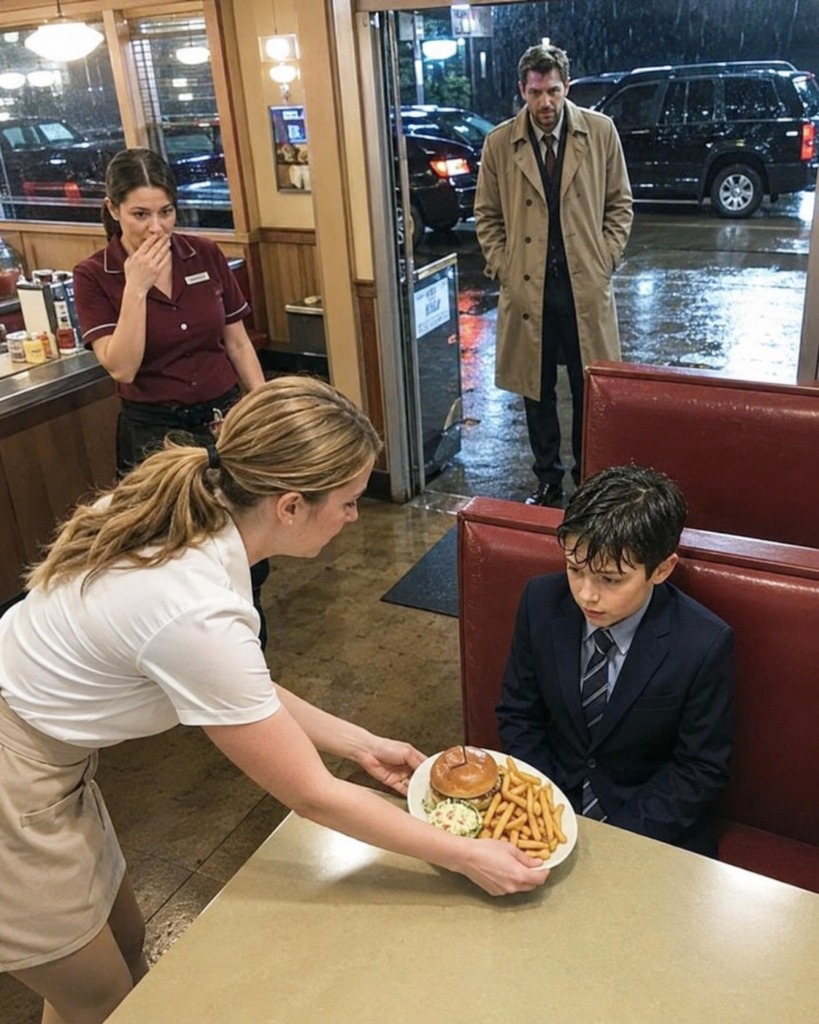
Chapter 1: A Stranger in the Storm
The rain in Chicago had turned the street outside Bell’s Diner into a churning river of gray grease and neon reflections. It was the kind of storm that made old buildings groan in their foundations, the wind rattling the cracked windowpanes while the neon sign—a faded blue bell painted by my father thirty years ago—flickered against the dark.
I stood behind the counter, clutching a damp dish towel, staring out into the empty street. Business had been dying for months. Unpaid invoices were stacked in neat, terrifying piles inside my back office, and every creak of the floorboards felt like a ticking clock counting down to bankruptcy. Ray, my cook, was wiping down the grill with the slow, rhythmic exhaustion of a man who knew his paycheck was as fragile as mine.
Then the brass bell above the front door chimed.
A blast of freezing air swept into the room, bringing with it the heavy smell of wet pavement and exhaust. A small figure stepped across the threshold, drenched to the bone and shivering so violently that he could barely keep his footing on the slippery tile floor. He couldn’t have been more than nine years old. Overgrown brown hair clung to his forehead, and he wore a coat far too thin for a November deluge. In his small, trembling hands, he clutched a crumpled brown paper bag against his chest like a treasure.
“Hey kiddo,” I said gently, stepping out from behind the counter. “Where are your parents?”
He looked up, wide gray eyes sweeping over the empty booths before landing on me. He couldn’t speak at first; his teeth were chattering too loudly.
I didn’t ask questions. I grabbed a dry bath towel from the back room, wrapped it around his small shoulders, and guided him into a corner booth near the radiator. Ray brought over a hot mug of sweet tea and a thick, steaming slice of warm apple pie—our last slice of the night.
The boy ate ravenously, his hands covered in pie crust, but he never let go of that paper bag. He told me his name was Misha. He said he had been at the nearby shopping center with his nanny, Nina, when he saw a tiny kitten run toward the storm drains near the parking lot. He had followed it, intent on saving it, only to turn around and find the crowds and rain had swallowed up the path back to Nina.
“She told me if I ever got lost,” Misha whispered, his eyes heavy with sleep and exhaustion, “I had to find the blue bell.”
I had smiled then, assuming he meant a toy or a store sign. Before I could ask more, a pair of heavy headlights cut through the downpour outside.
Three massive black SUVs pulled up to the curb, their engines humming like idling war machines. Four men in tailored black coats stepped out into the rain, positioning themselves at the corners of the diner. The door swung open again, and a man walked in.
The room seemed to shrink instantly. He was tall, sharp-edged, and radiating an authority that made the air feel thin. His dark coat was spotless despite the deluge outside, but beneath his controlled composure was an undeniable, white-hot desperation.
“Papa,” Misha whispered from the booth.
The man froze. The hard lines of his face crumbled for a fraction of a second, revealing a father who had spent the last two hours staring into an abyss of terror. In three long strides, he crossed the room and dropped to one knee on my old, cracked tile floor.
Misha slid out of the booth, still clutching his paper bag. “I’m sorry, Papa. I didn’t mean to wander off. The kitten ran, and then Nina wasn’t there…”
The man pulled Misha into a tight embrace, resting his chin against the boy’s hair. “You did well, Misha. You remembered what I taught you.”
When he stood up, his gaze locked onto mine. His eyes were cold, calculating, and piercingly intelligent. “I am Mikhail Volkov,” he said.
Ray dropped his rag behind the counter, letting out a sharp, choked noise. Even I knew that name. In Chicago, the Volkov name was whispered in hushed tones—a family associated with immense power, hidden wealth, and dangerous influence.
“You fed my son,” Mikhail said quietly. “And you asked for nothing in return.”
“He was cold and hungry,” I replied, standing my ground despite the sudden tension in the room. “I don’t charge lost children for pie.”
Mikhail reached into his coat for a leather wallet, but I shook my head before he could open it. “No. This wasn’t a transaction, Mr. Volkov. Your boy is safe. That’s all that matters.”
A quiet rustle came from the paper bag in Misha’s hands, followed by a tiny, high-pitched sneeze.
Mikhail paused, looking down. “Misha… what is in the bag?”
Misha carefully unfolded the top of the bag, revealing a tiny gray kitten wrapped in two paper napkins and part of my dish towel. “He didn’t have a mother, Papa. Can we keep him?”
Mikhail closed his eyes, exhaling a slow, exasperated breath. But before he could issue a stern refusal, one of his guards stepped forward from the doorway, his hand pressed firmly against his earpiece.
“Sir,” the guard whispered, his voice tense. “We found Nina’s car two blocks from the mall. It’s empty. Her purse and phone were left inside… and the doors were locked from the outside.”
The fragile warmth in the diner evaporated in an instant.
Chapter 2: Echoes of the Bell
The silence that followed was suffocating. Outside, the storm raged on, but inside the diner, the atmosphere had turned deadly cold.
Mikhail turned back to his guard, his jaw set in a hard line. “Any signs of a struggle?”
“No, sir,” the guard replied softly, conscious of Misha’s presence. “No forced entry. Just abandoned.”
Misha looked between his father and the guard, his small hands tightening around the kitten. “Is Nina okay? She said she was going to buy me hot chocolate while I waited by the fountain…”
Mikhail crouched down again, his voice carefully controlled. “We are going to find her, Misha. I promise you.” He looked up at me, his sharp gray eyes searching my face with renewed intensity. “You said my son mentioned a blue bell?”
“Yes,” I said, pointing toward the front window. “Our neon sign. My dad painted that faded blue bell on the glass thirty years ago when he opened Bell’s Diner. But I don’t understand how your nanny would know about this place. I’ve never met a woman named Nina.”
“Did your father?” Mikhail asked, his tone dropping an octave.
“My father was Thomas Bell,” I answered, folding my arms to hide the sudden chill running down my spine. “He served coffee and meatloaf to neighborhood cops, mailmen, and mechanics. He didn’t know high-society nannies or wealthy businessmen.”
Mikhail stared at me, his expression shifting from suspicion to profound recognition. He turned his head slowly, looking at the wall of framed photographs behind the register.
There were dozens of photos there: my parents cutting the ribbon on opening day, local Little League teams we sponsored, and regulars smiling over coffee mugs. Mikhail walked toward the wall, his eyes skimming the faded frames until he stopped at an old photograph taken nearly twenty years ago.
In the picture, my dad stood in the alley behind the diner, his arm draped around a pale, sharp-featured young man wearing a leather jacket. The young man looked haunted, but he had a tentative, grateful smile on his face.
Mikhail lifted a hand, his fingers hovering just inches from the glass. “Viktor,” he breathed softly.
Misha leaned forward from the booth. “Uncle Viktor?”
My heart gave a sickening thud. “You know him?”
“He was my younger brother,” Mikhail said without looking away from the photo. “He passed away years ago. But before he died, he told me that a man named Thomas Bell saved his life when he was running from very dangerous people. He said Thomas hid him in the back of this diner and asked for nothing in return.”
I remembered that photo. When I was a teenager, I had asked my dad who the sad-looking man was. Just someone who needed a friend, kiddo, Dad had told me with a gentle smile. Sometimes a hot meal and a quiet place to sit is the only thing standing between a man and the dark.
“Your brother knew my dad,” I murmured, the pieces slowly fitting together in a puzzle I hadn’t known existed. “And Nina told Misha to look for the blue bell if he ever got lost.”
“Nina didn’t pick this place by accident,” Mikhail said, turning back to me. “She knew about my brother. She knew this diner was a safe house.”
One of the guards stepped closer to Mikhail. “Sir, we need to move. The security feeds near the mall showed a suspicious vehicle tailing Nina’s car before she vanished. If someone is tracking your family, this location could be compromised.”
Mikhail nodded grimly. He turned to Misha and took the boy’s hand. “We are leaving now.”
Misha looked at me with wide, pleading eyes. “Miss Anna, can you come with us?”
“I can’t, sweetheart,” I said, kneeling down to his height. “I have to close up the diner.”
Misha reached into his pocket and pulled out a small, shiny copper token—a lucky coin he had been holding. He pressed it into my hand. “Thank you for the pie and for saving my kitten.”
Mikhail looked down at me, handing me a sleek, heavy black business card with a single phone number embossed in silver. “If you remember anything—anything at all about your father’s past or connections to my brother—call this number immediately. I will have my security team monitor this street tonight.”
“We don’t need bodyguards, Mr. Volkov,” I said, trying to regain my footing.
“It is not a request, Miss Bell,” he said firmly, though his tone carried a strange thread of genuine concern. “Your father was involved in things far larger than this diner. And I suspect those things have not stayed in the past.”
With that, Mikhail guided his son out into the howling storm. The black SUVs roared to life, their red taillights disappearing into the sheets of grey rain, leaving the diner silent once more.
Chapter 3: The Secret Beneath the Floorboards
Ray locked the front door and flipped the sign to CLOSED, his hands shaking slightly as he pulled the blinds.
“Anna,” Ray said, turning to face me with a pale face. “Your dad never told you about Mikhail Volkov’s brother? Not a single word?”
“No,” I said, staring down at the heavy black card in my hand. “Dad kept his secrets close. But…” I paused, a sudden memory surfacing from the dark corners of my mind. “The toolbox.”
Ray’s eyes widened. “The blue metal toolbox in the basement? The one he kept under the stairs?”
“He brought it up to the back office a few months before he passed away,” I remembered aloud. “He told me it was just old pipe fittings and spare parts. But he locked it, Ray. He locked it and hid the key.”
Without another word, Ray grabbed a heavy flashlight from behind the counter, and we headed down the creaking wooden stairs into the damp, dark basement beneath the kitchen.
The basement smelled of damp concrete, old cardboard, and winter storage. Dust motes danced in the beam of Ray’s flashlight as we pushed past stacks of extra paper towels, broken chairs, and rusty kitchen equipment. We searched for nearly twenty minutes, pulling apart old storage bins, until Ray let out a sharp gasp near the back corner by the old disused freezer.
“Anna… look here.”
He shone the flashlight on a small wooden crate tucked behind a stack of yellowed newspapers. Inside was a metal cash box, painted dark blue, its surface scratched and battered by time. A thick brass padlock held it shut.
Taped directly to the top of the metal box was a yellowed envelope with my name written in my father’s distinct, slanted handwriting: For Anna.
My breath caught in my throat. My hands trembled violently as I peeled the envelope from the cold metal lid.
“Do you want me to break the lock?” Ray asked softly, holding a crowbar he had retrieved from the tool shelf.
“Not yet,” I whispered. “Read the letter first.”
I unfolded the aged paper inside the envelope and began to read my father’s final message:
Dearest Anna,
If you are reading this, then the past has finally caught up with the quiet life I tried so hard to build for you. I am sorry for keeping secrets, sweetheart. I only wanted to protect you from the shadows that haunted the people I tried to help.
Years ago, Viktor Volkov came to my back door bled dry and terrified. He was running from men inside his own organization—men who believed he held proof of a massive betrayal. I hid Viktor, nursed him back to health, and kept his secrets. Before he left, he gave me something to protect. A safeguard.
He told me that if anything ever happened to him, someone might one day come seeking ‘The Blue Bell.’ He made me promise to keep the contents of this box hidden until the right person arrived.
The key to this padlock is hidden where your mother always said our sweetest memories were kept—inside the frame of the old clock above the kitchen counter.
Be careful, Anna. The men who hunted Viktor twenty years ago are still powerful. Do not trust anyone who comes asking for this box without knowing the secret password Viktor gave me: ‘The storm always clears.’
And remember: I love you more than the stars.
— Dad
A tear slipped down my cheek, dropping onto the faded ink.
“Ray,” I whispered, my voice trembling. “My dad wasn’t just running a diner. He was keeping a promise that could get us killed.”
Before Ray could answer, a sharp, piercing ring echoed from upstairs.
The diner’s landline phone was ringing.
We both froze, staring up at the dusty basement ceiling. It was past midnight. No one called the diner at this hour.
“Should we answer it?” Ray asked, his knuckles white around the handle of the crowbar.
“It might be Mikhail,” I said, rushing back up the wooden stairs with Ray close behind me.
I sprinted behind the counter, grabbed the black plastic receiver, and pressed it to my ear. “Hello? Bell’s Diner.”
Static crackled across the line, heavy and rhythmic, mixed with the sound of rushing wind and rain. Then, a woman’s voice came through—breathless, terrified, and sobbing quietly.
“Anna? Is this Anna Bell?”
“Yes! Who is this?” I demanded, holding the receiver tight against my ear.
“It’s Nina,” the woman whispered desperately, her voice trembling so hard she could barely articulate the words. “Listen to me very carefully. Misha… is Misha safe?”
“Yes, he’s with his father! Mikhail found him!” I shouted over the crackle of static. “Nina, where are you? Mikhail’s security team is searching everywhere for you!”
“No! You can’t let Mikhail find me!” Nina sobbed into the phone, the sound punctuated by the distant screech of tires. “And whatever you do, Anna… if you found your father’s box… do not give it to Mikhail Volkov!“
The line went dead with a sharp, hollow click.
I stood frozen behind the counter, the phone receiver still clutched in my hand, as the silence of the diner settled around us like lead.