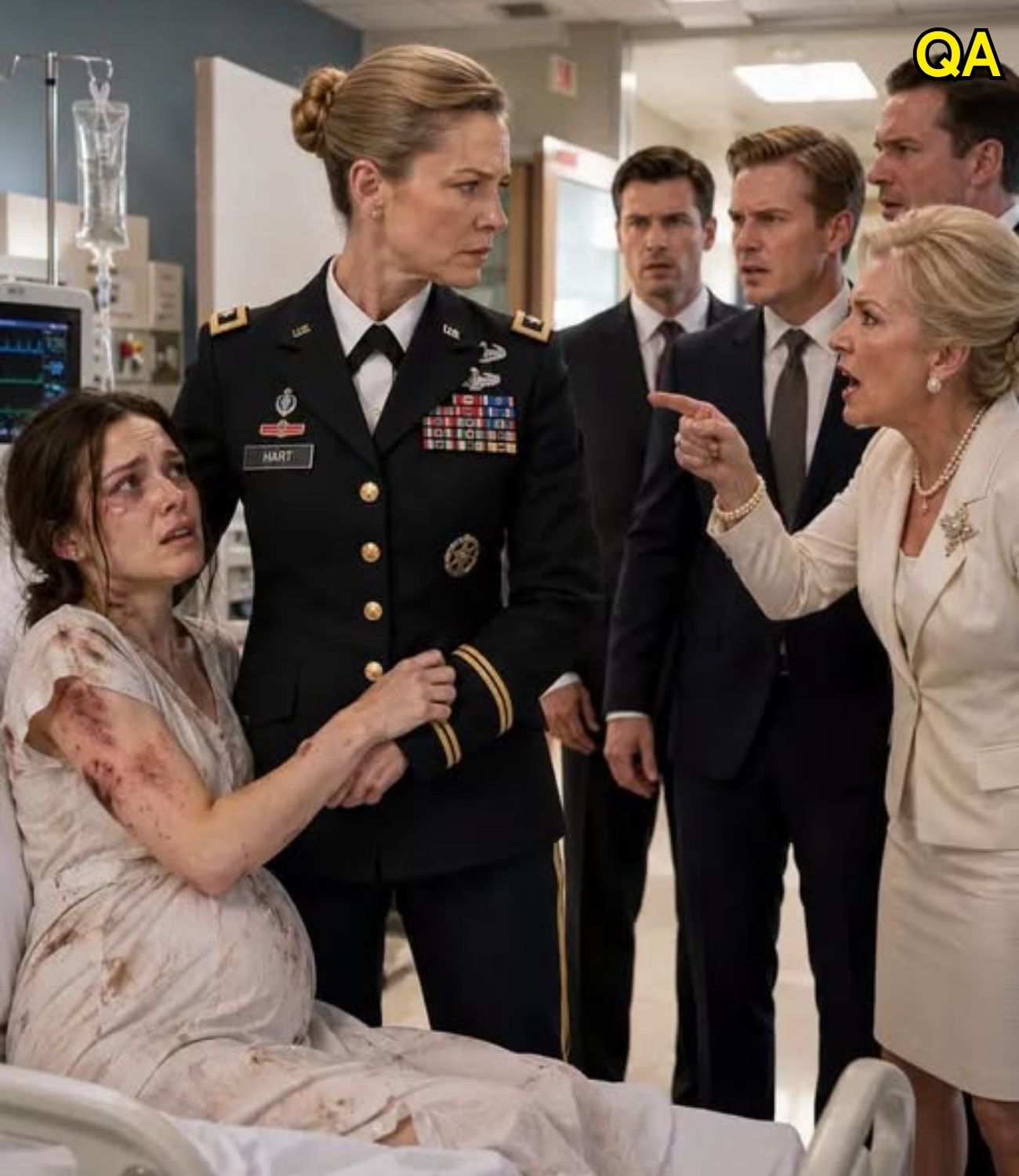
Chapter 1: The Call That Changed Everything
The sun was beginning to disappear behind the buildings of Charlotte, North Carolina, when my phone rang.
I was still wearing my uniform.
The day had been long, filled with meetings, reports, and responsibilities that came with decades of service.
But the moment I saw my daughter’s name appear on the screen, everything else stopped mattering.
Emily.
I answered immediately.
“Sweetheart?”
For several seconds, there was only silence.
Then I heard her voice.
Small.
Uncertain.
“Mom…”
A mother’s heart recognizes something before the mind understands it.
Something was wrong.
“What happened?”
Another pause.
Then she whispered the words I never expected to hear.
“Can you come get me?”
I looked around the office.
The documents on my desk.
The schedule waiting for tomorrow.
The uniform I was still wearing.
None of it mattered anymore.
“Where are you?”
She gave me an address.
A hospital.
“I’m coming.”
Those were the only words I needed to say.
I drove through the city without changing out of my uniform.
The streets blurred past the windshield.
People often saw the uniform first.
They saw the rank.
The years of service.
The medals earned through difficult assignments.
But before any of those things, I was a mother.
And my daughter needed me.
That was the only mission that mattered.
When I entered Mercy General Hospital, the emergency department was busy.
Doctors moved quickly.
Nurses answered calls.
Families waited anxiously in chairs along the hallway.
A receptionist looked up as I approached.
“I’m looking for Emily Hart.”
She checked the computer.
“Family member?”
“Mother.”
Something in my voice must have told her I wasn’t there for a routine visit.
She pointed toward the hallway.
“Room 214.”
I thanked her and walked quickly.
Every step felt heavier.
When I opened the door, I saw Emily sitting on the bed near the window.
She looked exhausted.
Not physically alone.
Emotionally alone.
That was somehow worse.
My daughter had always been the person who brought energy into every room.
As a child, she filled our house with drawings, music, and endless questions.
When I traveled for work, she used to send me pictures of sunsets because she knew I missed seeing them.
She would say:
“Mom, the sky looked beautiful today. I saved it for you.”
That was Emily.
Warm.
Thoughtful.
Always trying to make someone else’s day better.
But that evening, she looked like someone who had been carrying a burden for far too long.
The moment she saw me, her eyes filled with tears.
“Mom.”
I crossed the room and held her.
For a while, neither of us spoke.
Sometimes a person doesn’t need advice.
They need to know someone finally came.
“I’m here,” I whispered.
“You’re safe now.”
Emily held onto me tightly.
Like she had been waiting for permission to finally stop pretending everything was okay.
After a few minutes, I sat beside her.
“Tell me what happened.”
She looked down.
“I should have called you earlier.”
“That doesn’t matter.”
“Yes, it does.”
“No.”
I gently held her hand.
“What matters is that you called me today.”
She took a deep breath.
Then she began.
At first, the words came slowly.
Almost as if she was unsure whether she was allowed to say them.
She told me about feeling isolated.
About losing confidence.
About constantly trying to keep peace inside her marriage.
About feeling like she no longer recognized herself.
Every sentence revealed another piece of a story she had been carrying alone.
Then she finally said:
“Mom, I think I made a mistake.”
My heart tightened.
“What do you mean?”
She looked toward the window.
“When I married Ethan, I thought I was joining a family that cared about me.”
She paused.
“But over time, I started feeling like I was only there to fit into their plans.”
Ethan Prescott came from a family known throughout the state.
The Prescotts had built a respected business empire over several decades.
Their name appeared on charity events, university buildings, and community projects.
People admired them.
They were known as successful, connected, and influential.
When Emily first introduced Ethan, I understood why she was impressed.
He was confident.
Polite.
Ambitious.
He knew exactly what to say.
At their wedding, everyone talked about how perfect they looked together.
The photographs showed happiness.
The speeches sounded beautiful.
Everyone believed Emily had found her future.
Including me.
A mother always wants to believe her child has chosen well.
But after the wedding, small things began changing.
Not suddenly.
Not dramatically.
Just little moments that were easy to dismiss.
Emily stopped visiting friends as often.
She turned down opportunities she once enjoyed.
She apologized more.
Even when she had done nothing wrong.
At first, I thought it was simply the adjustment of married life.
Many people go through difficult periods.
Many couples need time to find balance.
I never imagined there was something deeper happening.
Until that phone call.
“Why didn’t you tell me?”
Emily wiped her eyes.
“Because I thought I could fix it.”
That answer hurt more than anything.
Not because she had stayed silent.
Because she believed everything was her responsibility.
“You don’t have to fix everything alone,” I said.
She looked at me.
“I was embarrassed.”
“Emily.”
“I thought everyone would say I made a bad choice.”
I shook my head.
“My job as your mother is not to judge your choices.”
I squeezed her hand.
“My job is to stand beside you when life becomes difficult.”
For the first time that evening, she allowed herself to cry.
Not from fear.
From relief.
A few minutes later, the door opened.
Three people stood outside.
Ethan.
His mother Margaret.
And his older brother Brandon.
They looked completely different from Emily.
Calm.
Confident.
Perfectly dressed.
The kind of people who appeared comfortable anywhere they went.
Margaret was the first to speak.
“Colonel Hart.”
Her tone was polite.
Almost too polite.
“We’re sorry this situation became so emotional.”
I looked at her carefully.
“Emotional?”
She smiled.
“Emily has always been sensitive.”
Behind her, Ethan remained silent.
Brandon glanced around the room.
Then said:
“We think everyone would benefit from handling this privately.”
I looked at my daughter.
Then back at them.
For years, I had dealt with difficult conversations.
I had learned something important.
The loudest person in the room was rarely the strongest.
Real strength came from patience.
From preparation.
From knowing the truth.
So I simply asked:
“Is that what Emily wants?”
Nobody answered.
That silence told me more than words could.
That night, I made a decision.
I would not rush.
I would not make promises I couldn’t keep.
I would not react emotionally.
I would listen.
I would learn.
And most importantly…
I would make sure my daughter never felt alone again.
Because the Prescotts believed this was a family matter they could quietly manage.
They didn’t understand something.
They weren’t dealing with a mother who wanted attention.
They were dealing with a mother who wanted answers.
And answers have a way of changing everything.

Chapter 2: The Family Behind the Name
The next morning, I woke up before sunrise.
For most of my adult life, early mornings had been part of my routine.
The quiet hours before the world became busy were when I reviewed plans, organized priorities, and prepared for whatever challenges waited ahead.
But that morning was different.
I wasn’t preparing for a mission.
I was preparing to understand my daughter’s life.
Emily was sleeping in the guest room of my house.
For the first time in months, she wasn’t waking up in a place where she felt she had to pretend everything was fine.
I stood in the kitchen making coffee when I saw her childhood photographs on the refrigerator.
A little girl with messy hair.
A missing front tooth.
A backpack almost bigger than herself.
A teenager smiling proudly after her first school performance.
A young woman holding flowers on her wedding day.
The same person.
Yet somehow, she looked different now.
Not because she had changed.
Because she had spent too long trying to hide how much she was struggling.
When Emily walked into the kitchen, she looked surprised to see breakfast already prepared.
“You didn’t have to do this.”
I smiled.
“You’re still my daughter.”
She sat down quietly.
For a moment, we simply ate.
No questions.
No pressure.
I had learned throughout my career that people rarely share important information when they feel interrogated.
They share when they feel safe.
After a few minutes, Emily placed her coffee cup down.
“Mom?”
“Yes?”
“I don’t know where to start.”
I looked at her.
“Start wherever you feel comfortable.”
She nodded.
Then she began telling me about the Prescott family.
The Prescotts were not ordinary.
Everyone in Charlotte knew their name.
The family had built its reputation over three decades through real estate development, investments, and community projects.
Their company headquarters stood in the center of the city.
Their family foundation sponsored educational programs.
Their names appeared at charity events and business conferences.
People admired their success.
Many wanted their approval.
Emily met Ethan at a fundraising event.
At the time, she had been working as a creative director for a small design company.
She wasn’t looking for a relationship.
She was focused on her career.
But Ethan was persistent.
“He made me feel like I was the only person in the room,” Emily said.
I smiled slightly.
That was something many people appreciated about him.
He was charming.
He knew how to make conversations feel personal.
“He remembered everything,” Emily continued.
“Things I said once. My favorite books. The places I wanted to visit.”
She looked down.
“At first, I thought that meant he really understood me.”
I stayed quiet.
Because I knew what she was saying.
Sometimes the beginning of a relationship shows a person’s best qualities.
The challenge is discovering whether those qualities remain when life becomes complicated.
After their wedding, Emily moved into the Prescott family’s world.
A world very different from the one she had known.
The Prescott estate was beautiful.
The gardens were carefully maintained.
Every room looked like it belonged in a magazine.
Dinner parties included executives, community leaders, and influential guests.
At first, Emily was amazed.
She thought she had entered a completely different life.
But slowly, she noticed something.
Everyone had a role.
Everyone had expectations.
Including her.
“Did they ever tell you what those expectations were?”
Emily nodded.
“Not directly.”
She looked toward the window.
“They would say things like, ‘Prescott women have always understood their responsibilities.'”
I frowned.
“What responsibilities?”
She gave a small, tired smile.
“Always looking perfect. Always saying the right thing. Always protecting the family image.”
I understood.
Some families built their reputation so carefully that they forgot the people inside the family still had feelings.
“Why didn’t you tell me sooner?” I asked.
Emily took a deep breath.
“Because every time I tried, I convinced myself it wasn’t serious enough.”
She looked embarrassed.
“I thought other people had bigger problems.”
That sentence stayed with me.
Many people dismiss their own struggles because they compare them to someone else’s.
But pain does not need to compete to matter.
“What was the moment you realized you needed help?”
Emily was silent for a long time.
Then she answered.
“The night I heard them talking.”
“Who?”
“Ethan and his mother.”
I listened carefully.
“What did they say?”
Emily looked uncomfortable.
“I wasn’t supposed to hear it.”
It happened several months earlier.
Emily had returned home late after visiting an old friend.
As she approached the house, she heard voices from the study.
The door was slightly open.
She wasn’t trying to listen.
She only stopped because she heard her own name.
Margaret was speaking.
“Ethan, we need to be careful.”
Careful?
Emily didn’t understand what they meant.
Then Ethan replied.
“She won’t do anything.”
Margaret answered:
“You don’t know that.”
Emily stood outside the door, confused.
Then she heard something that changed how she saw everything.
“They cannot find out yet.”
Emily held her breath.
“What are they talking about?” Ethan asked.
“I’ll handle it.”
The conversation ended shortly after.
Emily never discovered what they were discussing.
But from that night forward, she felt something was wrong.
I looked at my daughter.
“Did you ask Ethan?”
“Yes.”
“What did he say?”
“He told me I misunderstood.”
“And did you believe him?”
Emily hesitated.
“I wanted to.”
That answer said everything.
Trust doesn’t disappear all at once.
Sometimes it fades one unanswered question at a time.
After breakfast, I opened my laptop.
“Emily, I need to understand the timeline.”
She looked uncertain.
“Why?”
“Because feelings tell us something happened.”
I looked at the notes I was preparing.
“But facts tell us what happened.”
She nodded slowly.
It was a habit from years of service.
When situations became complicated, emotions mattered.
But organization mattered too.
Dates.
Documents.
Messages.
Records.
Patterns.
Small details often revealed the larger picture.
Over the next several hours, Emily and I went through everything.
The beginning of the marriage.
Changes in routines.
Conversations that felt uncomfortable.
Moments when she felt pressured.
People she stopped contacting.
Decisions she made because she wanted to avoid conflict.
Nothing stood alone.
But together, they created a pattern.
Then Emily remembered something.
“Wait.”
She stood and walked toward her bag.
“I have something.”
She returned with an old notebook.
“I wrote things down.”
I looked at her.
“Why?”
She shrugged.
“I don’t know.”
Then she whispered:
“Maybe because part of me knew I needed to remember.”
The notebook contained dates.
Short sentences.
Small observations.
Nothing dramatic.
Just moments she didn’t want to forget.
As I read through the pages, one detail kept appearing.
The Prescott family cared deeply about controlling their public image.
Every disagreement was framed as a misunderstanding.
Every concern became “an emotional reaction.”
Every question became something to avoid discussing.
That was important.
Because healthy families don’t fear honest conversations.
That evening, my phone rang.
The caller ID showed an unfamiliar number.
I answered.
“Colonel Hart speaking.”
A calm male voice responded.
“Mrs. Hart, this is Daniel from Prescott Legal Affairs.”
I said nothing.
“We understand Emily is currently staying with you.”
“Yes.”
“We would appreciate the opportunity to resolve this situation privately.”
I looked across the room at my daughter.
She was reading a book on the couch.
For the first time in days, she looked peaceful.
“What exactly needs to be resolved?” I asked.
There was a pause.
“We simply want to avoid unnecessary complications.”
I almost smiled.
Because that sentence revealed more than the speaker intended.
People who are confident in the truth usually welcome clarity.
They don’t avoid it.
“I appreciate your call,” I said.
“But any conversation about my daughter will include my daughter.”
Another pause.
Then:
“Of course.”
The call ended.
I placed the phone down.
Emily looked up.
“Was that them?”
“Yes.”
“What did they want?”
I looked at her.
“They wanted things to stay quiet.”
Her expression changed.
For years, Emily had believed silence would protect everyone.
Now she was beginning to understand something different.
Sometimes silence only protects the people who benefit from it.
That night, before going to sleep, I opened a folder and began writing.
Not accusations.
Not assumptions.
Questions.
What happened?
When?
Who knew?
What documents existed?
What conversations had been recorded?
What information was missing?
Because there was always a story behind a story.
And the Prescott family had spent years making sure everyone only saw the version they wanted people to see.
But every carefully built image has cracks.
You just have to know where to look.
And I had spent my entire career learning how to find the truth.