Chapter 1: The Story Everyone Believed
By the time the hearing began on a cold Thursday morning in Arlington County, every seat inside Courtroom Six was occupied.
Some people were there because they knew the Whitmore family.
Others came because they recognized the name.
And some simply wanted to understand how a marriage that had once appeared so successful had reached this point.
For nearly a decade, Grant Whitmore had been known as the face of Whitmore Logistics Group.
His company appeared frequently in business publications.
His photographs were displayed at charity events.
He spoke at conferences about leadership, innovation, and building a successful organization from the ground up.
To the public, Grant represented achievement.
He was described as focused, ambitious, and someone who always seemed to know the next opportunity before anyone else.
But behind every public image is another story.
And Grant’s story had always been incomplete.
Because there was another person who had been there long before the company became recognizable.
His wife.
Claire Whitmore.
For eleven years, Claire stood beside Grant during company celebrations, community events, and business dinners.
Whenever photographers gathered, they called Grant’s name.
Whenever reporters asked questions, they asked about his vision.
Whenever people discussed the company’s success, they discussed his leadership.
Claire never corrected them.
Not because she had nothing to say.
But because she had never believed that every contribution needed applause.
After their twin sons, Eli and Noah, were born, Claire gradually stepped away from public events.
Her days became centered around family.
School meetings.
Medical appointments.
Homework.
Meals.
The small routines that rarely appear in photographs but shape a child’s entire world.
While Grant traveled frequently for business meetings and conferences, Claire managed the daily rhythm of their home.
She knew which teacher each child trusted.
Which foods they refused to eat.
Which books made them laugh.
Which fears they never told anyone else about.
To most people, those things were invisible.
And over time, invisible became mistaken for unimportant.
By the morning of the hearing, many people had already decided they understood the story.
Grant had built a successful company.
Claire had supported him.
Grant had created financial security.
Claire had lived within that success.
Now their marriage was changing, and everyone expected the legal process to simply confirm what they already believed.
Grant arrived at the courthouse prepared.
He wore a dark navy suit tailored perfectly.
A simple platinum watch rested beneath his sleeve.
Three organized binders sat on the table in front of him.
Inside were financial reports, property documents, school schedules, and carefully prepared plans for the future.
His legal team had spent weeks organizing every detail.
Their argument was straightforward.
Grant could provide stability.
Grant could provide resources.
Grant could provide opportunities.
Beside him sat Vanessa Cole.
She was the vice president of corporate communications at Whitmore Logistics Group.
Known for her professionalism and polished public image, Vanessa remained quiet throughout the morning.
She occasionally reviewed documents with Grant’s attorneys.
She occasionally whispered brief comments.
But she never appeared nervous.
Everyone in the courtroom understood her connection to Grant.
No explanation was needed.
Across the aisle, Claire’s seat remained empty.
Judge Thomas Avery entered the courtroom shortly after nine.
The room immediately became silent.
After reviewing the case file, he looked toward the empty chair.
“Has Mrs. Whitmore arrived?”
Grant checked his watch.
Then he answered calmly.
“Claire has always had difficulty respecting schedules.”
A few people in the gallery exchanged looks.
Vanessa lowered her head slightly.
A small smile appeared before she quickly hid it.
Judge Avery noticed.
“Ms. Cole.”
Vanessa looked up.
“This courtroom requires professionalism. Please remember you are observing, not participating.”
“Yes, Your Honor.”
The smile disappeared.
Grant’s attorney, Malcolm Reed, stood.
“Your Honor, we are prepared to proceed.”
The judge nodded.
Malcolm began presenting Grant’s position.
He described the successful company.
The family home.
The educational plans created for the children.
The financial structure Grant had established.
Every detail painted a picture of stability.
“Mr. Whitmore has spent years creating opportunities for his family,” Malcolm explained.
“He has built a secure environment where Eli and Noah can continue growing.”
The presentation was organized.
Careful.
Professional.
It was exactly what everyone expected.
Until the courtroom doors opened.
The sound was quiet.
But everyone noticed.
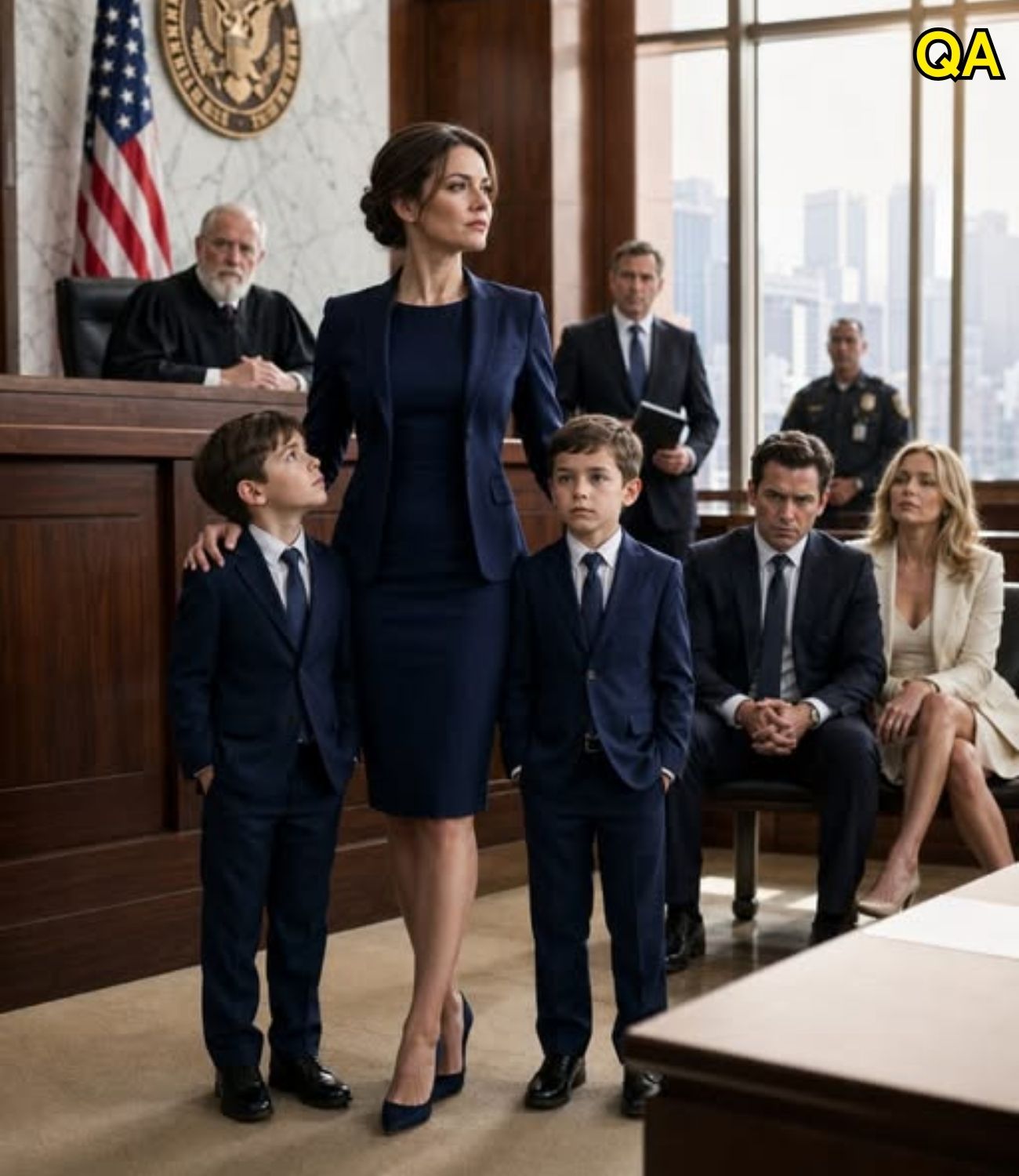
Claire walked inside.
She wasn’t rushing.
She wasn’t overwhelmed.
She simply entered with calm confidence.
She wore a burgundy coat over a simple black dress.
No expensive jewelry.
No large legal team.
No dramatic entrance.
Only a brown leather bag hanging from her shoulder.
And holding each of her hands were her two sons.
Eli and Noah.
The twins wore matching navy jackets.
They looked uncomfortable in formal clothing but remained polite and quiet.
The entire courtroom watched.
Grant’s expression changed slightly.
Not anger.
Not surprise.
Something closer to uncertainty.
Vanessa leaned toward him.
“She brought them?”
Her voice was quieter than before.
But still noticeable.
Judge Avery immediately looked over.
“Ms. Cole.”
Vanessa froze.
“I remind you once again that comments from observers are not appropriate.”
“Yes, Your Honor.”
Claire approached the front.
“I apologize for arriving at this time, Your Honor.”
Judge Avery looked at the boys.
“Mrs. Whitmore, may I ask why the children are present?”
Claire gently placed her hand on each son’s shoulder.
“They asked to come.”
The judge considered her answer.
“Children are usually kept away from these discussions.”
“I agree.”
Her response was immediate.
“But they have heard many conversations about their future recently. I wanted them to understand that the adults involved are here to make thoughtful decisions.”
Judge Avery studied her carefully.
Then he looked toward the twins.
The boys stood quietly.
They weren’t causing disruption.
They weren’t demanding attention.
They simply looked like children who wanted to understand what was happening around them.
The judge instructed an officer to allow them to sit safely at the side of the courtroom.
Claire bent down.
She whispered something to both boys.
They nodded.
Then she walked alone toward her table.
For the next twenty minutes, Malcolm continued.
He discussed Grant’s career.
His income.
His ability to provide.
Then he discussed Claire.
Her limited recent employment.
Her lack of public business involvement.
Her absence from the professional world.
The message was clear.
Grant had built something visible.
Claire had not.
When Malcolm finished, he turned toward the judge.
“Mr. Whitmore believes this arrangement provides the strongest foundation for the children’s future.”
Judge Avery looked toward Claire.
“Mrs. Whitmore, do you have a response?”
Claire stood.
“Yes, Your Honor.”
“Are you represented by counsel?”
“No.”
Several people looked surprised.
“You are representing yourself?”
“Yes.”
Grant leaned back slightly.
For the first time that morning, he appeared completely relaxed.
Judge Avery noticed.
“Mrs. Whitmore, you understand the seriousness of these proceedings?”
“I do.”
“And you understand the concerns raised regarding your financial position?”
“Yes.”
“Then this is your opportunity to respond.”
Claire opened the brown leather bag beside her.
Everyone expected paperwork.
Maybe notes.
Maybe personal documents.
Instead, she removed a single sealed envelope.
Grant’s confidence remained.
Until Claire spoke.
“Your Honor, I am not asking this court to ignore any agreement that was properly created.”
She placed the envelope on the table.
“I signed the documents presented at the time.”
She paused.
“But those agreements depended on accurate information from both sides.”
Malcolm stopped writing.
Claire continued.
“The issue is not whether Grant worked hard.”
She looked briefly toward her husband.
“He did.”
“The issue is whether everyone has always understood the complete history behind that success.”
The courtroom became silent.
Judge Avery opened the envelope.
Inside were several carefully organized documents.
Corporate records.
Ownership papers.
Early business agreements.
Financial statements.
The first page was simple.
But it immediately caught the judge’s attention.
He read it once.
Then again.
His expression changed.
Because the name listed on the earliest company document was not the name everyone expected.

Chapter 2: The Woman Behind the Company
The courtroom remained silent.
Not the uncomfortable silence of confusion.
A different kind of silence.
The kind that appears when people realize they may have misunderstood something important.
Judge Thomas Avery continued reviewing the first document placed before him.
Then he looked up.
“Mrs. Whitmore.”
“Yes, Your Honor.”
“Before we continue, I want to understand exactly what these records represent.”
Claire nodded.
“Of course.”
The judge lifted the document slightly.
“This appears to be an early business registration record.”
“Yes.”
“And you are suggesting this document is relevant to the financial matters being discussed today?”
“Yes, Your Honor.”
Across the room, Malcolm Reed adjusted his glasses.
“Your Honor, we would respectfully ask that we first establish the foundation and relevance of these materials.”
Judge Avery nodded.
“That is exactly what we are doing.”
Malcolm sat down.
But his confidence had changed.
Only slightly.
Almost invisibly.
Yet those who had spent years negotiating with people under pressure knew the signs.
A person who was certain did not usually need to reorganize their thoughts.
Grant watched Claire carefully.
For years, he had known his wife as someone who preferred peace over confrontation.
Someone who avoided unnecessary attention.
Someone who often said:
“Not everything needs to become an argument.”
That was one of the qualities he once admired about her.
Now, sitting across the courtroom, he wondered if he had mistaken patience for weakness.
Because Claire did not look uncertain.
She looked prepared.
Judge Avery placed the document on the bench.
“Mrs. Whitmore, tell me about the beginning of Whitmore Logistics Group.”
Claire took a slow breath.
For the first time that morning, her expression softened.
Not with sadness.
With memory.
“The company did not begin the way most people know it today.”
She looked toward the judge.
“There was no large office building.”
“No team of hundreds of employees.”
“No conference stages.”
She paused.
“There was a small rented workspace, an old computer, and two people trying to solve a problem.”
The judge glanced toward Grant.
“And those two people were?”
Claire answered calmly.
“Grant and me.”
A quiet murmur moved through the courtroom.
Malcolm immediately stood.
“Your Honor, Mrs. Whitmore’s personal involvement does not automatically establish ownership.”
Judge Avery raised his hand.
“I understand, Mr. Reed.”
He looked back at Claire.
“Continue.”
Claire nodded.
“I am not here to claim that every success belongs only to me.”
Her voice remained steady.
“Grant worked extremely hard. He built relationships. He made decisions. He spent years growing the company.”
She paused.
“But the story people know begins much later.”
“The story begins when everything was already successful.”
She looked down briefly.
“I’m talking about the years before that.”
Claire remembered those early days clearly.
Before the company had a recognizable name.
Before investors.
Before business articles.
Before anyone considered it impressive.
Back then, Grant was working long hours trying to develop a transportation software idea.
He had experience in logistics.
He understood the industry.
But understanding a problem and building a company were two very different things.
Many nights, he came home frustrated.
Bills were increasing.
The business was not generating consistent income.
Friends questioned whether the idea was realistic.
Some suggested he should find a safer path.
Claire never pressured him to quit.
Instead, she sat with him at the kitchen table.
They reviewed expenses.
They discussed plans.
They searched for ways to make the idea work.
Not because she expected a reward.
Because they were partners.
“One thing people forget,” Claire said, “is that companies are not built only during successful years.”
“They are built during uncertain years.”
The courtroom remained quiet.
“During the years when nobody is watching.”
“During the years when there are more questions than answers.”
Judge Avery nodded.
“That is true.”
Claire continued.
“In the beginning, I handled many of the tasks that needed to be done.”
“Scheduling.”
“Customer communication.”
“Basic accounting.”
“Organizing documents.”
“Preparing early proposals.”
“I wasn’t the person standing on stage.”
She smiled faintly.
“But I was there when there was no stage.”
Grant looked away.
Because he remembered.
He remembered the apartment they rented before buying their first home.
The evenings when Claire sat beside him reviewing spreadsheets.
The weekends when they worked while everyone else was relaxing.
The first customer who agreed to try their service.
The first payment they received.
The first time they realized the idea might actually become something.
Those memories had not disappeared.
They had simply become less convenient to remember.
Malcolm stood again.
“Your Honor, with respect, many spouses support each other’s careers. That does not necessarily change ownership arrangements.”
Judge Avery nodded.
“A fair point.”
Then he looked at Claire.
“Mrs. Whitmore, what exactly are you asking the court to consider?”
Claire answered immediately.
“I am asking the court to consider the complete history.”
Not anger.
Not accusation.
Just clarity.
“I am not saying Grant did not earn his achievements.”
“I am saying the foundation of those achievements began with contributions that were not always visible.”
The judge opened another document from the envelope.
This one was older.
A shareholder agreement.
The paper had been carefully preserved.
He read several lines.
Then looked up.
“Mr. Reed.”
“Yes, Your Honor?”
“Were these early agreements included in the financial review conducted before the marriage agreement was finalized?”
Malcolm paused.
“I would need to review the document further.”
Judge Avery nodded.
“That seems reasonable.”
But everyone noticed the hesitation.
Vanessa leaned slightly toward Grant.
“What is happening?”
Grant didn’t answer immediately.
He was looking at the documents.
At Claire.
At the woman he had spent years describing to others as someone who simply supported his career.
Suddenly, that description felt incomplete.
Not false.
But incomplete.
And sometimes incomplete stories create the biggest misunderstandings.
Judge Avery continued reviewing the records.
“This letter appears to reference an early ownership structure.”
“Yes, Your Honor.”
“And it lists multiple contributors.”
“Yes.”
The judge looked at Claire.
“Why was this not discussed publicly?”
Claire gave a small smile.
“Because it wasn’t important to us at the time.”
“That seems unusual.”
“It probably was.”
She looked down.
“But when you are trying to keep a young company alive, you are usually thinking about tomorrow.”
“Not about how people will describe the story years later.”
For many people in the courtroom, Claire’s words were unexpectedly relatable.
Not everyone who helps build something receives recognition.
Some people create opportunities.
Some organize the details.
Some support others through difficult seasons.
Their work may not appear in headlines.
But it still matters.
Judge Avery turned another page.
“This document is dated before the company’s public launch.”
“Yes.”
“And the signature?”
Claire looked toward the page.
“Mine.”
The judge studied it.
Then looked at Grant.
“Mr. Whitmore, were you aware of this document?”
The entire courtroom waited.
Grant remained quiet for several seconds.
Finally, he answered.
“Yes.”
The judge raised an eyebrow.
“Then why was it not included with the materials submitted by your legal team?”
Grant looked toward Malcolm.
The attorney quickly responded.
“Your Honor, we were not aware this specific document would be presented.”
Claire said nothing.
She didn’t need to.
The document was already speaking for itself.
Judge Avery closed the folder temporarily.
“We will take a short recess.”
The clerk announced the break.
People slowly began standing.
The courtroom filled with quiet conversations.
Everyone had entered believing they understood the story.
A successful businessman.
A supportive wife.
A disagreement over the future.
But now the picture had become more complicated.
Outside the courtroom, reporters gathered.
Inside, Grant remained seated.
Vanessa looked uncertain.
Malcolm reviewed documents faster than before.
And Claire walked over to her sons.
Eli looked up.
“Mom?”
“Yes?”
“Are we okay?”
Claire knelt beside him.
She smiled.
“We are.”
No matter what happened next, that was the most important thing.
As they left the courtroom temporarily, Grant watched Claire from across the room.
For years, he had believed the company had one story.
His story.
But now he was beginning to remember something he had forgotten.
Before there was a company.
Before there was a reputation.
Before there was success.
There was a partnership.
And the person who had been standing beside him from the beginning had never disappeared.
She had simply been standing quietly in the background.
Until today.