An Unexpected Moment in the Rainforest
Deep within the tropical forests of South America, nature often reveals behaviors that challenge even experienced researchers. Many of these discoveries happen not in laboratories but during quiet moments in the field, when careful observation uncovers something entirely unexpected.
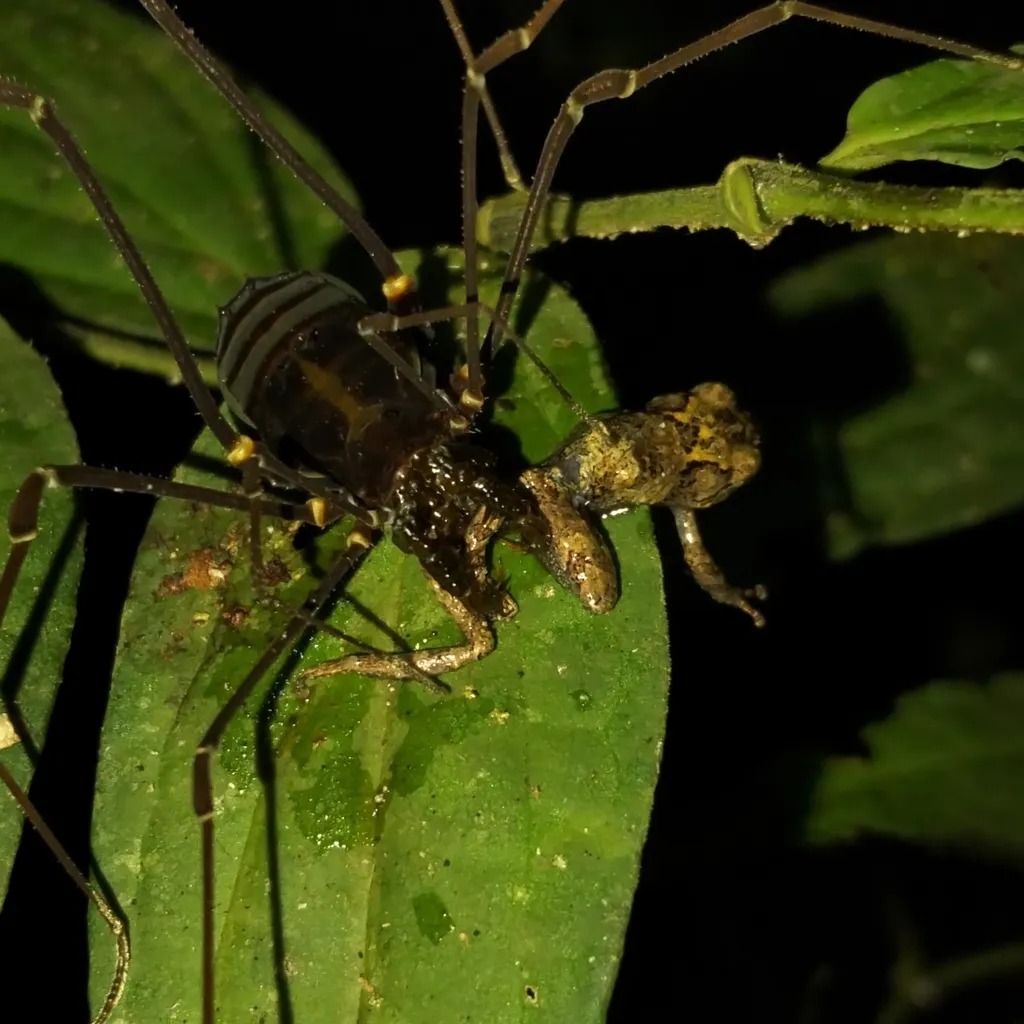
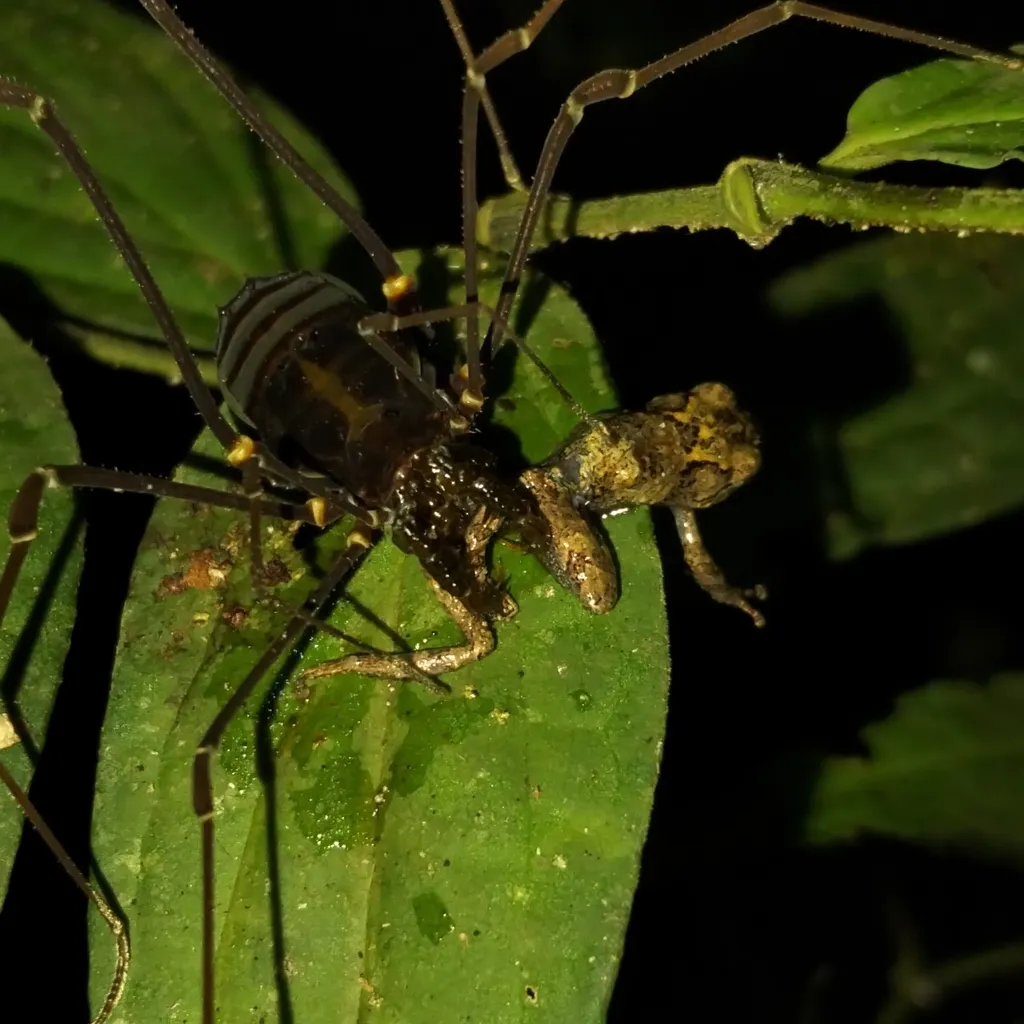
One such discovery involved a familiar creature that many people overlook every day: the daddy longlegs, also known as a harvestman. Long regarded as a harmless scavenger or opportunistic feeder, this arachnid recently became the focus of scientific attention after researchers documented individuals interacting with live frogs in ways few had anticipated.
The findings, published in a peer-reviewed scientific journal, suggest that harvestmen may be more capable predators than previously believed. At the same time, scientists caution that many questions remain unanswered, making this an exciting area for future research rather than a settled conclusion.
What Is a Daddy Longlegs?
The name “daddy longlegs” can refer to several different animals depending on where someone lives, which often creates confusion.
In this study, researchers focused on harvestmen, members of the order Opiliones. Although they belong to the arachnid class alongside spiders, harvestmen are not true spiders. Evolutionarily, they are considered a distinct group with their own unique characteristics.
Unlike spiders, harvestmen have a body that appears as a single rounded segment, lack silk-producing organs, and do not possess venom glands.
These arachnids are found on every continent except Antarctica and typically feed on a wide variety of organic material, including insects, small invertebrates, fungi, plant matter, and decaying material.
Because of their varied diet, scientists often describe them as generalist feeders.
A Discovery That Surprised Researchers
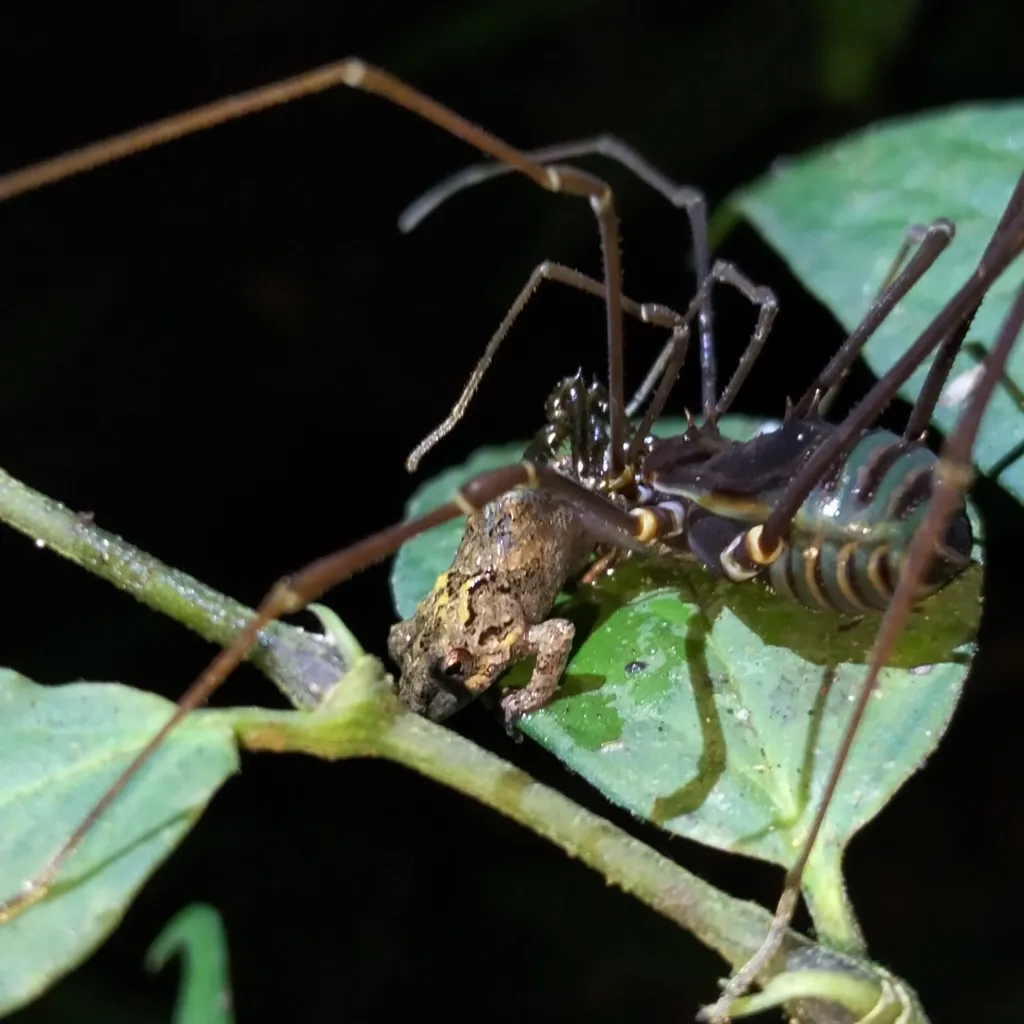
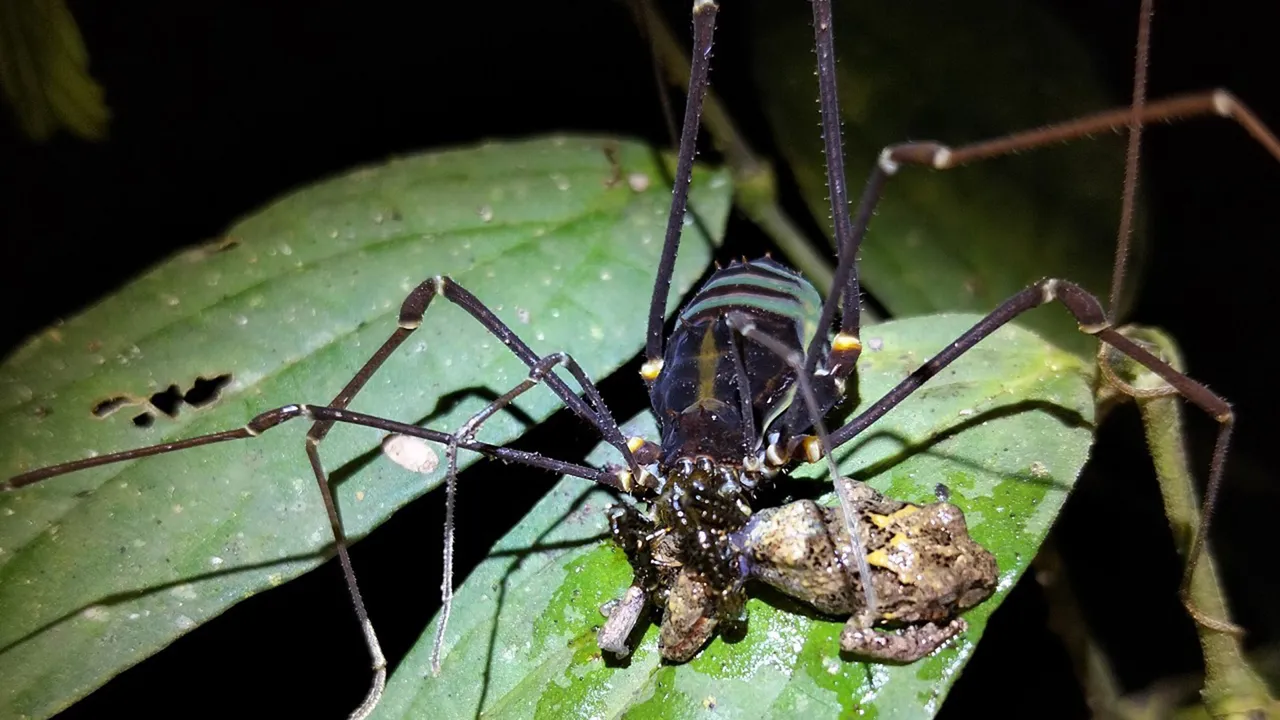
According to the study, researchers compiled ten documented observations from Ecuador and Colombia showing harvestmen feeding on frogs that were approximately similar in size to themselves.
The records came from several sources, including direct field observations, previously published scientific literature, and photographs submitted by members of the public through the citizen science platform iNaturalist.
Lead researcher Luís Fernando García of the University of the Republic in Uruguay explained that the observations were unexpected because scientists had not anticipated harvestmen successfully capturing live frogs.
Several frogs observed during these interactions were reportedly still moving, suggesting that the harvestmen may have captured them while they were alive rather than simply feeding on animals that had already died.
The researchers emphasize, however, that additional studies are needed before drawing broad conclusions about how common this behavior may be across different harvestman species.
Why This Finding Matters
When people think of predators capable of catching vertebrates, they often imagine birds, mammals, reptiles, or larger amphibians.
Small arthropods such as insects and arachnids are generally associated with hunting other invertebrates.
However, ecologists have increasingly documented situations in which arthropods consume small vertebrates such as frogs, lizards, bats, and birds.
According to ecologist Jose Valdez of Martin Luther University Halle-Wittenberg, who was not involved in the new study, these interactions may occur more frequently than scientists once believed.
Rather than being exceptionally rare, they may simply have been overlooked because they often occur in remote habitats and are difficult to observe.
Frogs Can Be Vulnerable in Certain Situations
The researchers note that frogs possess characteristics that can occasionally make them vulnerable to a variety of predators.
Unlike reptiles or mammals protected by scales or thick fur, many frogs have soft bodies and delicate skin.
This does not mean frogs are defenseless. Numerous species rely on camouflage, rapid jumping, chemical defenses, or toxic skin secretions to avoid predators.
Nevertheless, under particular environmental conditions, resting or sleeping frogs may become easier targets for opportunistic hunters.
Scientists stress that predator-prey relationships vary enormously among species, habitats, and individual encounters.
How Could Harvestmen Capture Frogs?
One of the biggest mysteries raised by the study concerns the mechanics of capture.
Harvestmen are relatively slow-moving arachnids.
They also lack venom, eliminating one of the most common methods predators use to immobilize prey.
Researchers therefore believe physical restraint may play a much larger role.
Harvestmen possess specialized front appendages known as pedipalps, which help them grasp objects and manipulate food.
Scientists speculate that these structures may assist in holding frogs securely long enough for feeding to begin.
Exactly how this process unfolds remains unknown because researchers have not yet observed the complete sequence under controlled scientific conditions.
Future behavioral studies may provide clearer answers.
The Role of Citizen Science
One particularly valuable aspect of this research involved contributions from everyday nature enthusiasts.
Among the observations included in the study was a photograph uploaded to iNaturalist, a global citizen science platform where people share wildlife observations.
Modern smartphones equipped with high-quality cameras have transformed biodiversity research.
People hiking through forests, exploring parks, or visiting gardens can now document unusual wildlife behavior and share it with scientists worldwide.
Many important ecological discoveries begin with careful observations made by members of the public.
Researchers increasingly recognize citizen science as a valuable complement to traditional fieldwork.
Myth Versus Reality: The Truth About Daddy Longlegs
Daddy longlegs have long been surrounded by myths.
One of the most widespread claims suggests they possess the world’s most powerful venom but cannot affect humans because their mouthparts are supposedly too small.
Scientists have repeatedly shown this claim to be inaccurate.
Harvestmen do not possess venom glands at all.
This misconception likely arose because the common name “daddy longlegs” is also used for certain cellar spiders in some regions, creating confusion between entirely different animals.
The new study offers another reminder that real biology is often more fascinating than popular myths.
Rather than relying on venom, harvestmen appear to use entirely different strategies that researchers are only beginning to understand.
Tropical Forests Continue Revealing New Behaviors
The tropical rainforests of South America remain among the world’s richest ecosystems.
Despite decades of scientific exploration, researchers continue documenting previously unknown interactions between species.
Every newly observed behavior contributes another piece to the ecological puzzle.
Predator-prey relationships influence population sizes, energy flow, and ecosystem stability.
Even seemingly small discoveries involving tiny arachnids can improve scientists’ understanding of biodiversity.
As researchers gather additional observations, they may discover that harvestmen occupy a more important ecological role than previously recognized.
Why Scientific Curiosity Matters
One reason discoveries like this receive widespread attention is that they challenge assumptions.
People often categorize animals according to familiar stereotypes.
Some creatures are viewed primarily as hunters, while others are assumed to play relatively passive ecological roles.
Scientific observation frequently demonstrates that nature is far more complex.
Unexpected behaviors encourage researchers to ask new questions, develop fresh hypotheses, and investigate ecological relationships that previously received little attention.
Rather than providing all the answers, studies like this open entirely new avenues of research.
What Scientists Hope to Learn Next
Researchers hope future studies will determine how widespread this behavior truly is among harvestmen.
Questions remain about which species participate, how frequently these interactions occur, what environmental conditions encourage them, and how significant they are within rainforest food webs.
Advances in wildlife photography, camera technology, and citizen science will likely continue contributing valuable observations.
Combined with traditional ecological field studies, these tools may help scientists build a more complete picture of the hidden lives of these remarkable arachnids.
Conclusion
The discovery that harvestmen may occasionally capture live frogs illustrates how much remains to be learned about even familiar groups of animals. Although the observations surprised researchers, they also highlight the importance of careful scientific investigation and the value of documenting unusual behaviors rather than dismissing them.
Equally important, the study reminds us to distinguish between well-supported evidence and long-standing myths. Daddy longlegs have inspired folklore and misconceptions for generations, yet ongoing research continues revealing a far more interesting reality grounded in biology.
Nature rarely follows the simple categories humans create. Every unexpected observation invites us to look more closely, ask better questions, and remain open to discovering that even the smallest creatures may still have remarkable stories to tell.
Sources
-
Live Science. Daddy longlegs may be capturing live frogs in the tropical forests of South America. https://www.livescience.com/animals/spiders-arachnids/daddy-longlegs-may-be-capturing-and-devouring-frogs-in-the-tropical-forests-of-south-america
-
García, L. F., et al. (2026). Ecology and Evolution. Study on harvestmen feeding behavior.
-
iNaturalist. Wildlife observations contributed through citizen science.
-
Encyclopedia of Life (EOL). Opiliones (Harvestmen).
-
Smithsonian Institution. Resources on arachnid diversity and tropical ecology.