How Many Chairs Are in the Picture? This Viral Optical Illusion Is Fooling Everyone
Optical illusion puzzles have become a favorite pastime online because they challenge the way our brains interpret what we see. A seemingly simple image of a table and chairs has sparked plenty of debate, with viewers arriving at different answers depending on how they interpret the scene.
The question is straightforward:
How many chairs are really in the picture?
While it sounds like an easy counting exercise, the image contains a clever visual twist that makes the answer less obvious than it first appears.

Why the Puzzle Is So Confusing
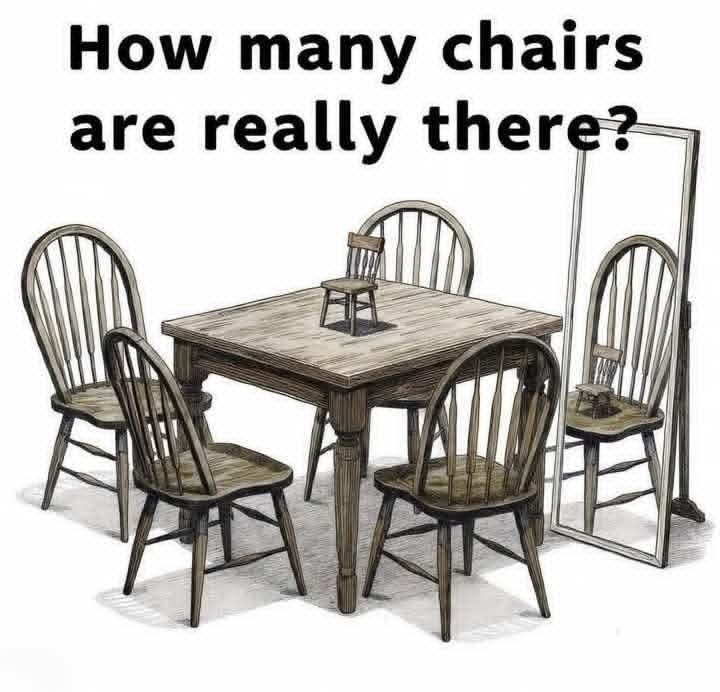
At first glance, the illustration shows a wooden table surrounded by several chairs. However, one unusual detail immediately stands out—a tiny chair appears to be sitting on top of the table.
To make things even more interesting, a large mirror on the right side reflects part of the room, including what looks like another chair with the tiny chair positioned above it.
This combination of perspective and reflection encourages viewers to question whether they are seeing separate objects or simply different views of the same ones.
What Can You See?
Looking carefully at the illustration, you can identify the following visible chair shapes:
-
Two chairs on the left side of the table.
-
One chair positioned at the front right.
-
One chair behind the table.
-
One miniature chair resting on the table.
-
One large chair visible in the mirror.
-
One miniature chair reflected in the mirror.
This creates multiple ways to interpret the puzzle.
Different Ways People Solve It
Interpretation One: Count Only the Physical Chairs
Some viewers count only the actual chairs that exist in the room and ignore the mirror reflection. Using this method, they may conclude there are four or five chairs, depending on how they interpret the tiny chair and the chair behind the table.
Interpretation Two: The Optical Illusion
Others believe the tiny chair and the chair behind the table represent the same object viewed from different perspectives. This interpretation relies on the visual illusion created by the drawing’s perspective and is one reason the puzzle generates so much discussion.
Interpretation Three: Count Every Visible Chair Shape
Another common approach is to count every chair shape visible in the image, including those reflected in the mirror.
Using this method, the total becomes:
-
2 chairs on the left
-
1 chair on the front right
-
1 chair behind the table
-
1 miniature chair on the table
-
1 reflected chair in the mirror
-
1 reflected miniature chair
Total: 7 visible chairs
The Most Literal Answer
If the puzzle is interpreted as asking how many chair images appear in the entire picture, including reflections, the answer is:
7
This approach counts every chair that can be seen, regardless of whether it is a physical object or a mirror reflection.
Why Optical Illusions Are So Popular
Puzzles like this demonstrate that our brains do more than simply record what our eyes see. We constantly interpret depth, perspective, reflections, and object relationships, sometimes leading different people to completely different conclusions.
There is often no single universally accepted solution because the wording of the question leaves room for interpretation.

Final Thoughts
The viral chair puzzle reminds us that perception and observation are not always the same. While some viewers focus only on the physical furniture, others include the reflected images or interpret the perspective differently. If you count every visible chair shape in the illustration, the most literal answer is 7 chairs. More importantly, the puzzle highlights how easily our minds can be influenced by perspective, making even the simplest images surprisingly challenging.
Sources
-
American Psychological Association (APA) – Visual Perception
-
Encyclopedia Britannica – Optical Illusions
-
National Geographic – How the Human Brain Processes Visual Information