It was not a gentle sound.
It dragged him out of the kind of thin sleep older men get after midnight, when the house has gone quiet but the mind keeps counting old mistakes.
For a second, he thought it might be a wrong number.
Then he saw Lily’s name glowing on the screen.
His granddaughter never called at that hour.
Not once.
Thomas sat up so fast the blanket slid to the floor, and the cold boards under his feet seemed to wake every nerve in his body.
Outside the bedroom window, the porch flag snapped softly in the wind.
Somewhere down the street, a dog barked once and then went silent.
He answered before the phone could buzz again.
“Lily?”
There was breathing first.
Small, broken breathing.
Then her voice came through, barely more than a whisper.
“Grandpa…”
Thomas’s hand tightened around the phone.
“What happened?”
“I’m at the police station.”
He was already standing.
“My stepmother hit me,” Lily whispered, and the next words came out faster, like she was afraid someone would snatch the phone away. “But she told them I attacked her first. Dad believes her. He believes Veronica, not me.”
For three seconds, Thomas could not move.
Then the old habit of crisis took over.
He reached for the jeans he had folded over the chair.
“Which station?”
“Ridgeway Precinct.”
“Are you alone?”
“No. Dad’s here. Veronica’s here. Please don’t tell them I called you.”
“Why?”
Her voice cracked.
“She said if I made trouble, I’d never see Dad again.”
That last word carried more fear than any scream could have.
Thomas closed his eyes once.
He had heard enough.
“I’m coming,” he said.
“Grandpa, please—”
“I’m coming, Lily.”
He ended the call, not because he wanted to, but because every second he spent reassuring her was a second she remained in that room with people who had already failed her.
Thomas Bennett was seventy-one years old.
He had a bad knee from a warehouse accident thirty years earlier, two reading glasses in different rooms because he kept misplacing them, and a habit of drinking coffee too late because the evenings felt too long.
But he was not weak.
Not where Lily was concerned.
He had been there the day she was born, standing in the hospital hallway with a paper coffee cup he never drank from while Mark paced holes into the tile.
He had bought her first backpack.
He had sat through school concerts where she sang half a beat behind everyone else and waved at him from the risers like he was the only person in the room.
After her mother died, he had driven over every Saturday morning with donuts from the grocery store bakery and fixed whatever grief had left undone.
A loose cabinet hinge.
A broken porch light.
A child who had stopped talking at dinner.
Lily had trusted him with the kind of trust children do not announce.
She simply ran to him when the world got too loud.
And at 2:13 a.m., from a police station, she had run to him through a phone.
Thomas pulled on his coat, grabbed his keys, and went out into the cold.
The driveway was silver under the porch light.
His pickup coughed once before the engine caught.
He backed out carefully, then drove faster than he should have through the quiet streets toward Ridgeway Precinct.
He thought of Mark the whole way.
His son had once been tender in a way that made Thomas proud.
Mark used to check the locks twice because his wife hated windy nights.
He used to carry Lily on his shoulders through the supermarket parking lot when she was little, even when she kicked him in the chest and laughed into his hair.
Then Lily’s mother died.
Cancer had taken her slowly enough to make hope feel cruel.
After the funeral, Mark folded inward.
He stopped coming by for Sunday lunch.
He stopped answering calls on the first ring.
He started saying he was tired, then busy, then fine.
Veronica arrived six months later.
She was polished in a way that impressed people who mistook control for competence.
She brought casseroles to church friends after funerals.
She remembered birthdays.
She spoke softly when others were listening.
She touched Mark’s arm in public, always at the exact moment he looked lost.
Thomas had disliked her from the beginning, but dislike was not evidence.
So he watched.
He watched Lily get quieter.
He watched Mark start checking with Veronica before answering simple questions.
He watched Veronica correct Lily’s posture, her tone, her clothes, her appetite, her memories of her own mother.
Not all cruelty raises its voice.
Some cruelty learns the schedule, packs the lunch, smiles at the neighbors, and waits until the door is closed.
By 2:29 a.m., Thomas pulled into the precinct lot behind two squad cars and Mark’s family SUV.
The SUV’s dome light was still glowing.
A child’s water bottle rolled under the passenger seat.
That small detail made Thomas angrier than he expected.
There was something unbearable about normal objects sitting beside abnormal betrayal.
He parked crooked, grabbed his cane from the passenger floor, and walked inside.
The precinct lobby smelled like burnt coffee, wet jackets, and lemon floor cleaner.
A vending machine buzzed against one wall.
A small American flag stood on the front desk beside a stack of police report forms and a jar of cheap pens.
A young officer looked up from the computer.
“Can I help you?”
“I’m here for Lily Bennett.”
The officer’s fingers paused above the keyboard.
“Are you family?”
“Her grandfather. Thomas Bennett.”
Something changed in the room before the young officer could answer.
A door opened behind him.
A heavier officer stepped into the lobby with a folder tucked under one arm.
He looked at Thomas’s face, then down at the name the young officer had begun typing, and the color drained from him.
“Sir…” he said quietly. “I didn’t know who she was calling.”
Thomas looked at the badge on his chest.
“Officer Grayson. Where is my granddaughter?”
Grayson swallowed.
“Interview room two.”
“And why is a fourteen-year-old girl being questioned at two in the morning without counsel?”
“Her father is here.”
“Her father is not thinking clearly.”
Grayson glanced toward the hallway.
Thomas did not wait for permission.
He walked past him.
The hallway was too bright, too clean, too cold.
Every footstep clicked against the tile.
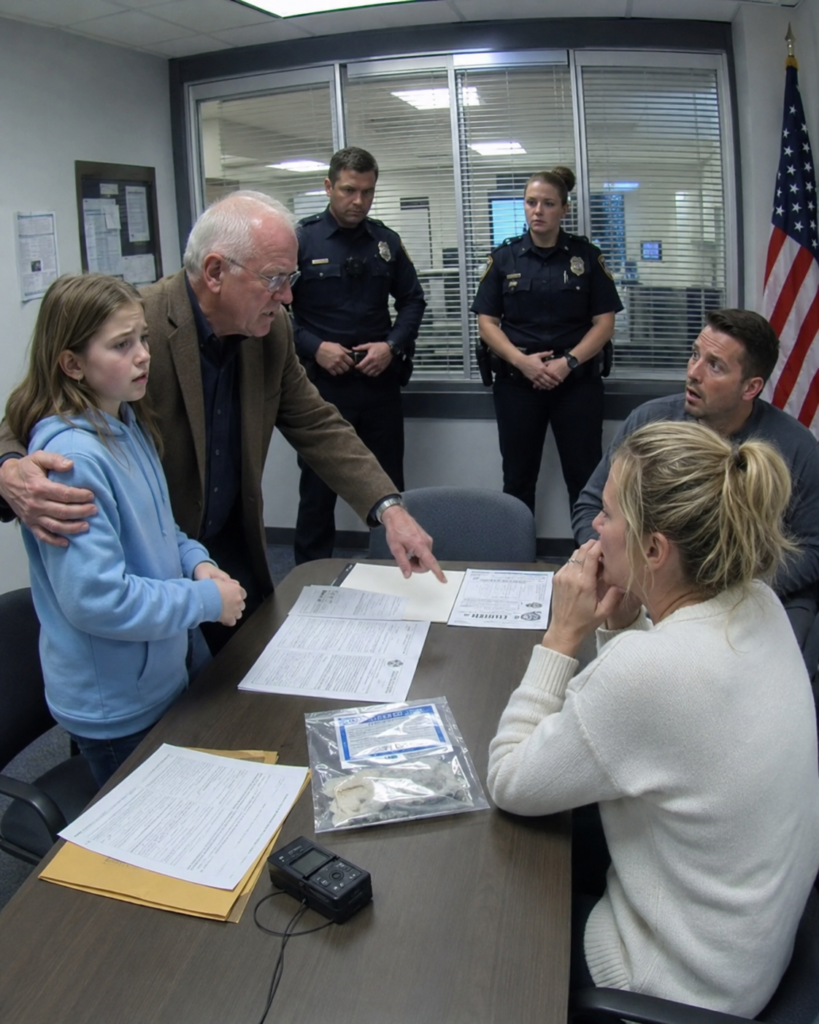
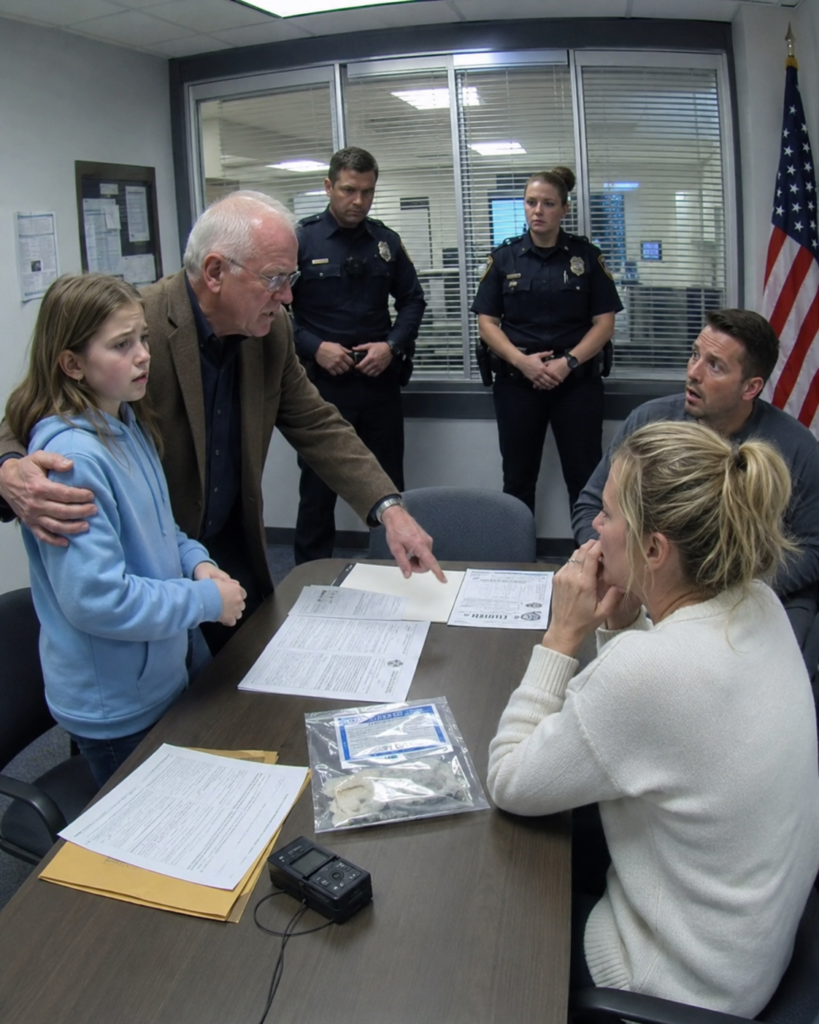
Through the glass window of interview room two, Thomas saw Lily.
She sat with her arms folded tight across her middle.
Her blue hoodie sleeves were pulled over her hands.
One cheek was swollen.
A purple bruise climbed along her jaw.
Her lower lip was split.
She looked smaller than fourteen.
Across the table sat Mark, bent forward with both hands buried in his hair.
Beside him stood Veronica.
White sweater.
One sleeve torn.
A neat red scratch on her neck.
Too neat.
Too perfectly placed.
Thomas had lived long enough to know that real chaos does not arrange itself for sympathy.
The recorder light blinked on the table.
A paper coffee cup sat untouched near Mark’s elbow.
A form labeled incident report lay half-covered beneath Grayson’s folder.
The clock on the wall read 2:31 a.m.
Lily had been sitting there for nearly twenty minutes while adults debated whether her pain was believable.
Thomas opened the door.
Lily looked up.
For one second, she did not move, as if she could not trust that he was real.
Then she bolted from the chair and ran into him.
She hit his chest so hard the breath left him.
“I didn’t do it,” she whispered.
“I know.”
He put one hand on the back of her head and the other on her shoulder.
Her whole body shook once, then locked still.
That stillness told him more than tears would have.
Children who feel safe collapse.
Children who feel watched hold themselves together.
Veronica laughed once.
It was a small, sharp sound.
“Of course you know,” she said. “You always hated me.”
Thomas looked at her torn sleeve.
Then he looked at Lily’s hands.
“No,” he said. “I just recognize a staged scene when I see one.”
Mark stood.
“Dad, don’t start.”
Thomas turned his head slowly.
For a moment, Mark looked like a boy again, guilty and defensive and desperate for someone else to decide what kind of man he was.
Thomas wanted to shout at him.
He wanted to ask how grief had made him forget the sound of his own daughter’s fear.
He wanted to tell him that believing the loudest person in the room over the bruised child in the chair was not confusion.
It was cowardice.
Instead, Thomas kept his hand on Lily’s shoulder.
There are moments when anger is useful only if you refuse to spend it too early.
A slammed fist might feel good.
A paper trail lasts longer.
Thomas looked at Officer Grayson.
“Pull the body camera footage from the first responding officers.”
Veronica’s face did not move.
“Get the neighbor statements.”
Her fingers tightened slightly at her torn cuff.
“Check the home security camera facing the kitchen hallway.”
That did it.
Her eyes flicked to Mark.
Then to Grayson.
Then back to Thomas.
It lasted less than a second.
It was enough.
She had forgotten about the camera.
Thomas continued, voice even.
“I also want the time the call came in, the intake sheet, and the incident report before anyone puts another word in my granddaughter’s mouth.”
The young officer had followed them to the doorway.
He looked from Lily’s face to Veronica’s torn sleeve and then down at the folder in Grayson’s hands.
Grayson did not answer right away.
The room had changed.
Not loudly.
Not dramatically.
But everyone felt it.
Veronica had walked in as the injured wife.
Now she was standing in a room where evidence had become more important than performance.
“Sir,” Grayson said carefully, “the father declined to press charges on the original statement.”
Lily’s fingers dug into Thomas’s sleeve.
Thomas looked at Mark.
“You declined before you saw the footage?”
Mark’s mouth opened.
Nothing came out.
Veronica moved in quickly.
“Because there is no footage,” she said. “That old hallway camera hasn’t worked in months. Mark knows that.”
Thomas did not speak.
He did not have to.
Nobody had mentioned which camera he meant.
Grayson went very still.
The young officer’s eyes lifted from the folder.
Mark turned toward Veronica slowly.
“What do you mean, that old hallway camera?” he asked.
Veronica blinked.
“It’s obvious. He said kitchen hallway.”
“No,” Thomas said. “I said home security camera facing the kitchen hallway.”
The difference landed like a dropped plate.
Mark stared at her.
For the first time, doubt moved across his face with enough force to break through the fog he had been living in.
Then the young officer stepped into the room.
“There’s something else,” he said.
He reached for a small clear evidence bag on the side table.
Thomas had not noticed it before.
Inside was Lily’s phone.
The screen was cracked at one corner.
A thin line of light still glowed through the plastic.
“She gave this to us during intake,” the young officer said. “She said she hit record before the argument moved into the kitchen.”
Lily lowered her head.
“I was scared,” she whispered.
Thomas felt her voice against his coat more than he heard it.
Mark reached for the back of the chair.
His fingers curled around it until his knuckles went pale.
“Lily,” he said, but her name came out broken.
Veronica whispered, “She’s lying.”
Her voice had changed.
It no longer had the clean edge of certainty.
It had the thin panic of someone watching a locked door open from the other side.
Officer Grayson picked up the evidence bag.
He looked at Mark.
Then at Thomas.
Then at Veronica.
“Before I play this,” he said, “I need everyone in this room to understand something.”
Nobody moved.
Even the recorder light seemed louder.
“This is now part of the incident file,” Grayson said. “If it shows what she says it shows, we are not treating this as a misunderstanding.”
Veronica folded her arms.
“She edited it.”
The young officer glanced down.
“It was recorded at 1:58 a.m. The responding call came in at 2:04.”
Thomas looked at Mark.
“That means she recorded before anyone called police.”
Mark closed his eyes.
Grayson removed the phone from the bag carefully.
The cracked screen lit his face from below.
For a moment, no one spoke.
Then Lily’s voice came from the phone.
Small.
Terrified.
“Please stop.”
Mark flinched.
A second voice followed.
Veronica’s.
Not soft.
Not injured.
Cold.
“You think your father will choose you over me?”
The air left the room.
The recording continued.
There was a scrape.
A thud.
Lily crying out.
Then Veronica again.
“You little brat. Look what you made me do.”
Mark grabbed the chair harder.
Thomas felt Lily curl inward against him.
He wanted to cover her ears, but she had already lived it.
The room was only catching up.
On the recording, Lily sobbed, “I didn’t touch you.”
Veronica laughed.
Then came the line that made Mark finally look like a father waking up inside his own body.
“By the time I’m done,” Veronica’s recorded voice said, “your dad will be begging them to take you away.”
Mark whispered, “No.”
It was not denial anymore.
It was horror.
Veronica lunged toward the phone.
Grayson stepped back and lifted one hand.
“Do not touch evidence.”
The word evidence changed the room again.
It made the whole thing official.
Not family drama.
Not a teenage girl acting out.
Not a stepmother trying her best.
Evidence.
Veronica froze.
The young officer moved to the door and spoke quietly into his radio.
Thomas heard only pieces.
Supervisor.
Juvenile victim.
Recorded admission.
Possible false statement.
Mark sat down hard.
His face looked emptied.
“Lily,” he said.
She did not go to him.
That hurt him.
Thomas could see it.
But hurt was not the same as injustice.
Sometimes pain is simply the bill arriving.
Lily stayed where she was, one sleeve-covered hand gripping Thomas’s coat.
“I told you,” she whispered.
Mark nodded once.
“I know.”
“No,” she said, and her voice was small but clear. “I told you before tonight.”
That was the sentence that broke him.
Not the recording.
Not the bruise.
Not the officer’s warning.
The fact that this had not begun at 2:13 a.m.
It had only finally become impossible to ignore.
Mark covered his mouth with one hand.
Veronica looked at him and saw she was losing the only witness she had counted on controlling.
“Mark,” she said sharply. “Don’t let them twist this.”
He stared at her.
“How many times?”
She blinked.
“What?”
“How many times did she tell me, and I made excuses for you?”
Veronica’s face hardened.
“She is dramatic. She has always been dramatic. You know how she gets when she doesn’t get attention.”
Thomas took one step forward.
Grayson noticed and shifted slightly, not blocking him exactly, but reminding everyone where they were.
Thomas stopped.
He had promised himself he would spend his anger wisely.
So he spoke to Mark instead.
“When Lily’s mother died, I told you grief would try to make decisions for you.”
Mark looked down.
“I remember.”
“I told you not to hand your daughter to the first person who made the house quiet.”
Mark’s eyes filled.
Veronica snapped, “This is ridiculous.”
Grayson turned to her.
“Mrs. Bennett, I need you to step into the hallway.”
“I’m not going anywhere.”
“You can step into the hallway voluntarily, or we can continue this conversation with a supervisor present.”
That was the moment Veronica understood charm had no jurisdiction there.
She looked at Mark, waiting for him to rescue her.
He did not move.
The young officer opened the door.
Veronica walked out with her head high, but her hands betrayed her.
They shook at her sides.
Once she was gone, the room became painfully quiet.
Mark turned to Lily.
“I’m sorry.”
Lily stared at the floor.
Thomas felt her breathing change.
A child should not have to decide whether a parent’s apology is safe.
“I don’t want to go home with her,” Lily said.
“You won’t,” Thomas said.
Mark looked at him.
Then at Grayson.
“What happens now?”
Grayson’s voice softened, but only a little.
“First, medical documentation. Then a revised statement. Then we contact the appropriate child welfare response line and document placement for the night. If Mr. Bennett is willing and cleared as family, she can remain with him while the report is processed.”
“I’m willing,” Thomas said before Grayson finished.
Lily finally looked up.
Her face crumpled for the first time.
Not because she was afraid.
Because someone had said a sentence she could rest inside.
“I want Grandpa,” she whispered.
Mark nodded.
It cost him something, and it should have.

At 3:12 a.m., Thomas sat beside Lily on a hard bench outside the interview rooms while a female officer brought her a bottle of water and a clean tissue.
The precinct still smelled like coffee and cleaner.
The vending machine still buzzed.
But Lily’s shoulders had lowered a fraction.
That mattered.
Grayson came out with the revised incident report clipped to a folder.
He did not look as pale now.
He looked grim.
“We’ll need a full statement from you as well, Mr. Bennett.”
“You’ll have it.”
“And the home security footage.”
“You’ll have that too.”
Thomas had installed the system after Lily’s mother got sick because Mark was at the hospital so often and Lily hated being alone in the house.
He had paid for it himself.
Veronica had complained about it twice.
Now he knew why.
At 4:06 a.m., Thomas drove Lily home only long enough to collect her backpack, her medication, and the stuffed bear her mother had given her when she was seven.
Grayson followed in a patrol car.
Mark drove separately.
Veronica was not allowed inside while Lily gathered her things.
She stood near the driveway, wrapped in her white sweater, looking smaller under the porch light than she had in the interview room.
The kitchen hallway camera sat above the archway, angled exactly where Thomas had said it was.
A tiny green light blinked on its side.
Mark stared at it like it had been watching him fail for months.
Thomas removed the memory card himself.
He placed it in a small envelope Grayson provided.
The officer labeled it with the date, time, address, and case number.
Lily watched from beside the kitchen table.
Her eyes followed the envelope.
For the first time all night, Thomas saw something in her face besides fear.
Not relief yet.
Relief was too heavy to arrive quickly.
But recognition.
Proof had a shape now.
It had a phone, a file, a timestamp, a camera, an envelope.
It had adults finally moving in the right direction.
At 5:18 a.m., Lily fell asleep in Thomas’s guest room under the quilt his late wife had made.
Her hoodie was folded on the chair.
Her bear sat tucked under one arm.
Thomas stood in the doorway for longer than he meant to.
He listened to her breathing.
Then he walked to the kitchen, made coffee, and sat across from Mark.
His son looked ruined.
Good, Thomas thought.
Some ruins are where rebuilding begins.
“I don’t know how I let this happen,” Mark said.
Thomas wrapped both hands around his mug.
“Yes, you do.”
Mark flinched.
Thomas did not soften it.
“You were lonely. She made life easier. And every time Lily made that harder, you chose the easier story.”
Mark cried then.
Quietly.
No performance.
No defense.
Just a grown man breaking under the weight of what he had refused to see.
Thomas let him cry.
Then he said, “Your daughter can forgive you someday if she wants to. But you do not get to ask her for that to make yourself feel better.”
Mark nodded.
“She comes first now,” Thomas said.
“She should have always come first.”
“Yes,” Thomas said. “She should have.”
The days after that were not clean or simple.
Real consequences rarely arrive in one dramatic scene.
They come as forms, appointments, phone calls, waiting rooms, statements, and the same story told again to people with clipboards.
Lily was examined at a clinic before noon.
The nurse documented the bruising on an intake form and photographed the marks under proper procedure.
The police report was amended.
The phone recording was logged.
The camera footage showed Veronica cornering Lily in the kitchen hallway and grabbing her hard enough to spin her into the wall.
It also showed Veronica tearing her own sleeve afterward.
That was the detail that haunted Mark.
Not just the violence.
The pause after.
The way Veronica stood in the hallway, breathing hard, then looked toward the living room, hooked two fingers into her own sleeve, and pulled until the seam ripped.
A plan.
A performance.
A child framed in her own home.
When Mark watched the footage, he had to leave the room.
Thomas did not follow him.
He stayed with Lily.
In the following weeks, temporary protective conditions were put in place.
Veronica was removed from the home while the investigation moved forward.
Mark began counseling, not because counseling erased anything, but because someone had to teach him how to stop confusing guilt with repair.
Lily stayed with Thomas.
At first, she slept with the lamp on.
She checked the bedroom door twice.
She jumped when the phone rang.
Thomas did not make speeches.
He made pancakes.
He drove her to school.
He put a paper coffee cup in the car’s cup holder and pretended not to notice when she only took two sips.
He sat in the parking lot until she got through the front doors.
Some mornings, she looked back.
Some mornings, she did not.
Both were allowed.
The first time Mark came to visit, Thomas met him on the porch.
“Not inside unless she asks,” Thomas said.
Mark nodded.
He looked thinner.
He held a grocery bag with Lily’s favorite cereal and the sketchbook she had left at home.
“I brought these.”
Thomas took the bag.
“I’ll tell her.”
Mark swallowed.
“Can you tell her I love her?”
Thomas looked through the screen door, where Lily sat at the kitchen table pretending not to listen.
“No,” he said. “You can tell her when she asks to hear it.”
Mark lowered his head.
It was not cruelty.
It was boundaries.
There is a difference, though guilty people often pretend they cannot tell.
Weeks passed.
Then months.
Lily began sleeping through the night.
She started leaving her hoodie sleeves at her wrists instead of pulled over her hands.
She laughed once at a ridiculous commercial while Thomas washed dishes.
The sound startled them both.
She looked guilty for laughing.
Thomas kept scrubbing the plate.
“That was a dumb commercial,” he said.
She smiled.
A small one.
But real.
Mark kept showing up.
Not loudly.
Not with grand gestures.
He attended the meetings he was told to attend.
He signed the paperwork.
He gave statements.
He stopped asking Lily to understand him.
He started asking what she needed.
Most days, she said nothing.
One day, she said, “I need you not to bring her up like she’s the victim.”
Mark nodded.
“You’re right.”
That was all he said.
It was the first right answer he had given in a long time.
The case moved through the system slowly.
Slower than Thomas liked.
But the evidence did what evidence does when handled properly.
It stayed.
The recording stayed.
The camera footage stayed.
The intake photos stayed.
The report stayed.
Veronica’s story did not.
It changed three times before anyone asked her a hard question in a formal room.
First, Lily attacked her.
Then Lily slipped.
Then Veronica only grabbed her to prevent her from running away.
But the phone had caught her words.
The camera had caught her hands.
And the torn sleeve had caught her lie.
By the time the family court hearing came, Lily was sitting between Thomas and a victim advocate in a hallway that smelled like copier toner and old coffee.
A flag stood beside the courtroom door.
Mark sat across from them, elbows on his knees, staring at the floor.
Veronica arrived with a lawyer and the same polished face Thomas had seen at funerals.
But Lily did not shrink.
Thomas noticed that first.
Her hands shook.
Her eyes stayed forward.
Both things could be true.
Courage is not the absence of shaking.
Sometimes courage is shaking and staying in the chair anyway.
When the hearing began, the evidence was reviewed in order.
Timestamp.
Recording.
Incident report.
Medical documentation.
Camera footage.
Veronica’s attorney tried to call it a family misunderstanding.
The judge did not appreciate that.
Neither did Mark.
He stood when asked where Lily should live while the matter continued.
For the first time, he did not look at Veronica before answering.
“With her grandfather,” he said. “Until Lily wants otherwise.”
Lily stared down at her hands.
Thomas saw one tear fall onto her thumb.
She did not wipe it away.
Afterward, in the hallway, Mark approached her slowly.
He stopped several feet away.
“I’m proud of you,” he said.
Lily looked at him for a long time.
Then she said, “I needed you to believe me before strangers did.”
Mark’s face crumpled.
“I know.”
“No,” she said. “I don’t think you do yet.”
Then she turned and walked back to Thomas.
He did not tell her to be kinder.
He did not tell her he was still her father.
He did not tell her forgiveness would heal her.
Children hear enough instructions from adults who have not protected them.
Thomas simply opened the courthouse door and walked with her into the daylight.
Months later, Lily returned to the house where she had lived with Mark, but not because anyone pressured her.
She returned because the locks had changed, Veronica was gone, and Mark had spent enough time doing quiet work that Lily wanted to try Sunday dinner.
Thomas came too.
That was Lily’s condition.
They ate spaghetti at the kitchen table.
The camera in the hallway was still there.
Mark asked if she wanted it taken down.
Lily looked at it, then at him.
“No,” she said. “Not yet.”
Mark nodded.
“Okay.”
No argument.
No wounded sigh.
No speech about trust.
Just okay.
That was how repair began.
Not with one apology.
Not with a courtroom.
Not with a dramatic promise.
With a father learning to accept a boundary without making his child comfort him for it.
Thomas watched them from across the table.
He knew they were not healed.
Healing was not a switch someone flipped after the villain left.
But Lily reached for the parmesan, and Mark passed it without speaking.
Their hands did not touch.
Neither forced it.
That mattered too.
Later, when Thomas drove Lily back to his house, she leaned her head against the passenger window.
The small American flag on his porch came into view as they pulled into the driveway.
The porch light glowed warm over the steps.
For the first time in a long time, she did not ask whether she could sleep with the lamp on.
She simply went upstairs, changed into pajamas, and left her bedroom door open a few inches.
Thomas stood in the hallway and listened until her breathing settled.
Then he went to the kitchen and placed his phone faceup on the table.
He looked at the screen for a moment.
The call log still held that night.
2:13 a.m.
Lily Bennett.
He did not delete it.
Some records are not there because you want to remember the pain.
They are there because someone finally answered.
And if Lily ever doubted that the truth had existed before the adults were ready to see it, Thomas wanted proof close enough to hold.
A phone, a file, a timestamp, a camera, an envelope.
And one grandfather who walked into a police station at 2:29 in the morning and refused to let a bruised child be turned into the villain of her own story.