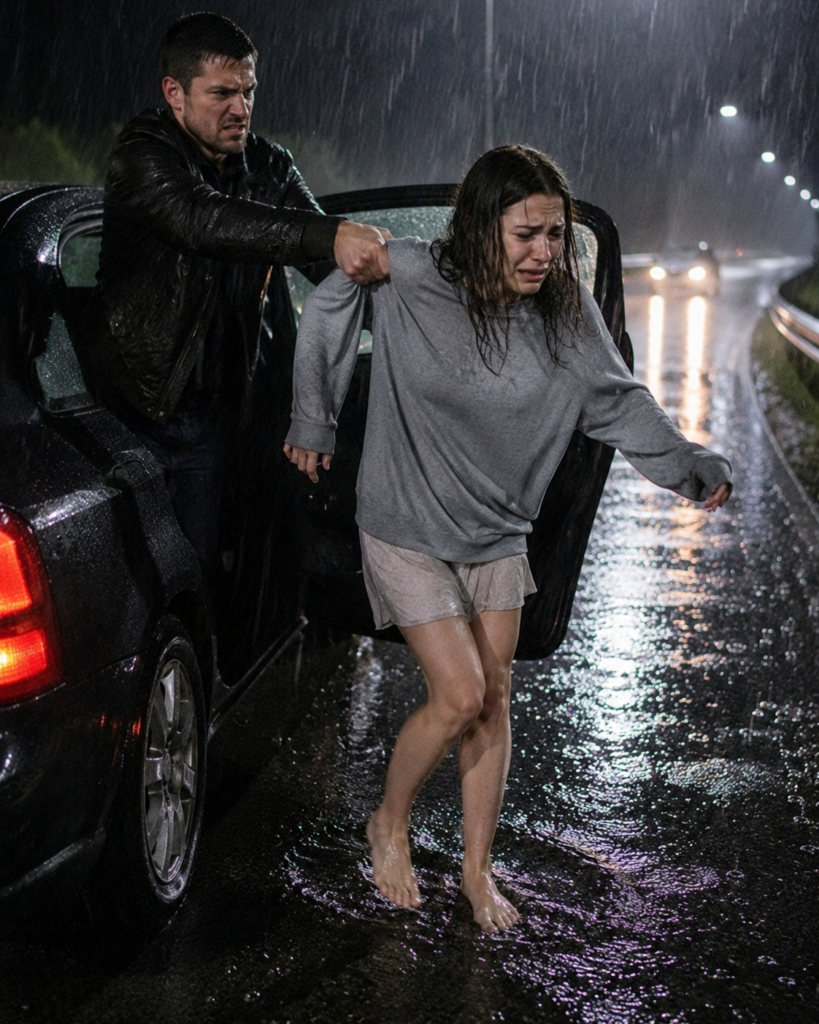
The rain had been falling for hours when Eleanor Harper looked out the passenger window and realized she had never seen the highway so empty.
Dark clouds covered the Tennessee sky, and every passing mile seemed quieter than the last. Lightning flickered in the distance, briefly illuminating rows of pine trees before disappearing again into the night.
Eleanor rested her head against the seat and closed her eyes.
For months, she had been living with a serious medical condition that required frequent appointments, regular medication, and more rest than she wanted to admit. The journey had tested her physically and emotionally. Some days she felt hopeful. Other days, even getting out of bed seemed like an accomplishment.
Her husband had driven her to countless appointments over the years, but the strain of balancing work, finances, and caregiving had affected them both. Conversations that had once been filled with encouragement had gradually become shorter, quieter, and more complicated.
That evening, after another difficult day, they found themselves sitting in silence for miles.
Eventually, Eleanor asked softly, “Are we still heading toward the hospital?”
There was no immediate answer.
Instead, her husband pulled into a small roadside parking area, turned off the engine, and took a long breath.
“I think we both need time to think,” he said quietly.
Eleanor looked at him with surprise.
She understood that they were both exhausted, but she hadn’t expected the evening to unfold this way.
Without anger or raised voices, they agreed that Eleanor would stay somewhere safe nearby while they both reflected on what came next. It wasn’t the future either of them had imagined, but sometimes difficult seasons require difficult conversations.
After he drove away, Eleanor found herself standing beneath the shelter of a small roadside information stop, wrapped in an oversized sweatshirt and watching the rain fall across the empty highway.
She felt tired.
Not only physically.
Emotionally.
Mentally.
For the first time in years, she truly didn’t know what tomorrow would look like.
As she considered her next step, headlights appeared through the rain.
An older produce truck slowed before coming to a stop.
The driver stepped out, holding an umbrella against the wind.
“Evening,” he called kindly. “Are you all right?”
His name was Calvin Brooks.
For more than thirty years, Calvin had delivered fresh fruit and vegetables to diners, schools, and local markets across middle Tennessee. Long hours had taught him to notice details that others often overlooked.
He noticed Eleanor’s pale expression.
He noticed how carefully she moved.
Most importantly, he noticed she looked like someone who simply needed help.
“I think I could use a place to sit for a little while,” Eleanor admitted with an apologetic smile.
Calvin smiled back.
“Then let’s fix that.”
Rather than asking uncomfortable questions, he simply invited her into the warm cab of the truck.
The heater hummed softly as rain tapped against the windshield.
For several minutes, neither of them spoke.
Sometimes kindness begins with allowing silence.
Eventually, Calvin said, “There’s a diner about five miles from here. The owner has helped more people than she’ll ever admit.”
Eleanor nodded.
“That sounds nice.”
Mabel’s Kitchen had already closed for the evening when Calvin pulled into the parking lot.
Warm yellow lights still glowed through the windows.
Inside, Mabel Hart was finishing paperwork while a fresh pot of coffee brewed in the kitchen.
She looked toward the door as Calvin entered.
“You’re later than usual,” she joked.
Then she noticed Eleanor.
Without hesitation, Mabel stood.
“You look exhausted,” she said warmly.
“Come sit down.”
Within minutes, Eleanor had a bowl of homemade vegetable soup, fresh bread, and hot tea resting in front of her.
No one rushed her.
No one pressured her to explain everything immediately.
Instead, Mabel simply treated her like a welcome guest.
That simple act nearly brought Eleanor to tears.
After months of focusing almost entirely on medical appointments and daily routines, she had forgotten how comforting ordinary kindness could feel.
As they talked, Eleanor shared pieces of her story.
She spoke about the challenges of living with a long-term illness.
She admitted how lonely recovery sometimes felt.
She confessed that asking for help had always been difficult.
Mabel listened carefully.
“You know,” she said after a while, “strength isn’t pretending everything is fine.”
Eleanor looked up.
“It’s allowing people to walk beside you while you heal.”
Those words stayed with her.
The following morning, Mabel introduced Eleanor to Dr. Nora Lee, a physician who had served the local community for decades.
Rather than focusing only on symptoms, Dr. Lee wanted to understand Eleanor’s entire experience.
They discussed nutrition.
Sleep.
Stress.
Medication.
Exercise.
Emotional well-being.
Everything mattered.
By the end of the appointment, Eleanor didn’t simply have a treatment plan.
She had a team.
Dr. Lee arranged follow-up care with specialists.
Mabel insisted Eleanor stay in the small guest room behind the diner until she regained her strength.
Calvin checked in each morning while delivering produce.
Gradually, Eleanor began settling into a peaceful routine.
She helped wipe tables before breakfast.
She folded napkins during the afternoon.
She organized recipe cards while chatting with customers.
No one expected perfection.
They simply appreciated her company.
Weeks passed.
Spring slowly replaced winter.
Flowers appeared outside the diner windows.
Birds returned to the nearby trees.
For the first time in many months, Eleanor noticed herself smiling without forcing it.
She started taking short walks around the neighborhood.
At first, she managed only a few minutes.
Soon those walks became twenty.
Then thirty.
Every small victory mattered.
Mabel celebrated each one.
“So,” she teased one afternoon, “when are you going to admit you’re stronger than you think?”
Eleanor laughed.
“I’m working on believing that.”
One Saturday morning, a local community center hosted a wellness fair.
Dr. Lee encouraged Eleanor to attend.
Instead of focusing solely on illness, the event celebrated healthy habits, resilience, and supportive relationships.
Volunteers offered cooking demonstrations.
Fitness instructors led beginner exercise sessions.
Counselors discussed stress management.
Neighbors shared encouragement with one another.
Eleanor realized something important.
Healing isn’t always about returning to the person you used to be.
Sometimes it’s about discovering a stronger version of yourself.
Inspired by the event, she began volunteering twice each week.
She welcomed visitors.
Prepared refreshments.
Answered questions.
Most importantly, she listened.
Many people carried invisible challenges.
Some faced health concerns.
Others struggled with loneliness.
Some simply needed someone willing to hear their story.
Eleanor understood that feeling better didn’t require having all the answers.
Sometimes people simply needed hope.
Months later, Dr. Lee smiled during a routine checkup.
“Your progress has been remarkable.”
Eleanor smiled.
“I couldn’t have done it alone.”
That evening, she looked around Mabel’s Kitchen.
Customers laughed over coffee.
Families shared homemade pie.
Calvin carried fresh produce through the back entrance while humming an old country song.
Everything felt wonderfully ordinary.
She realized ordinary moments had become extraordinary gifts.
Two years later, Nashville hosted its annual Community Compassion Awards, recognizing individuals whose everyday kindness had transformed lives.
Mabel refused to attend.
“I don’t need awards,” she insisted.
Calvin agreed.
“I’m just doing my job.”
The event organizers had other ideas.
Both received invitations.
So did Eleanor.
Standing backstage before the ceremony, Eleanor looked at the audience.
Hundreds of people filled the auditorium.
Healthcare workers.
Teachers.
Volunteers.
Local business owners.
Neighbors.
Friends.
She took a slow breath before stepping onto the stage.
The applause surprised her.
Not because she thought she didn’t deserve it.
Because, for so long, she had forgotten what encouragement sounded like.
She smiled.
“My story isn’t really about illness,” she began.
“It’s about kindness.”
The room became quiet.
“There was a time when I believed recovery meant finding the perfect treatment or waiting for life to become easy again.”
She paused.
“I’ve learned something different.”
“Healing often begins with people who choose to care.”
She spoke about Calvin stopping his truck during a rainy evening simply because someone looked like they needed help.
She described Mabel offering warm soup before asking difficult questions.
She thanked Dr. Lee for seeing her as a complete person rather than just another medical chart.
Each person had changed her life in a different way.
None of them considered themselves extraordinary.
Yet together, they had created something remarkable.
Hope.
By the time Eleanor finished speaking, many people in the audience were smiling.
Some quietly wiped away tears.
Not tears of sadness.
Tears of recognition.
Everyone, at some point, has depended upon someone else’s kindness.
As the audience stood to applaud, Eleanor looked toward the front row.
Calvin shifted uncomfortably, embarrassed by the attention.
Mabel crossed her arms, pretending not to enjoy the applause.
Dr. Lee simply smiled.
Eleanor laughed softly.
She realized something beautiful.
The people who make the greatest difference rarely think of themselves as heroes.
They simply show up.
Again and again.
Rain or sunshine.
Busy days or quiet ones.
They choose compassion.
One ordinary act at a time.
When the ceremony ended, people gathered to congratulate the award recipients.
A young woman approached Eleanor.
“I’ve been going through a difficult health journey,” she admitted.
“Listening to your story gives me hope.”
Eleanor gently squeezed her hand.
“I hope you remember something.”
“What?”
“You don’t have to walk the road alone.”
The young woman smiled.
“I’ll remember that.”
As Eleanor stepped outside into the cool Nashville evening, she noticed light rain beginning to fall.
Months earlier, rain had reminded her of uncertainty.
Now it reminded her of new beginnings.
She lifted her face toward the sky and smiled.
Life hadn’t become perfect.
There were still appointments.
Still challenges.
Still days when progress felt slow.
But there was also friendship.
Community.
Purpose.
And hope.
Sometimes, the greatest turning point in our lives doesn’t arrive with dramatic fanfare.
Sometimes it begins with a stranger stopping to ask a simple question:
“Are you all right?”
And sometimes, that single moment of kindness becomes the first chapter of an entirely new life.