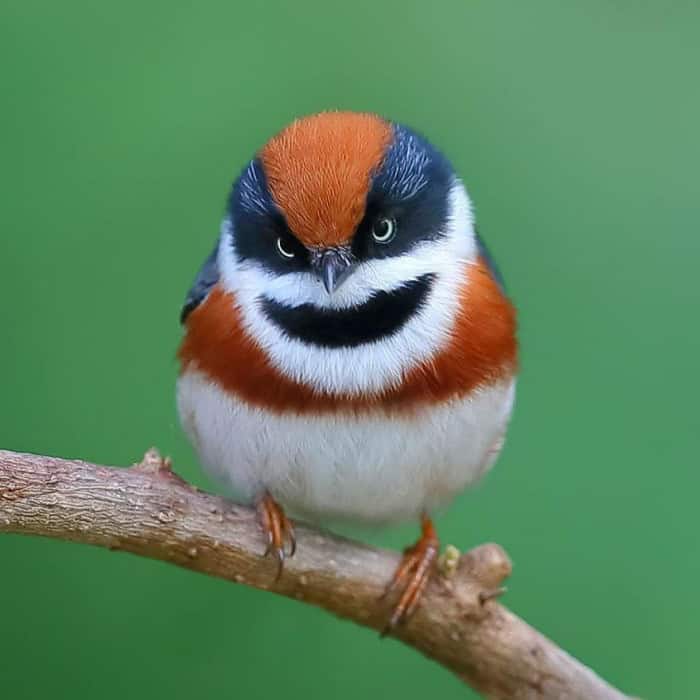
Have you ever seen a bird that looks like a troublemaker? The black-throated bushtit (Aegithalos concinnus) certainly fits the bill. With its bold “bandit mask” around the eyes and a grin-like mark on its throat, this small bird gives off an air of mischief.
Native to parts of eastern and southern Asia, the black-throated bushtit belongs to the Aegithalidae family and is known for its colorful plumage and striking patterns. These birds can be found in Nepal, Bhutan, northeastern India, and parts of Southeast Asia, including Vietnam and Thailand.

One of their most distinctive features is the black mask around their eyes, paired with a black mark on their throat, giving them a unique “grinning” expression. While males and females look similar, the females are typically lighter and smaller.
These birds are social creatures, staying in small flocks throughout the year, sometimes joining mixed-species feeding groups.

Unlike many other species, black-throated bushtits don’t migrate far but may move with the seasons. Their population tends to grow during the breeding season.
Despite their petite size—around 4 to 9 grams in weight and 10.5 cm (about 4 inches) in length—they make a big impression with their cheerful appearance.
Taiwanese wildlife photographer Chen Chengguang has captured some stunning images of this bird. While their plumage may vary depending on location, all subspecies share the iconic black throat and “bandit” mask.

Their range spans from the foothills of the Himalayas to northern India, Bhutan, and beyond, with some populations as far as northern China and Taiwan.
Black-throated bushtits primarily eat berries and seeds but enjoy insects, spiders, and even raspberries! Breeding pairs often stay together for years, raising one brood annually.
Breeding season is typically from February to May, and nests are made from materials like moss, spider webs, and lichen. Both parents feed the chicks, which fledge in about 16 to 17 days.

These birds are not known for territorial calls but communicate with high-pitched calls, trills, and sputters. Fortunately, their population is stable and classified as Least Concern, though habitat loss remains a possible threat in the future.


ADVERTISEMENT


Botanical Architects: The Engineering of the Hanging Nest
When the breeding season arrives—typically running from February to May depending on the elevation—the social flocks temporarily disband into highly devoted monogamous pairs. It is during this phase that the black-throated bushtit displays its most remarkable evolutionary trait: its extraordinary architectural capability.
The pair constructs an intricate, pouch-like nest that hangs elegantly from the outer branches of a bush or tree, typically within three meters of the forest floor. This nest is not a simple collection of twigs, but a highly engineered, flexible, and insulated dome woven from a delicate combination of materials:
Both the male and female work in perfect synchronization to harvest fresh moss and lichen, utilizing sticky spider webs as a high-tensile structural mortar to bind the pieces together. The inclusion of spider silk is an ingenious biological adaptation. As the female lays her clutch of 3 to 8 tiny speckled eggs, and the chicks subsequently hatch and grow, the elastic silk allows the walls of the nest to stretch outward. This prevents the nest from rupturing under the weight of the growing brood while maintaining an airtight, insulated sanctuary lined with soft feathers and animal fur.
Cooperative Breeding: The “Helper” Phenomenon
The commitment of the black-throated bushtit to social cooperation extends directly into their reproductive strategies. While both biological parents are highly active in incubation and feeding duties, researchers have documented a fascinating behavior known as cooperative breeding within the Aegithalidae family.
During busy nesting cycles, breeding pairs are frequently assisted by “helpers”—third-party adult birds that do not have their own nests. These helpers are typically close relatives, often older offspring from the previous year or males whose own nesting attempts failed early in the season.
By actively bringing caterpillars, spiders, and soft berries to the nest, these helpers significantly reduce the physical exhaustion of the biological parents. This cooperative system ensures a continuous supply of protein to the chicks, allowing them to fledge in a remarkably rapid 16 to 17 days. This highly efficient communal nursery model maximizes the species’ reproductive success in unpredictable mountain environments.
Conservation Status and Environmental Balance
Currently, the International Union for Conservation of Nature (IUCN) lists the black-throated bushtit as a species of Least Concern. Thanks to their wide distribution—stretching from the foothills of the western Himalayas across northern India, Nepal, Bhutan, Myanmar, southern China, Vietnam, and Taiwan—their global population remains exceptionally stable and resilient.
| Core Geographic Sanctuary | Preferred Habitat Type |
| Himalayan Foothills (India, Nepal, Bhutan) | Middle-altitude broadleaf oak forests. |
| Indochina Peninsula (Vietnam, Thailand, Laos) | Mixed pine, cedar, and bamboo woodlands. |
| East Asia (Taiwan, Northern China) | Subtropical evergreen forests and shrublands. |
Despite their current safety, conservation biologists keep a close watch on regional populations. Because these birds are highly dependent on healthy understory vegetation, such as rhododendron and wild berry brambles, for their winter foraging, localized habitat fragmentation caused by agricultural expansion and climate-driven shifts in mountain vegetation could pose challenges to their migratory ranges in the future. Protecting these mid-altitude forest reserves is essential for ensuring that these cheerful, energetic insect-eaters can continue to thrive.
Reflection on Human Curiosity and the Tapestry of Nature
The widespread joy and scientific interest generated by a bird as small as the black-throated bushtit highlights a beautiful, fundamental characteristic of human curiosity. As a species, we are inherently driven to look beyond our immediate environments, constantly seeking to explore, document, and understand the intricate lives of the creatures that share our planet. Our analytical curiosity provides us with the tools to map regional genetic variations, decode the acoustics of social communication, and analyze the material science of spider-silk nests with precise dedication. We build these rigorous academic and observational frameworks to bring order, logic, and deep appreciation to our shared biosphere.
At the same time, our emotional curiosity reminds us that the wild spaces of our world are filled with endless whimsy and surprise. The black-throated bushtit, with its comic “bandit mask” and cooperative, social lifestyle, is a brilliant reminder of life’s capacity for joy, resilience, and community coordination. By continuing to explore these daily natural encounters with scientific integrity, environmental awareness, and deep empathy, we expand our collective capacity for stewardship. We ensure that human progress and a profound reverence for the natural world work hand in hand, protecting the delicate, living networks that enrich our shared global journey.
Sources
-
For official conservation ratings, global distribution assessments, and current population trends, consult the IUCN Red List of Threatened Species.
-
For comprehensive species descriptions, taxonomic histories, and subspecific variations within the Aegithalidae family, refer to the Handbook of the Birds of the World (Lynx Edicions).
-
To explore detailed field identification guides, geographic distribution records, and habitat preferences across Southeast Asia, check the Thai National Parks database.
-
For clinical veterinary records, behavioral studies on cooperative breeding, and avian nesting architecture, consult resources from the Cornell Lab of Ornithology.