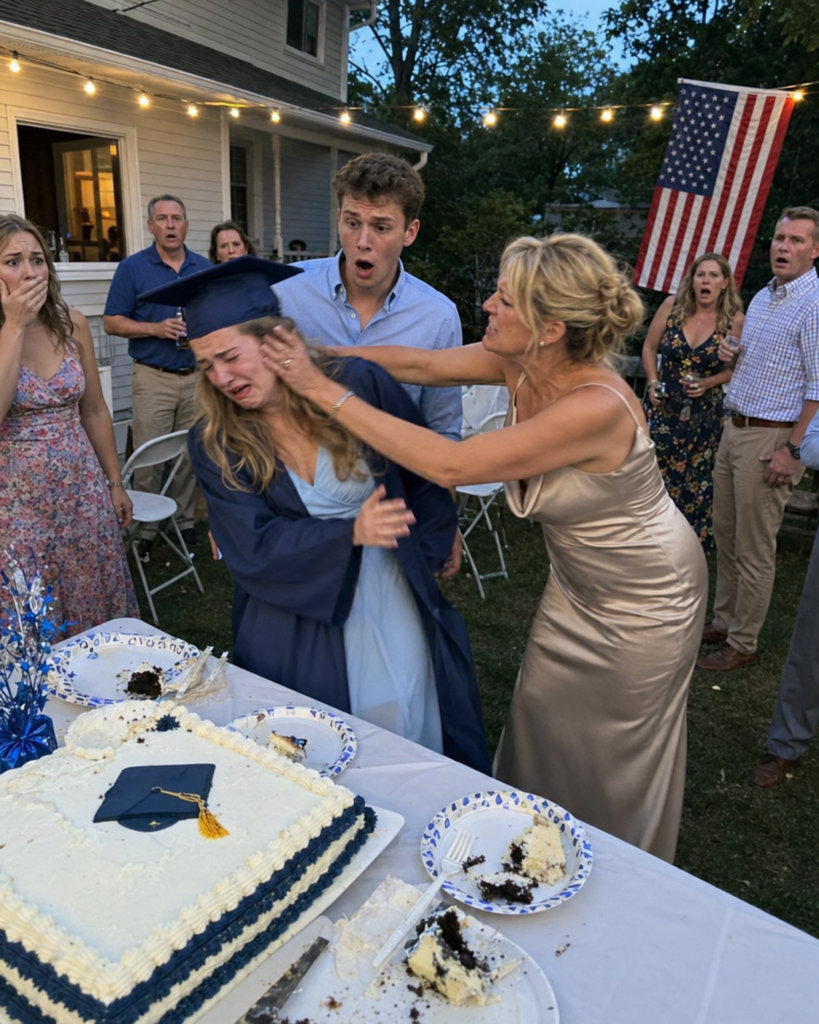
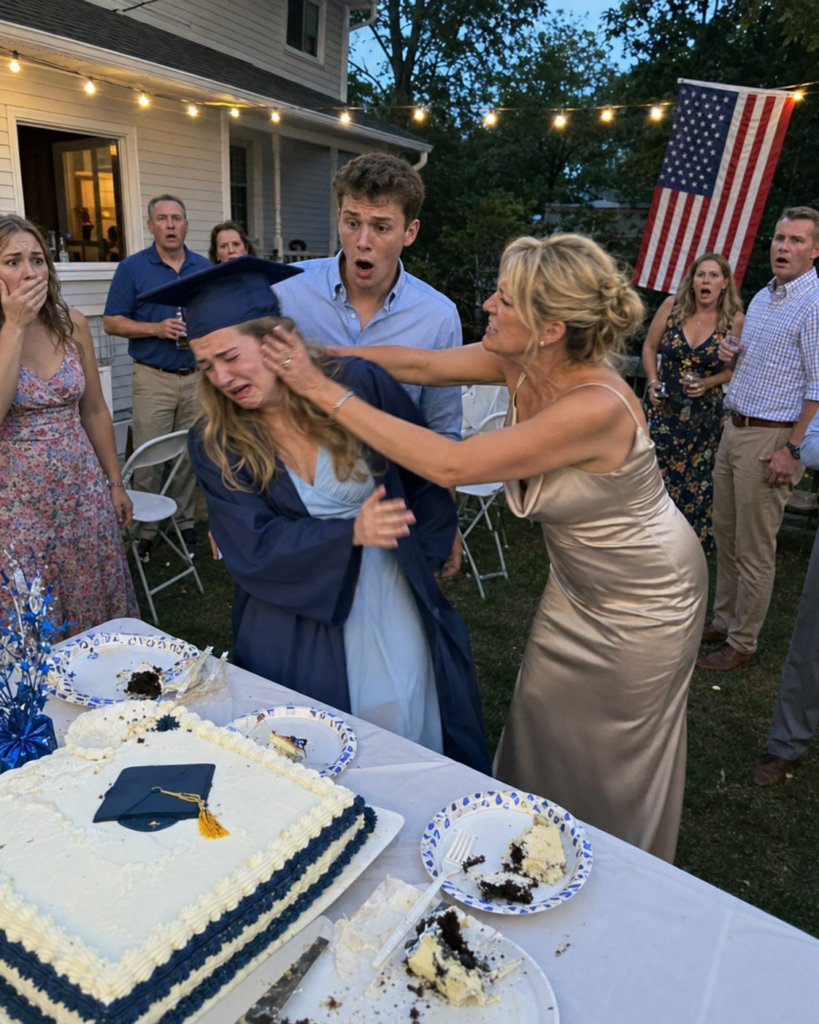
My stepmother struck me at my college graduation party the moment I announced my engagement.
Three days later, I woke up in a hospital room and learned that what she had done in front of everyone was only the beginning of what my family tried to hide.
My name is Natalie, and that Saturday was supposed to be the first celebration in my father’s house that belonged to me.
Not borrowed.
Not tolerated.
Mine.
The backyard smelled like cut grass and buttercream frosting.
The white lights were already glowing in the maple trees, even though the sky had not gone dark yet.
My father had set up folding chairs around the patio, and somebody had dragged the old cooler out near the fence.
There was a small American flag on the back porch rail, the kind my mother used to put out every summer because she said a home should look lived in.
I noticed it right away.
I notice things like that.
When you grow up in a house where somebody keeps removing proof that you belonged there, you learn to count what remains.
I had graduated from Georgetown that morning with honors.
Four years of political science lectures, night shifts at a hotel front desk, and bus rides back to my apartment with my shoes cutting into my heels had finally turned into a diploma.
I had a job offer from a nonprofit in Washington, D.C.
It was not glamorous money.
It was enough to make rent, pay my own phone bill, and stop feeling like every grocery receipt had to be explained to someone.
That felt like freedom.
Diane hated freedom when it belonged to me.
She married my father when I was thirteen, two years after my mother died.
At first, people thought she was gentle.
She made casseroles.
She wrote thank-you notes.
She remembered birthdays with cards that looked expensive and said nothing.
But inside our house, she erased me in small, careful ways.
My mother’s photos moved from the hallway to the guest room, then from the guest room to a plastic storage bin in the basement.
My mother’s Christmas ornaments stopped appearing on the tree.
When I asked where they were, Diane smiled and said we were making new traditions.
When I came home with an A on an exam, she called it cute.
When I cried after finding my mother’s blue scarf packed behind old paint cans, she told my father I was too sensitive.
My father never yelled at me for being upset.
He simply did not defend me.
That was worse.
There are houses where cruelty does not shout because it does not have to.
It just waits for everyone else to look away.
By the time I was seventeen, I had learned to be small.
By twenty-one, I had learned to be useful.
By graduation day, I had decided I was done earning permission to exist.
Ethan knew all of this.
He had met me my sophomore year when I was working the hotel desk and he came in with a group of engineering students for a conference.
He asked where he could find decent coffee after midnight.
I pointed to the lobby machine and warned him that decent was a generous word.
He laughed like I had handed him a gift.
After that, he kept showing up.
Not in a pushy way.
In a steady way.
He brought me paper coffee cups during finals.
He waited outside the library when I studied too late.
He sat beside me in the financial aid office while I corrected a form Diane had “accidentally” filled out with the wrong household information.
He learned my silences.
That mattered more than flowers.
When Ethan proposed, it was quiet.
No restaurant.
No crowd.
Just my apartment kitchen, two chipped mugs, and a rainstorm tapping against the window while he held out a simple oval diamond and said, “I want to build a life where nobody makes you ask to be loved.”
I said yes before he finished.
We decided to wait until after graduation to announce it.
I wanted one day where my diploma and my future could stand in the same room.
I should have known Diane would treat that as theft.
At 6:42 p.m., my father raised his glass near the dessert table.
The yard settled.
Paper plates stopped moving.
A cousin turned down the music from the portable speaker.
My father looked nervous, but he smiled.
“To my daughter, Natalie,” he said.
For a second, I saw the man he used to be when my mother was alive.
I saw him kneeling in the driveway to fix the chain on my bike.
I saw him burning pancakes on a Sunday morning while my mother laughed into her coffee.
I saw the version of him that had not yet learned to survive his second marriage by disappearing inside it.
My throat tightened.
Then Ethan stepped forward.
“And to one more beginning,” he said.
I lifted my left hand.
The ring caught the porch light.
“We’re engaged,” I said.
Joy broke open around me.
My best friend screamed so loudly somebody laughed.
My aunt pressed both hands over her mouth.
Ethan’s parents hugged each other near the cooler.
One of my professors clapped with his paper cup tucked under his arm, and for one perfect breath, I forgot to be careful.
Then I looked at my father.
His smile was gone.
He was not looking at the ring.
He was looking past me.
I turned.
Diane was walking through the crowd.
She wore a champagne silk dress and the same bright smile she used when she wanted strangers to think she was kind.
But her eyes were flat.
The yard changed before she said a word.
People felt it.
Forks paused above cake.
A paper napkin slipped off a knee and landed in the grass.
The grill hissed behind us.
Even the music seemed too cheerful for the air.
“How dare you,” Diane said.
It was not loud.
That was what made it worse.
I blinked at her.
“Diane—”
Her hand struck my face.
The sound was sharp and clean.
My head snapped to the side, and heat rushed through my cheek and ear.
The diamond flashed in the corner of my vision as my hand came up too late.
Somebody gasped.
Somebody said, “Oh my God.”
A plastic fork hit the patio and bounced.
“How dare you announce an engagement without permission!” Diane screamed.
Permission.
Not blessing.
Not concern.
Permission.
Some families call control love because it sounds prettier that way.
Control is still control when it comes dressed for a party.
Ethan grabbed my arm.
I heard him say my name.
I tasted blood where my teeth had caught my lip.
For one awful second, I wanted to hit her back.
I wanted every basement box, every missing photograph, every holiday where my mother’s name had been treated like a stain to return through my hand.
But I did not raise it.
I remember my father’s voice.
“Natalie!”
I remember Diane saying, “She’s being dramatic.”
Then the string lights stretched into white lines.
The grass tilted.
Ethan’s hand tightened.
Everything went black.
I was unconscious for three days.
I know that because the hospital intake bracelet on my wrist said Saturday, and the wall clock read Tuesday morning when I finally understood where I was.
The first sound was the monitor.
A small, stubborn beep.
The second was Ethan breathing in a chair beside me.
The room smelled like antiseptic, plastic, and old coffee.
A clear bag with my earrings sat on the counter.
A folded hospital intake form lay beside it.
My mouth felt like cotton.
My head throbbed so badly that opening my eyes felt like pushing through water.
“Ethan,” I whispered.
He woke so fast his knee hit the chair arm.
“Natalie.”
He took my hand in both of his.
His shirt was wrinkled beyond saving.
His jaw was rough with three days of stubble.
I had never been more grateful to see anyone in my life.
“What happened?” I asked.
His face changed.
He tried to make it gentle and failed.
“You had a concussion,” he said.
“From the slap?”
“From the fall after the slap.”
I tried to sit up.
Pain shot behind my eyes.
He put a hand near my shoulder but did not push me down.
He had always known the difference between helping and controlling.
“Where’s Dad?” I asked.
Ethan looked at the door.
That was when I saw two police officers outside my room.
For a moment, my mind refused to put the pieces together.
Police meant accident.
Police meant report.
Police meant something had gone wrong enough that nobody could smooth it over with cake and a clean tablecloth.
Behind the officers stood Diane.
Her wrists were cuffed in front of her.
My father stood behind her, also cuffed.
So did two relatives who had been near the patio when I fell.
My aunt Carol was crying into a tissue.
Diane looked furious.
Not ashamed.
Furious.
As though my concussion had inconvenienced her.
I stared at the handcuffs until Ethan said my name softly.
The older officer stepped into the room and introduced himself without making it sound like a television show.
He said there had been witness statements.
He said there was video.
He said the hospital had documented the injury and the responding officer had opened a police report at 9:18 p.m. Saturday night.
I looked at Ethan.
“You filed it?”
“Yes,” he said.
His voice did not shake.
“I filed it because she hit you, because you collapsed, and because while the ambulance was pulling away, three people tried to tell the officer you had been drinking and fell on your own.”
My father closed his eyes.
That was the moment I understood the mistake.
It was not only that Diane had hit me.
It was that my family had tried to turn my injury into my fault before I even woke up.
Diane stepped forward as far as the officer allowed.
“Natalie, tell them this is a misunderstanding,” she said.
Her voice had changed.
It had softened into the tone she used in public.
The good-stepmother tone.
The tone that had fooled teachers, neighbors, and sometimes my own father.
Ethan moved slightly between us.
“No,” he said.
Diane looked at him like he was a stain on the floor.
“This is family business.”
“No,” he said again. “It stopped being that when she was loaded into an ambulance.”
My father finally spoke.
“Nat, please.”
I turned to him.
He looked smaller than I had ever seen him.
Not older.
Smaller.
His shoulders were rounded.
His eyes were red.
His mouth moved like he was searching for the version of fatherhood that might still save him.
“Did you tell them I fell?” I asked.
He did not answer.
That was an answer.
The officer placed a manila folder on the foot of my bed.
“There are statements in here,” he said. “You do not have to read them now.”
But I did.
My hands shook so hard Ethan had to steady the folder without taking it away from me.
The first statement was from a neighbor.
She had written that Diane struck me with an open hand immediately after the engagement announcement.
The second was from Ethan’s mother.
She had written that my father shouted my name after I fell but did not approach me until Ethan had already called 911.
The third was from my aunt Carol.
Her handwriting was messy.
She said Diane told everyone to calm down and insisted I was overreacting.
Then I saw my father’s statement.
He had told the responding officer that I became emotional, stumbled backward, and may have hit my head because I had not eaten much that day.
He had signed it.
Under penalty of law.
My own father had signed away the truth while I was unconscious.
Something inside me went very still.
Not quiet.
Still.

There is a kind of heartbreak that does not cry at first because tears would make it too human.
It simply records.
Line.
Signature.
Date.
Ethan touched the edge of the bed.
“Natalie.”
I looked at my father.
“Did she ask you to say that?”
Diane snapped, “He was trying to protect this family.”
The officer’s eyes moved to her.
My father whispered, “I thought if I explained it the right way, we could keep it from becoming…”
He stopped.
“Becoming what?” I asked.
He swallowed.
“Permanent.”
I laughed once.
It hurt my head.
“Dad, I’m in a hospital bed.”
Aunt Carol covered her face.
The sound she made was not dramatic.
It was the sound of someone realizing too late that silence had become participation.
The officer told Diane and the others they would be taken for processing.
He did not make a speech.
Real consequences rarely arrive like speeches.
They arrive in paperwork, cuffs, timestamps, and people saying your full name in a voice that does not care how respectable you look.
Diane stared at me.
“You are going to ruin your father’s life over a slap?”
I thought of my mother’s photos in the basement.
I thought of every cute report card.
I thought of the word permission thrown at my engagement like a chain.
“No,” I said. “You are going to face what you did.”
For the first time since I was thirteen, nobody in that room corrected my tone.
They took Diane out first.
Her heels clicked against the hospital floor.
My father looked back once.
I do not know what he expected from me.
Comfort, maybe.
A daughter’s reflex.
The old habit of making his life easier because he had already chosen the person making mine harder.
I did not give it to him.
I watched him leave.
Ethan stayed.
After the door closed, I cried so hard the monitor changed its rhythm and a nurse came in.
Ethan did not tell me to breathe.
He did not say it would be okay.
He just held my hand and let the room be honest.
The weeks after that were not clean.
Diane’s attorney tried to frame the slap as a family misunderstanding.
My father’s first message to me said, “Please don’t let one bad moment destroy us.”
I read it three times before I understood what bothered me.
One bad moment.
As if a woman erases your mother for nine years, slaps you at your graduation party, watches you collapse, and then helps build a false story while you are unconscious by accident.
I did not respond that day.
I saved the message.
Ethan drove me to follow-up appointments.
The hospital gave me discharge instructions printed in plain black ink.
No driving until cleared.
No bright screens for too long.
Return immediately for worsening symptoms.
Nobody prints instructions for what to do when your father signs a lie about you.
I made my own.
I asked for copies of every document I was allowed to request.
I wrote down what I remembered from the party.
I kept screenshots of every message.
I asked my aunt Carol to send me her full statement without Diane standing beside her.
She did.
It was longer the second time.
She admitted that Diane told two cousins to say I had fainted because I was overwhelmed.
She admitted my father did not correct them.
She admitted Ethan’s father had blocked one cousin from taking my ring off my hand while I was on the ground because Diane said, “Don’t let the ambulance lose it.”
That sentence stayed with me for days.
Not because of the ring.
Because even when I was unconscious, Diane was managing the appearance of my life.
The charges moved slowly.
Everything official does.
There were calls, forms, appointments, and the kind of waiting rooms where vending machines hum louder than anyone speaks.
Diane eventually accepted a plea arrangement for the assault charge.
The relatives who lied were not all charged the same way, but the false statements followed them.
My father was not taken to prison.
Life is not always that neat.
But he was named in the report.
He had to explain his statement.
He had to sit across from me in a mediation room months later with a county victim advocate present and say, out loud, that he had failed to protect me.
He cried when he said it.
I believed the tears.
I did not mistake them for repair.
There is a difference between regret and change.
Regret hurts the person who caused harm.
Change protects the person who was harmed.
My father asked if he could walk me down the aisle someday.
I told him I did not know if he would be invited.
That was the first boundary I ever spoke without apologizing afterward.
Ethan and I did not rush the wedding.
For a while, the ring stayed in a small ceramic dish beside my bed because wearing it made strangers smile at me, and I did not have the strength to explain why joy felt complicated.
One morning, about two months after the party, Ethan found me in the kitchen staring at it.
The apartment window was open.
Somebody outside was dragging a trash bin over the pavement.
A school bus hissed at the corner.
Ordinary sounds.
Living sounds.
He did not ask if I was okay.
He said, “Do you want me to make coffee?”
I laughed.
Then I cried.
Then I put the ring back on.
We eventually married in a courthouse ceremony with twelve people present.
No backyard lights.
No champagne silk dress.
No speeches that made me brace.
My aunt Carol came.
So did Ethan’s parents, my best friend, and the professor whose paper cup had buckled when he clapped.
My father was not there.
He sent a card.
Inside, he wrote, “I hope someday I become someone safe enough for you to know again.”
I kept the card.
I did not answer it.
Not then.
Maybe someday.
Maybe not.
Healing did not make me generous on command.
It made me honest.
A year after the graduation party, Ethan and I moved into a small townhouse with a porch just wide enough for two chairs.
On Memorial Day weekend, I bought a little American flag from the hardware store and placed it by the railing.
Not because I was trying to recreate my father’s house.
Because I wanted proof that a home could hold memory without letting it become a weapon.
I brought my mother’s photographs out of storage.
The real storage.
The boxes I had taken from my father’s basement before Diane could decide they were clutter.
I hung one in the hallway.
My mother in a blue sweater, laughing at something outside the frame.
The first time I walked past it without flinching, I knew something had shifted.
Not everything was fixed.
That is not how these stories work in real life.
Diane did not become kind.
My father did not become brave overnight.
The family did not gather around me with perfect apologies.
But the lie did not win.
That mattered.
The party had been supposed to belong to me.
Diane tried to turn it into proof that I still needed permission.
Instead, it became the night everyone finally saw the hand that had been erasing me for years.
An entire backyard watched her hit me.
A hospital report wrote down what my family tried to soften.
A police report carried the truth farther than my father’s silence ever had.
And I learned something I wish every overlooked daughter could learn without first waking up under fluorescent lights.
You do not need the people who harmed you to agree that it was harm.
You do not need their permission to name it.
You only need one clear moment where you stop helping them hide the wound.
Mine came three days after my graduation party, with a monitor beeping beside me, Ethan’s hand around mine, and my stepmother in cuffs outside the door.
For once, the whole room had to look at what she had done.
For once, nobody got to call me dramatic and move on.