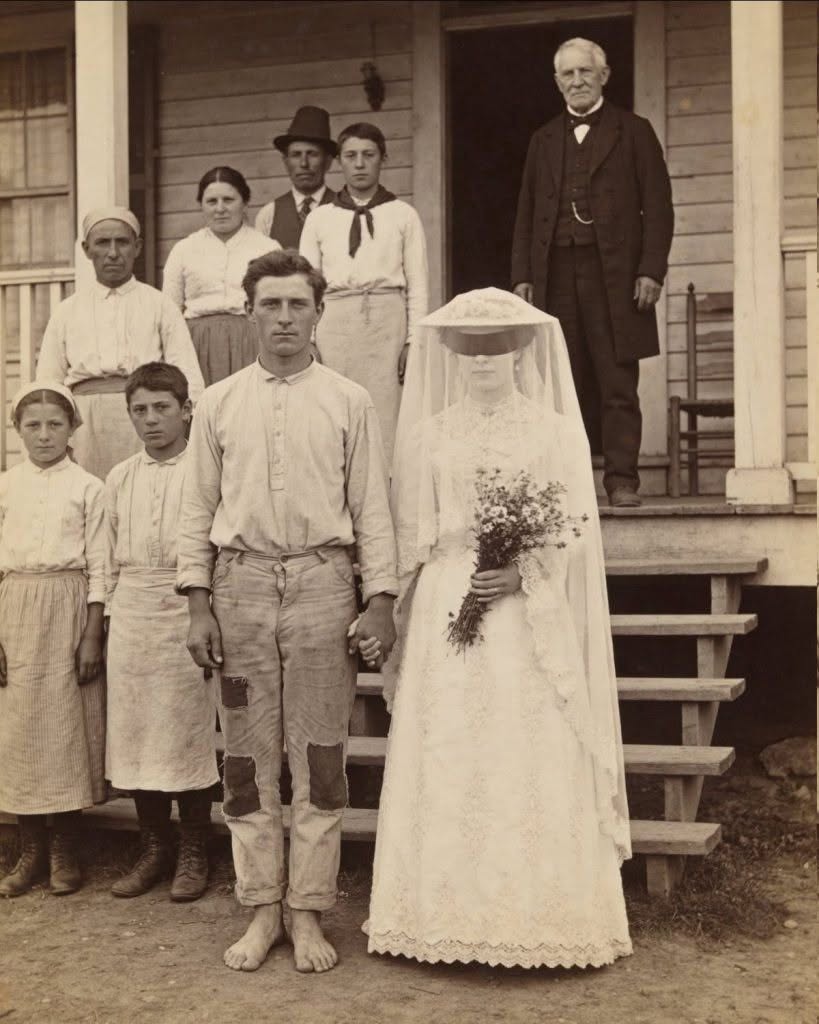
Yusha held Zainab’s hands carefully, as though he feared the truth might slip away if he let go.
“I was never born into poverty,” he said quietly. “And I never became your husband by chance.”
Zainab listened without interrupting. His voice carried a weight she had never heard before.
“My father owned farmland and a successful trading business in the next province. We lived comfortably, and people respected our family. After my parents passed away, I inherited everything. I was young, proud, and convinced that money could solve every problem.”
He paused before continuing.
“Then I lost almost all of it.”
It hadn’t happened overnight. A series of failed investments, dishonest business partners, and poor decisions slowly destroyed the fortune his parents had spent decades building. Friends disappeared one after another. The people who once praised him suddenly avoided him.
“I wanted to understand how people treated those who had nothing,” he said. “So I left the last of my property under the care of an old family lawyer and traveled with almost no possessions.”
He smiled faintly.
“I discovered that kindness often came from those who owned the least.”
For nearly two years, Yusha lived simply, helping travelers, assisting elderly villagers, and accepting small donations only when people insisted. Some assumed he was a beggar because of his worn clothes, and he never corrected them.
“It taught me more about people than wealth ever did.”
Zainab remained silent.
“So…” she whispered. “When my father arranged our marriage…”
“I heard everything.”
Yusha remembered that painful afternoon outside the mosque. Zainab’s father had approached the village elder with obvious frustration.
“No respectable family would accept my daughter,” the man had complained. “That poor fellow sitting by the entrance will do.”
Several people nearby had laughed.
Yusha had looked toward the young woman standing quietly behind her father. Although she could not see the crowd, she stood with remarkable dignity.
Something about her silence stayed with him.
“I agreed,” he admitted. “Not because I felt sorry for you. I agreed because I saw someone who deserved to be treated with respect.”
Tears rolled gently down Zainab’s cheeks.
“You chose this?”
“Yes.”
“You could have refused.”
“I could have.”
“Then… why didn’t you?”
His answer came without hesitation.
“Because everyone else saw your blindness. I wanted to know the person inside.”
The room fell quiet except for the crackling fire.
For the first time in her life, Zainab felt that someone had chosen her freely.
Not out of obligation.
Not out of pity.
But out of genuine respect.
Several weeks later, Yusha suggested they travel.
“There is someone I want you to meet.”
They made the journey to a nearby town where an elderly lawyer welcomed Yusha warmly.
“I’ve been waiting for you,” the old man said with relief.
He placed several documents on the wooden table.
“They’ve all been protected exactly as you requested.”
Yusha explained everything to Zainab.
The remaining family property had never disappeared. The lawyer had managed it responsibly while Yusha traveled. The business was smaller than before but stable again.
“You own all of this?” Zainab asked in disbelief.
“We own it now,” he corrected gently.
She shook her head.
“I’ve never owned anything.”
“You do now.”
For the first time, someone asked her to sign papers that included her name beside his.
The lawyer carefully guided her fingers to the correct place.
When the ink dried, Zainab smiled.
Not because of the property.
But because, for the first time, she felt included instead of excluded.
Their lives changed gradually.
Instead of building a large mansion, they repaired the modest cottage where they had begun their married life.
They expanded the roof.
Added a proper kitchen.
Planted fruit trees around the yard.
People found it strange.
“If you’re comfortable now,” one neighbor asked, “why stay here?”
Yusha answered with a smile.
“This house reminds us where kindness began.”
Soon they started using their resources to help others.
Children who couldn’t afford school supplies received books.
Older villagers living alone received regular meals.
Families facing difficult seasons found anonymous bags of food waiting outside their doors before sunrise.
Nobody was asked to repay anything.
Word quietly spread throughout neighboring villages.
People no longer spoke about “the blind woman who married a beggar.”
Instead, they spoke about the generous couple who never turned anyone away.
Months later, unexpected visitors arrived.
Zainab recognized her father’s footsteps before anyone announced him.
He had come with Aminah.
Neither spoke immediately.
The proud man who had once refused to call her by name looked much older now.
His business had failed after several poor harvests.
Debts had accumulated.
The large family house had been sold.
He cleared his throat.
“I heard you’ve… done well.”
Zainab remained calm.
“We’ve been fortunate.”
He looked around the simple but welcoming home.
There were no signs of luxury.
Only warmth.
Children laughed outside while volunteers packed baskets for struggling families.
Everything felt peaceful.
Something he had never managed to create in his own household.
Finally, he lowered his eyes.
“I came to ask for help.”
The words seemed painfully difficult for him to say.
Aminah stood silently beside him.
The confidence she once displayed at the market had disappeared.
Yusha looked toward Zainab.
The decision belonged entirely to her.
Years of painful memories returned in an instant.
The lonely meals.
The cruel words.
The wedding arranged simply to remove her from the house.
Every wound remained somewhere inside her.
She could have refused.
No one would have blamed her.
Instead, she slowly stood.
She walked toward her father and gently placed a basket of food into his hands.
Then she added enough money to cover several months of living expenses.
Her father stared at her in complete surprise.
“Why?” he asked.
“You owe me nothing after everything I did.”
Zainab answered softly.
“I am not helping because of the past.”
She smiled gently.
“I am helping because I don’t want anyone else to carry bitterness the way I once did.”
No lecture.
No revenge.
Only quiet compassion.
Her father couldn’t find the words to respond.
Before leaving, he hesitated.
Then, for the first time in many years, he spoke her name.
“Thank you… Zainab.”
It was only two words.
But to her, they carried the apology he struggled to express.
Life continued peacefully.
One spring morning, Yusha surprised Zainab with another journey.
They visited a medical center in the city where specialists examined her carefully.
No one promised a miracle.
But modern treatment offered possibilities that had never existed when she was a child.
Several procedures followed over the next year.
Recovery required patience.
Some days felt discouraging.
Others brought small improvements.
Finally, after months of healing, the doctor removed the protective bandages.
A soft light reached Zainab’s eyes.
At first, everything appeared blurry.
Shapes slowly formed.
Colors emerged one by one.
The first face she ever truly saw was Yusha’s.
She reached forward carefully.
“So this is you,” she whispered.
He laughed through happy tears.
“I was beginning to wonder if I’d match the picture I’d painted with words.”
She smiled.
“You do.”
Perhaps not because he was the most handsome man in the room.
But because every act of kindness she had experienced was reflected in the expression she now saw.
In the years that followed, the couple established a learning center where children with disabilities studied alongside every other child.
No one was separated.
No one was hidden.
Parents who once felt hopeless found encouragement.
Young people grew up believing that ability mattered more than limitation.
Whenever visitors asked why they had devoted themselves to this work, Zainab always gave the same answer.
“There was a time when people believed my life had little value because I couldn’t see.”
She would pause before smiling.
“They were wrong.”
“The greatest things I have ever received were never visible to the eye.”
“Respect.”
“Trust.”
“Hope.”
“And love.”
Those gifts had transformed her life long before her eyesight began to return.
And that was the lesson she hoped every child who entered their doors would remember:
A person’s worth is never measured by appearance, wealth, or circumstance—but by the kindness they give, the courage they show, and the compassion they choose even when life has not been easy