A Visual Puzzle That Has Captivated Millions
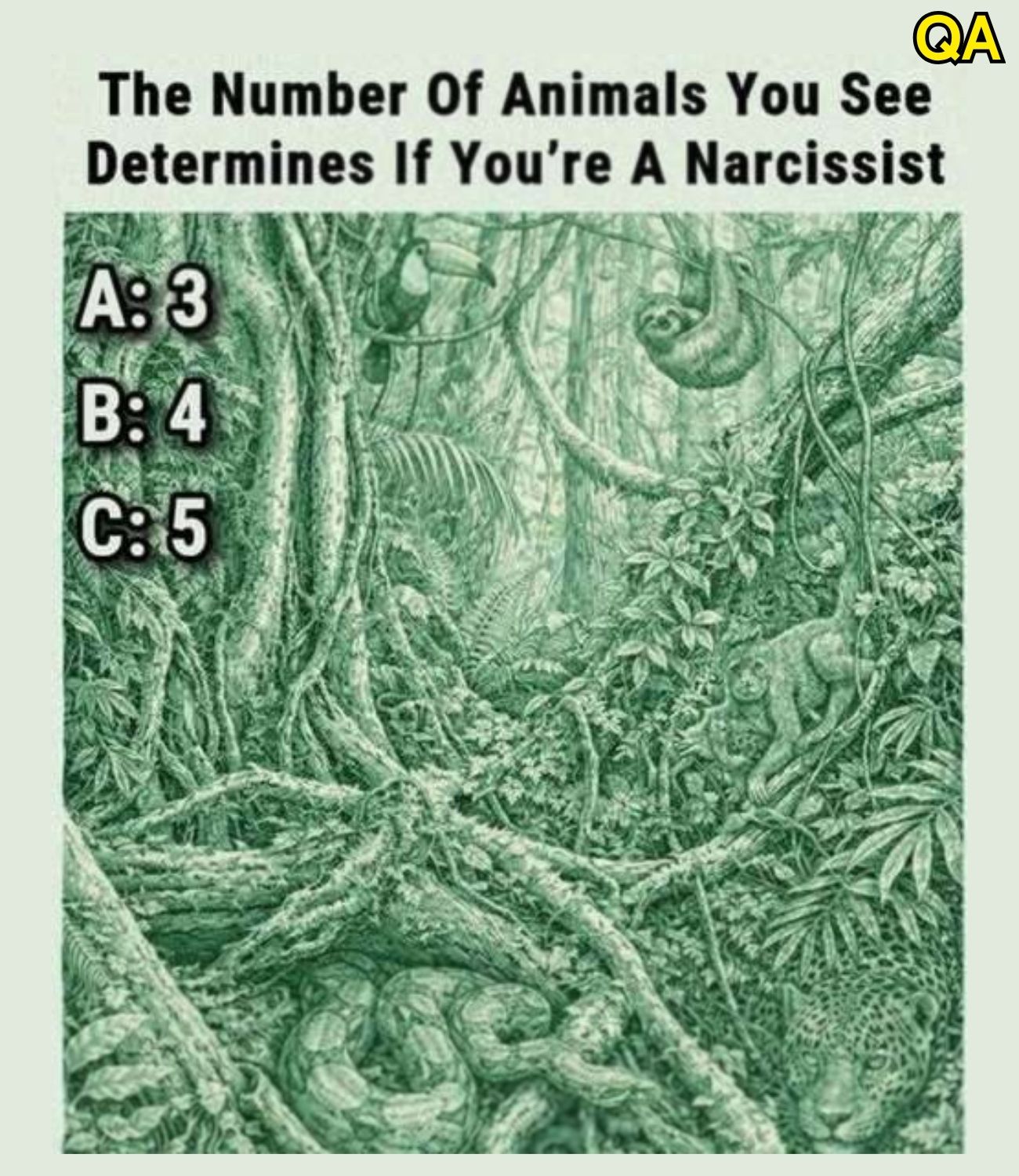
At first glance, the image looks like an ordinary jungle scene. Dense foliage fills the frame, vines weave through towering trees, and layers of leaves create a vibrant forest landscape. But hidden within this lush environment are several cleverly camouflaged animals waiting to be discovered.
What makes the puzzle especially popular is a bold claim that often accompanies it:
“The number of animals you see determines whether you’re a narcissist.”
It’s an attention-grabbing headline that encourages viewers to look more closely and compare their results with friends. But is there any scientific evidence behind the claim?
The short answer is no.
While this optical illusion is entertaining and encourages careful observation, psychologists agree that it cannot diagnose personality traits or determine whether someone has narcissistic tendencies. Instead, it offers a fascinating glimpse into how our brains process complex visual information.
Why This Jungle Illusion Is So Popular
Optical illusions have fascinated people for centuries because they challenge our expectations.
Rather than presenting obvious answers, they encourage viewers to slow down, examine details, and question what they initially see. Social media has made these puzzles even more popular because they’re easy to share and invite friendly discussion.
The jungle illustration is particularly engaging because multiple animals blend naturally into the surrounding vegetation. Depending on where your eyes land first, you may immediately notice some creatures while overlooking others.
Many people enjoy comparing results with family members or coworkers, discovering that everyone seems to notice different details.
Which Animals Can You Find?
Although different versions of the image exist online, many include animals such as:
- A toucan resting on a branch
- A sloth hanging from a tree limb
- A monkey partially hidden among the leaves
- A snake blending into the forest floor
- A large spotted cat, such as a jaguar or leopard, concealed near the ground
Some viewers identify only three animals at first glance.
Others continue scanning and gradually uncover four, five, or even more hidden figures depending on the specific illustration.
This variation is completely normal.

Does the Number of Animals Reveal Your Personality?
The viral headline suggests that spotting fewer or more animals reveals whether someone is narcissistic.
However, there is no scientific evidence supporting this claim.
Personality is far too complex to be measured through a single visual puzzle.
Clinical psychologists evaluate personality using carefully developed assessment tools, interviews, behavioral observations, and standardized questionnaires. An image hidden within a jungle scene cannot provide reliable information about someone’s personality.
Experts consider headlines like these examples of entertainment rather than psychological testing.
Understanding Narcissism
The word narcissism appears frequently in online discussions, but it is often misunderstood.
In psychology, narcissism refers to a range of personality characteristics rather than a simple yes-or-no category.
Many people display healthy confidence, ambition, or self-esteem without these traits becoming problematic.
At the other end of the spectrum, some individuals may experience more persistent patterns involving an unusually strong need for admiration, an inflated sense of importance, or difficulty recognizing other people’s perspectives.
Only qualified mental health professionals can determine whether someone’s overall behavior meets the diagnostic criteria for Narcissistic Personality Disorder (NPD) through comprehensive clinical evaluation.
A visual puzzle cannot make that determination.
Why People Notice Different Animals
If personality isn’t the explanation, why do people see different numbers of animals?
The answer lies in how human perception works.
Our brains constantly organize enormous amounts of visual information. Instead of analyzing every detail equally, the brain looks for patterns, familiar shapes, and meaningful objects.
Several factors influence what people notice first:
Attention
Some people naturally scan an entire image before focusing on individual details, while others immediately examine one small section at a time.
Experience
Previous exposure to wildlife, artwork, or visual puzzles may help viewers recognize camouflaged shapes more quickly.
Pattern Recognition
The human brain excels at identifying familiar outlines even when they’re partially hidden. However, individuals vary in how quickly they recognize those patterns.
Patience
Many hidden-image puzzles reward careful observation. Spending an extra minute studying the illustration often reveals animals that were invisible at first glance.
These differences reflect normal variations in visual processing rather than personality characteristics.
The Science Behind Optical Illusions
Optical illusions reveal just how remarkable human vision really is.
Rather than functioning like a camera, the brain actively interprets incoming information.
It fills gaps.
Makes predictions.
Filters distractions.
Searches for familiar forms.
In busy scenes like dense forests, these mental shortcuts help us understand complicated environments quickly. Occasionally, however, those same shortcuts cause us to overlook objects hiding in plain sight.
Researchers studying perception use similar visual tasks to understand attention, eye movement, and pattern recognition—not to diagnose personality disorders.
Why Viral Psychology Claims Spread So Easily
Statements such as “What you see first reveals your personality” spread rapidly online because they combine two powerful ingredients:
Curiosity and self-discovery.
People naturally enjoy learning about themselves.
Even when they know a claim may not be scientifically supported, many still participate because the activity is fun and sparks conversation.
Social media algorithms also tend to reward interactive content that encourages comments and sharing.
As a result, playful visual puzzles often become viral even when their psychological interpretations lack scientific support.
A Better Way to Enjoy Hidden Image Challenges
Rather than viewing these puzzles as personality assessments, they can be appreciated for what they truly are:
Exercises in observation.
They encourage viewers to slow down, focus carefully, and appreciate the complexity of visual design.
They’re also enjoyable activities to share with friends and family, since everyone tends to discover different details at different times.
The real challenge isn’t discovering what the image supposedly says about your personality.
It’s seeing just how many cleverly hidden animals you can uncover.
Final Thoughts
The jungle illusion demonstrates how fascinating human perception can be. While viral captions may claim that the number of animals you find reveals whether you’re a narcissist, psychology offers a different explanation.
What you notice depends on attention, experience, visual processing, and the amount of time you spend exploring the image—not on your personality.
Ultimately, puzzles like this remind us that our brains are constantly interpreting the world around us. Two people can look at the same picture and notice entirely different details, making these optical illusions enjoyable conversation starters rather than psychological evaluations.
Curiosity has always driven people to explore hidden patterns, solve mysteries, and better understand how the mind works. Perhaps that’s the true appeal of these viral images: they invite us to look a little closer and appreciate just how remarkable human perception really is.
Sources
- American Psychological Association (APA) – https://www.apa.org
- National Institute of Mental Health (NIMH) – https://www.nimh.nih.gov
- Encyclopaedia Britannica – Optical Illusion – https://www.britannica.com
- Simply Psychology – Perception and Visual Processing – https://www.simplypsychology.org
- American Psychiatric Association – Diagnostic and Statistical Manual of Mental Disorders (DSM-5-TR) (overview of personality disorders).