
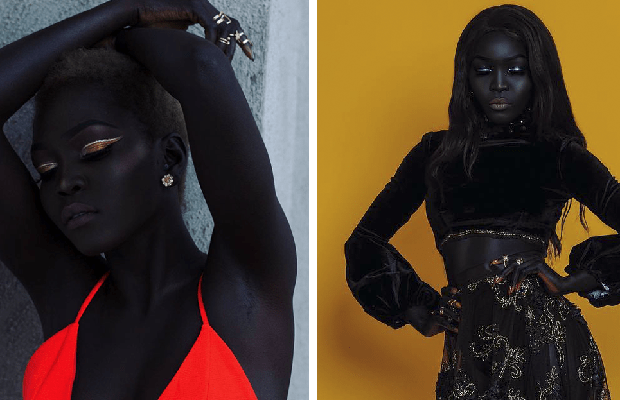
A young girl flips through fashion magazines, scrolling through social media feeds filled with polished faces and carefully curated images. For years, she rarely sees someone who truly resembles her. Then, one day, a photograph appears. A Sudanese model stands confidently before the camera, her rich, deep complexion illuminated with elegance rather than hidden. The image spreads across the internet, inspiring conversations about confidence, identity, and the ever-changing definition of beauty.
Many people have come to know her by the affectionate nickname “Queen of Dark.” While the phrase has gained attention online, its deeper meaning extends far beyond appearance. For many admirers, it symbolizes confidence, representation, and the growing appreciation for beauty in all its natural diversity.
Her story is not simply about modeling success. It reflects a broader cultural movement that encourages people to celebrate authenticity instead of chasing narrow ideals. At the same time, experts in psychology, anthropology, and fashion history remind us that beauty standards have always evolved alongside society, making today’s conversations part of a much larger human story.
The Rise of a Global Beauty Icon
The fashion industry has undergone remarkable changes over the past few decades. While earlier eras often promoted limited ideals of attractiveness, modern audiences increasingly celebrate individuality, cultural heritage, and diversity.
The Sudanese model known online as the “Queen of Dark” quickly attracted worldwide attention through striking photography that highlighted her natural features. Her confident presence, elegant styling, and unmistakable authenticity resonated with millions of viewers across different cultures.
Rather than relying solely on trends, her growing popularity appears connected to something more meaningful. Many people view her success as evidence that the fashion world is gradually embracing a wider range of skin tones, facial features, and cultural backgrounds.
This shift reflects a growing appreciation for beauty that exists across every community rather than within a single standard.
Understanding the Meaning Behind “Queen of Dark”
Although the nickname may sound dramatic at first, many supporters interpret it as a celebration rather than a literal title.
Historically, darker skin tones have not always received equal representation in international media. As conversations about inclusion expanded, many communities began reclaiming language that once carried negative associations, transforming it into expressions of pride and admiration.
In this context, “Queen of Dark” has become a symbolic phrase representing confidence, dignity, and self-acceptance.
It is important to recognize that nicknames like this emerge organically through online communities. Their meanings may differ among individuals, and interpretations often depend on cultural perspectives rather than official definitions.
Beauty Standards Have Always Changed
One fascinating aspect of beauty is that it has never remained constant throughout history.
Ancient civilizations admired different physical traits depending on geography, climate, and cultural values. What one society considered beautiful often differed greatly from another.
Throughout history, ideals have included:
Ancient Civilizations
Historical records suggest that many African kingdoms celebrated rich skin tones as symbols of heritage and identity. In other regions, entirely different characteristics became fashionable.
Beauty was often connected to cultural traditions rather than universal rules.
European Fashion History
During several historical periods in Europe, pale complexions became associated with social status because they suggested less outdoor labor. However, these preferences changed repeatedly over the centuries.
Modern Global Culture
Today’s interconnected world exposes people to countless cultures through films, social media, travel, and digital communication. As a result, beauty standards continue becoming broader and more inclusive.
Instead of replacing one ideal with another, many industries are gradually recognizing that beauty exists in countless forms.
The Science Behind Skin Color
While fashion focuses on appearance, science offers an objective explanation for human skin diversity.
Human skin color primarily depends on a pigment called melanin, produced by specialized cells known as melanocytes.
Melanin serves several important biological functions, including helping protect the skin from ultraviolet radiation.
Scientists explain that differences in skin tone developed gradually over thousands of years as human populations adapted to varying environmental conditions around the world.
This natural diversity represents one example of human adaptation rather than any measure of value, ability, or attractiveness.
Every skin tone contains unique biological characteristics that contribute to the remarkable diversity of humanity.

Why Representation Matters
Psychologists have long studied how media influences self-perception.
When people regularly see individuals who resemble themselves succeeding in various fields, they often develop stronger confidence and a greater sense of belonging.
Representation can influence:
Self Confidence
Seeing diverse role models encourages individuals to appreciate their own unique characteristics rather than comparing themselves to unrealistic ideals.
Cultural Pride
Public recognition of different backgrounds helps celebrate traditions, languages, and identities that enrich global culture.
Future Opportunities
Greater visibility often inspires industries to broaden opportunities for models, designers, photographers, and artists from many communities.
The success of influential figures can encourage future generations to pursue creative careers with greater confidence.
Social Media and the New Definition of Beauty
Social media has transformed how beauty trends spread around the world.
Instead of relying entirely on magazines or television, individuals now share their own stories through photographs, videos, and personal experiences.
This shift has several important effects.
First, audiences encounter a wider variety of appearances than ever before.
Second, creators from previously underrepresented communities can reach global audiences without traditional gatekeepers.
Third, conversations about inclusion happen almost instantly, allowing diverse perspectives to shape public opinion.
The Sudanese model’s popularity reflects these changing dynamics. Her photographs circulated rapidly because viewers connected not only with her appearance but also with the message of confidence they seemed to express.

Fashion’s Growing Appreciation for Diversity
Major fashion brands increasingly recognize that consumers appreciate authentic representation.
Runways, advertising campaigns, and editorial photography now feature models representing many ethnicities, cultures, ages, and backgrounds.
This evolution benefits both audiences and the creative industry.
Designers gain opportunities to present clothing on a wider variety of individuals.
Photographers explore new artistic possibilities.
Consumers see fashion becoming more reflective of the world around them.
Although progress continues gradually, many experts believe diversity has become an important creative strength rather than simply a marketing trend.
Cultural Perspectives on Beauty
Every culture tells stories about beauty.
Some celebrate elegance through clothing.
Others emphasize confidence, kindness, or personal achievements.
Many African cultures have long appreciated rich skin tones alongside traditional hairstyles, jewelry, textiles, and artistic expression.
These traditions remind us that beauty is rarely limited to physical appearance alone.
Instead, it often reflects identity, heritage, family history, and community values.
The growing popularity of internationally recognized African models has introduced many audiences to these longstanding cultural traditions.
Internet Fascination and Public Perception
Online communities often amplify remarkable stories.
Sometimes admiration grows naturally around individuals who represent meaningful social change.
At other times, headlines may use dramatic language designed to capture attention.
Readers should approach viral stories thoughtfully, recognizing that photographs, captions, and online discussions may emphasize certain aspects while simplifying others.
Balanced reporting encourages appreciation without exaggeration.
Rather than viewing any individual as representing a single ideal, it is healthier to recognize each person’s unique contribution to broader conversations about diversity and inclusion.
Confidence as the Real Source of Beauty
One recurring theme appears throughout discussions surrounding the “Queen of Dark.”
People frequently mention her confidence.
Confidence cannot be measured by skin tone, height, facial features, or fashion alone.
Psychologists often describe confidence as developing through self-acceptance, supportive relationships, personal growth, and life experiences.
Photographs may capture appearance, but genuine confidence often comes from within.
This may explain why so many viewers describe her images as inspiring rather than simply attractive.
Lessons for the Next Generation
Young people growing up today experience unprecedented access to global cultures.
They can learn that beauty is not confined to one country, one ethnicity, or one appearance.
Instead, diversity itself becomes something worth celebrating.
Parents, educators, and community leaders increasingly encourage children to appreciate:
- Individual uniqueness
- Cultural diversity
- Self-respect
- Healthy confidence
- Respect for others
These values extend far beyond fashion and contribute to stronger, more inclusive communities.
Balancing Inspiration With Reality
Stories like this inspire millions, but they should also be viewed realistically.
Success in modeling depends upon numerous factors, including dedication, professionalism, opportunity, creative collaboration, and timing.
Likewise, online admiration represents one aspect of public recognition rather than a complete measure of influence.
The nickname “Queen of Dark” should therefore be understood as an expression of appreciation shared by many admirers rather than an official designation.
Maintaining this balanced perspective helps celebrate achievements while avoiding unrealistic expectations.
The Future of Beauty
Fashion historians suggest that beauty standards will continue evolving as societies become increasingly connected.
Artificial intelligence, digital media, international collaboration, and global storytelling are introducing audiences to faces, cultures, and traditions that were once rarely seen internationally.
Future generations may grow up with a far broader understanding of beauty than previous generations experienced.
Instead of asking who fits a single ideal, people may increasingly appreciate how every culture contributes something valuable to humanity’s shared story.
That ongoing evolution makes today’s conversations especially meaningful.
Conclusion
The story of the Sudanese model affectionately known as the “Queen of Dark” is about much more than striking photographs. It reflects changing attitudes toward representation, confidence, and cultural appreciation in an increasingly connected world.
Science reminds us that human skin color is a natural result of adaptation and biological diversity. History shows that beauty standards have constantly evolved across civilizations. Culture demonstrates that every community carries its own unique understanding of elegance and identity.
When these perspectives come together, they reveal a powerful truth: beauty cannot be reduced to a single definition.
Perhaps that is why stories like hers resonate so widely. They invite us to look beyond appearances and recognize the richness of human diversity. In doing so, they satisfy one of humanity’s oldest qualities—our enduring curiosity about one another and our continuous search for meaning, identity, and connection.
Sources
- World Health Organization (WHO) – Information on skin health and ultraviolet radiation: https://www.who.int
- American Psychological Association (APA) – Research on self-esteem, identity, and media representation: https://www.apa.org
- UNESCO – Cultural diversity and inclusion resources: https://www.unesco.org
- National Geographic – Articles exploring human evolution, diversity, and culture: https://www.nationalgeographic.com
- Smithsonian Institution – Human origins, anthropology, and cultural history: https://www.si.edu
- Harvard Medical School – Educational resources on skin biology and melanin: https://hms.harvard.edu