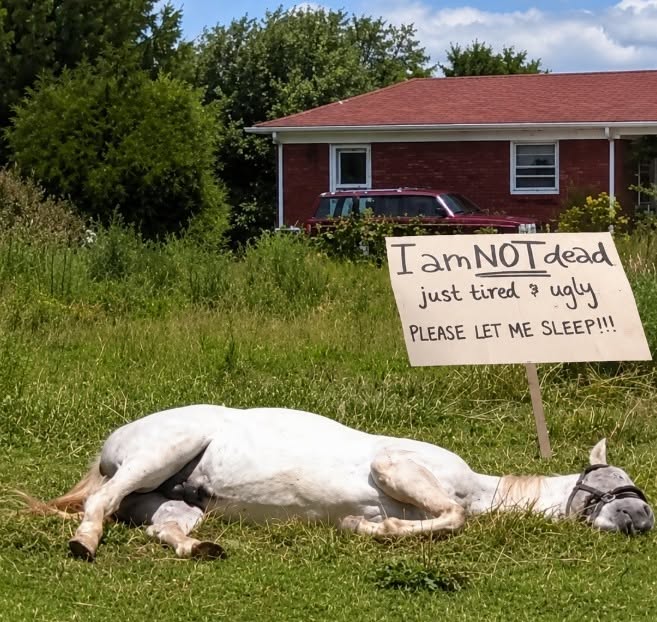
It was a peaceful afternoon in the countryside. The sun was shining, the grass swayed gently in the breeze, and everything appeared calm. Yet one unusual sight immediately caught the attention of anyone passing by.
A large white horse lay completely stretched out in the field, perfectly still, looking as though it had fallen into the deepest sleep imaginable. Nearby stood a handwritten sign that read:
“I am NOT dead… just tired & ugly. PLEASE LET ME SLEEP!!!”
The humorous message quickly transformed concern into laughter. What first seemed unusual became a charming reminder that even majestic animals can have wonderfully dramatic sleeping habits.
Photos like this often go viral because they challenge our expectations. Many people rarely see horses sleeping flat on the ground, leading to curiosity and countless questions. Is this normal? Why do horses usually stand while resting? Do they actually sleep lying down?
The answers combine fascinating biology, centuries of cultural symbolism, and our enduring fascination with the animals that have accompanied humans throughout history.
Why This Photo Captured So Much Attention
The image became memorable because it plays with our assumptions.
Most people are accustomed to seeing horses standing, whether grazing, walking, or even appearing to rest. Seeing one lying fully extended across a field is far less common, especially for those who have limited experience around horses.
The humorous sign immediately reassures viewers that the horse is simply enjoying a nap while also inviting everyone to smile.
Its playful message reminds us that appearances can sometimes be misleading, particularly when viewed through a single photograph.
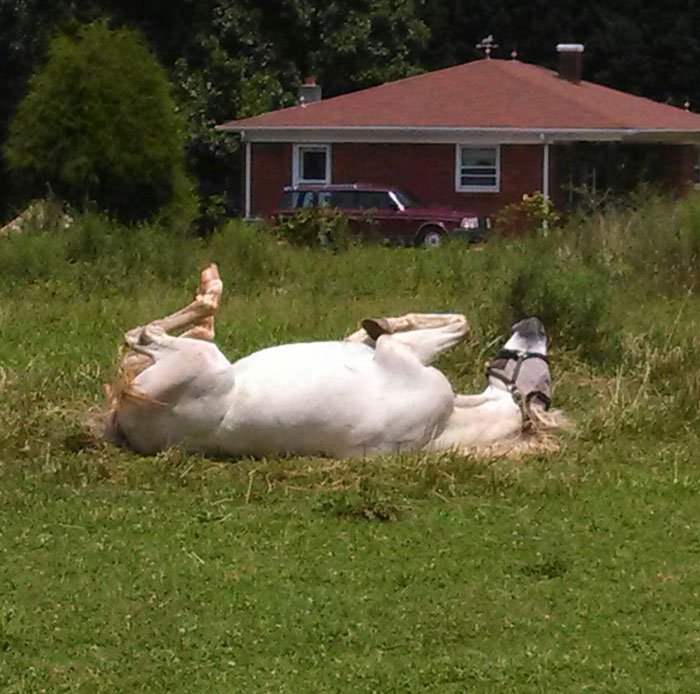
Do Horses Really Sleep Lying Down?
Yes, they do.
Contrary to a common misconception, healthy horses occasionally sleep while lying completely on their sides.
However, they do not spend most of their sleeping time in this position.
Instead, horses divide their rest into several different stages throughout the day.
These include:
- Standing relaxation
- Light sleep while standing
- Deep sleep while lying down
Each stage serves a different purpose.
Why Horses Can Sleep Standing Up
One of the most remarkable features of horses is their ability to rest while standing.
This is possible because of a specialized anatomical feature called the stay apparatus.
The stay apparatus is a network of tendons and ligaments that allows horses to lock portions of their legs with minimal muscular effort.
As a result, they can:
- Relax without falling.
- Conserve energy.
- Respond quickly if necessary.
- Spend long periods resting comfortably.
This adaptation developed over millions of years and has helped horses survive in open environments.
Why Horses Still Need to Lie Down
Although standing rest is useful, it is not enough on its own.
Like many mammals, horses require periods of deep REM (Rapid Eye Movement) sleep.
Scientists believe REM sleep supports:
- Brain function
- Memory processing
- Emotional regulation
- Overall health
To enter this stage, horses generally need to lie down because their muscles relax more completely.
Most healthy adult horses spend only a relatively short time lying flat each day.
This explains why seeing a horse stretched across a field can appear surprising even though it is perfectly normal.
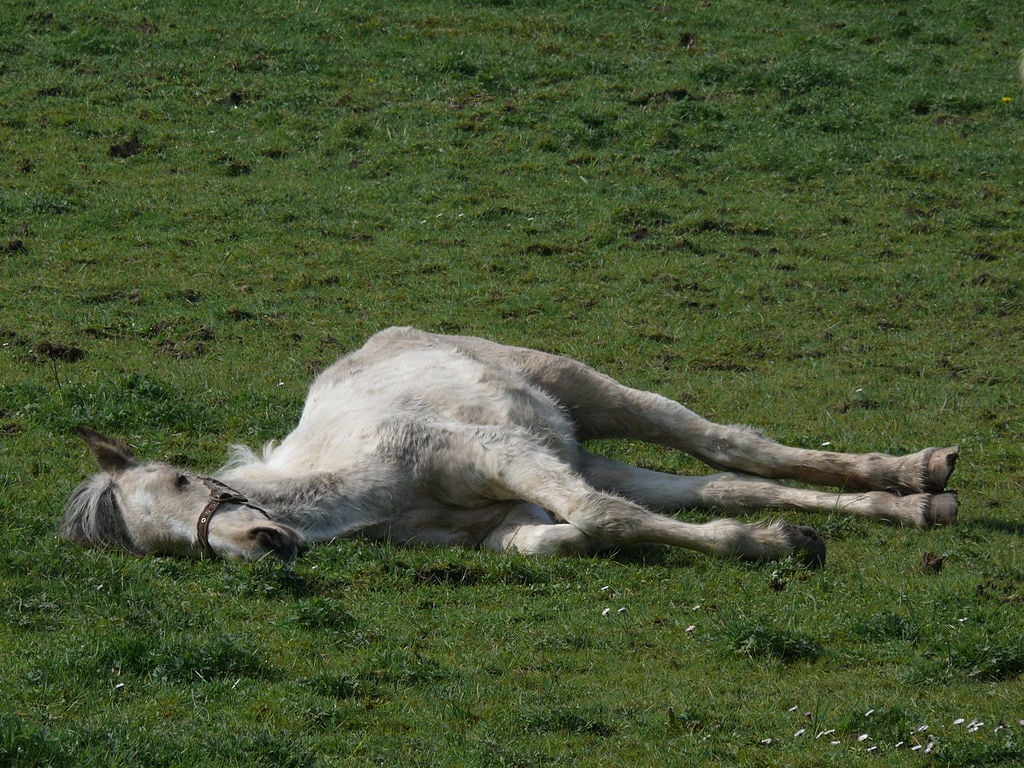
What Makes a Horse Feel Safe Enough to Sleep?
Horses are naturally cautious animals.
In unfamiliar surroundings, they may avoid lying down for long periods because standing allows quicker movement if startled.
Several factors help horses feel comfortable enough to sleep deeply.
Familiar Environment
A quiet pasture or familiar stable encourages relaxation.
Trust
Horses living with companions often take turns remaining alert while others rest.
Comfortable Ground
Soft grass or dry bedding provides comfortable support for deep sleep.
Good Health
Healthy horses are generally more likely to alternate naturally between standing rest and lying sleep.
The Psychology Behind Viral Animal Photos
Why do images like this spread so quickly online?
Researchers studying human behavior suggest several reasons.
People naturally enjoy content that combines:
- Surprise
- Humor
- Animals
- Relatable emotions
- Positive storytelling
The handwritten sign adds personality to the photograph.
Although the horse obviously did not write the message, viewers easily imagine its thoughts, creating an amusing connection between humans and animals.
This tendency is known as anthropomorphism—the habit of attributing human emotions or personalities to animals.
While it simplifies animal behavior for entertainment, it also strengthens emotional engagement.
The Cultural Significance of Horses
Throughout history, horses have occupied a unique place in human civilization.
Across cultures they have symbolized:
- Freedom
- Loyalty
- Strength
- Endurance
- Adventure
Ancient artwork, literature, and folklore often portray horses as trusted companions on journeys both physical and symbolic.
In many traditions, a peacefully resting horse also represents harmony between humans and nature.
Although cultural interpretations vary, admiration for horses remains nearly universal.
Understanding Horse Sleeping Behavior
Equine researchers have observed several interesting sleeping habits.
Healthy horses often:
- Sleep in short intervals.
- Alternate between standing and lying rest.
- Prefer quiet surroundings.
- Choose familiar resting areas.
- Rest more comfortably with herd companions nearby.
Foals generally spend much more time lying down than adult horses because growing bodies require longer periods of sleep.
Older horses may also adjust their sleeping habits depending on comfort and mobility.
Why Some Horses Appear Completely Motionless
Deeply sleeping horses can appear remarkably still.
During REM sleep:
- Muscles become relaxed.
- Breathing slows.
- External movement decreases.
- The horse may remain stretched out.
This calm appearance sometimes surprises people unfamiliar with normal horse behavior.
Experienced caretakers usually recognize the difference between a horse enjoying a peaceful nap and one that may require veterinary attention.
The Importance of Comfortable Living Conditions
Providing horses with suitable environments supports healthy rest.
Responsible horse care includes:
- Clean, dry bedding or pasture.
- Adequate shelter.
- Fresh water.
- Balanced nutrition.
- Regular veterinary care.
- Opportunities for exercise.
Comfortable surroundings encourage natural behaviors, including appropriate sleep patterns.
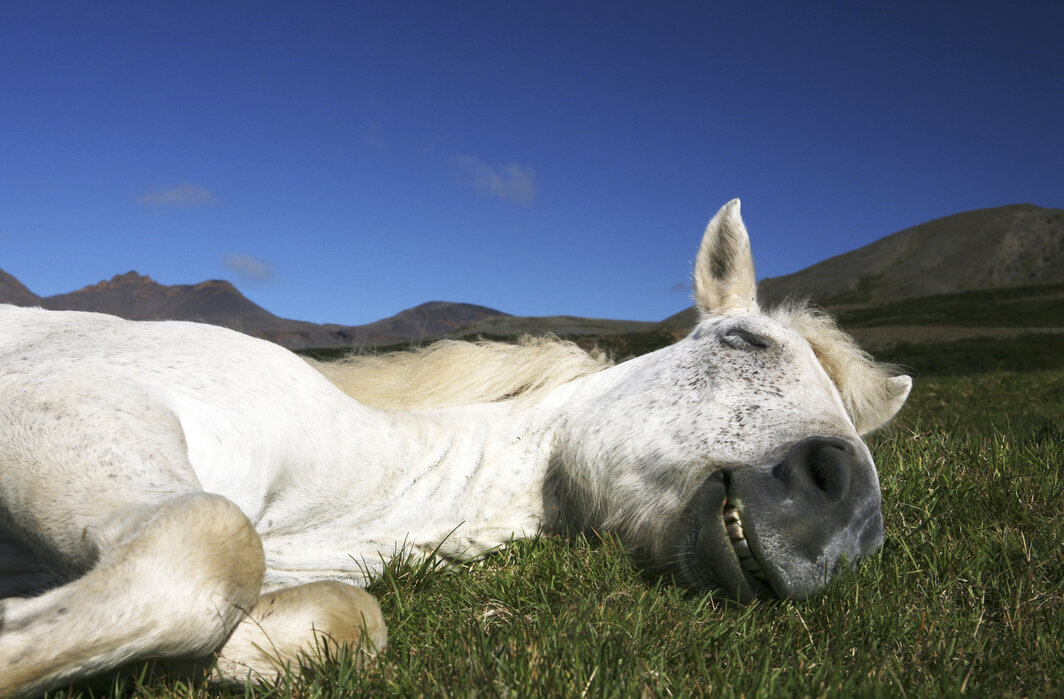
Humor as a Tool for Education
The handwritten sign in the photograph does more than entertain.
It also educates.
Many people who see the image learn for the first time that horses sometimes sleep lying completely flat.
Humor often makes scientific information easier to remember.
By combining laughter with education, the photograph encourages curiosity rather than confusion.
Myths About Sleeping Horses
Several common myths continue to circulate.
Myth: Horses Never Lie Down
Scientific observation clearly shows that healthy horses do lie down for deep sleep.
Myth: A Horse Lying Down Is Always Unwell
Not necessarily.
Many horses regularly rest on their sides when they feel comfortable and secure.
Myth: Standing Sleep Is Their Only Sleep
Standing rest is important, but deep REM sleep generally occurs while lying down.
Understanding these facts helps owners and animal lovers better appreciate normal equine behavior.
What This Photo Teaches Us
Beyond its humor, the image reminds us that animals often behave in ways that surprise us.
Simple observations can become opportunities to learn about:
- Animal biology.
- Evolution.
- Behavior.
- Human perception.
- The relationship between people and animals.
Sometimes one amusing photograph inspires more curiosity than an entire textbook.
Appreciating Animals Through Observation
Watching animals carefully often reveals behaviors many people never notice.
Whether observing birds building nests, dogs dreaming during sleep, or horses taking peaceful naps, these everyday moments deepen our appreciation for wildlife and domestic animals alike.
Careful observation also encourages respect.
Rather than disturbing resting animals, people can enjoy watching quietly while allowing natural behavior to continue uninterrupted.
Conclusion
The image of a white horse peacefully sleeping beside a humorous sign captured attention because it combined surprise, humor, and genuine curiosity about animal behavior. While many people expect horses to remain standing, science tells us that healthy horses also need periods of deep sleep while lying comfortably on the ground.
Cultural traditions have long celebrated horses as symbols of strength, loyalty, and freedom, while modern research continues to reveal the remarkable adaptations that allow them to rest both standing and lying down. Together, these perspectives remind us that even familiar animals still have fascinating secrets to share.
Ultimately, moments like this encourage us to slow down, observe more carefully, and remain curious about the natural world. Sometimes, a simple photograph of a horse enjoying an afternoon nap becomes a delightful reminder that learning often begins with asking one simple question: “Is that really normal?” More often than not, nature’s answer is even more interesting than we expect.
Sources
- American Association of Equine Practitioners (AAEP)
- American Veterinary Medical Association (AVMA)
- The Horse (Equine Health Care Journal)
- Merck Veterinary Manual
- Cornell University College of Veterinary Medicine
- University of Minnesota Extension – Horse Care
- Equine Veterinary Journal
- Journal of Veterinary Behavior
- World Organisation for Animal Health (WOAH)
- National Geographic Wildlife