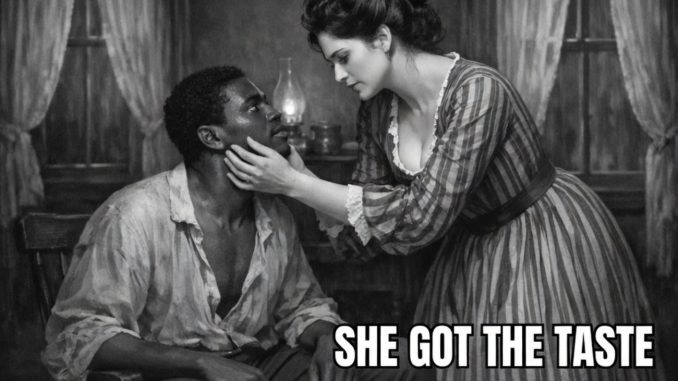
The mid-day Louisiana heat of 1854 hung over the Montrose estate like a suffocating blanket. Spanish moss draped from ancient oak trees, swaying gently in the humid breeze and casting dancing shadows across the grand white columns of the main house. Lady Beatrice Montrose stood on her wrap-around veranda, her emerald silk dress clinging to her slender frame as she surveyed her domain with the calculating gaze of someone born to command. At twenty-eight, Beatrice was considered past her prime for marriage by Southern society standards, but she wore her independence like armor.
The passing of her father two years prior had left her the sole heir to one of the region’s most prosperous cotton operations, a position that came with both immense power and crushing responsibility. The weight of managing over three thousand acres and the lives of more than two hundred laborers sat heavily upon her, carving faint lines of worry around her steel-blue eyes.
The morning sun cast long shadows across the manicured gardens surrounding the main house, where carefully tended roses grew in defiance of the oppressive climate. Beyond the gardens, the fields stretched endlessly toward the horizon, white bolls ready for harvest gleaming like stars against the dark earth. It was a scene of pastoral beauty that masked a rigid socioeconomic reality.
“Miss Beatrice,” called Martha, her elderly house servant, approaching with careful steps across the polished wooden floors of the veranda. Martha had been with the Montrose family since before Beatrice was born, her weathered hands and graying hair a testament to decades of faithful service. “The overseer, Mr. Caldwell, is here to see you about the upcoming harvest.”
Beatrice nodded curtly, her steel-blue eyes never leaving the fields where dozens of workers moved between the white rows like dark figures in a painting. She had inherited not just land and wealth, but the total management of over two hundred human lives—a responsibility that sat uneasily in her chest, though she would never admit it aloud. Her father had taught her that sentiment was a luxury she could not afford, and that the estate’s success depended entirely on maintaining strict discipline and emotional distance.

James Caldwell, a weathered man in his fifties with the permanent squint of someone who had spent too many years under the harsh Southern sun, climbed the veranda steps with his hat in hand. His clothes bore the dust and sweat of the fields, and there was an unusual agitation in his manner.
“Miss Montrose, we need to discuss the new field hand,” he said without preamble, his voice carrying the rough accent of a man born to hard labor.
“Which one?” Beatrice asked, finally turning her attention to the overseer. She had learned to read Caldwell’s moods over the past two years, and something in his demeanor suggested this was more than routine business.
“The man we acquired from the Beauregard estate last month, named Samuel. He’s causing a disruption among the others.”
Beatrice raised an eyebrow, her interest piqued despite herself. The Beauregard estate had been one of the most prestigious in the region before financial ruin forced a liquidation of their assets. Any laborer from that background would likely be highly trained and capable. “What kind of disruption?”
Caldwell shifted uncomfortably, his weathered hands working the brim of his hat. “Well, ma’am, he can read and write. He’s been teaching some of the others. You know how dangerous that can be. Last week I caught him with a group of workers, drawing letters in the dirt. They scattered when they saw me coming, but the damage was done.”
The mention of literacy among the workforce sent a chill down Beatrice’s spine. Education was strictly forbidden within this social order. It bred ideas, and ideas bred unrest. She had heard stories from neighboring districts of organized resistance that began with a single literate individual spreading notions of autonomy.
“Where is he now?”
“Working the north field, ma’am, but I think we should consider selling his contract before he influences the others completely. I’ve got buyers coming through next week who might be interested.”
“No.” The word came out sharper than Beatrice intended, surprising both herself and Caldwell. She wasn’t sure why the thought of selling Samuel disturbed her, but something about the situation demanded her personal attention. “I’ll handle this myself. Have him brought to the study after sunset.”
Caldwell’s eyes widened slightly, his bushy eyebrows rising. It was highly unusual for the lady of the house to deal directly with a field laborer, particularly a problematic one. Such matters were typically left to the overseer’s discretion, but he knew better than to question Beatrice Montrose. “Yes, ma’am. Should I remain present during the meeting?”
“That won’t be necessary,” Beatrice replied, her tone brooking no argument.
As evening approached, Beatrice found herself pacing the length of her study, her mind racing. The room was lined with leather-bound books—her father’s collection of philosophy, literature, and agricultural texts. First editions of classical poetry sat alongside treatises on crop rotation and soil management. The irony wasn’t lost on her that she surrounded herself with knowledge while actively denying it to those who worked her land.
The study itself was a monument to traditional authority, with dark mahogany paneling and heavy furniture. Her father’s portrait hung above the fireplace, his stern gaze seeming to watch her every move. He had been a hard man, shaped by the demands of estate life, but fair in his own rigid way. She wondered what he would think of her decision to meet personally with a troublesome laborer.
A soft knock interrupted her thoughts. “Come in,” she called, trying to steady her voice.
Martha entered, followed by a man who immediately commanded Beatrice’s attention. Samuel was tall and broad-shouldered, his dark skin glistening with the day’s sweat despite the evening hour. His clothes were simple—rough utility pants and a plain shirt—but he carried himself with an innate dignity that seemed to transform the humble garments.
But it was his eyes that struck her most: intelligent, observant, and utterly unafraid as they met hers directly. Most workers kept their gaze downcast in her presence, but Samuel looked at her as if she were simply another human being.
“You may go, Martha,” Beatrice said. She noticed the way Martha hesitated at the door, clearly uncomfortable leaving her mistress alone, but years of training won out, and she departed without comment.
When they were alone, silence stretched between them like a taut rope. Samuel stood with quiet composure, his hands clasped behind his back, waiting. His presence filled the room in a way that made Beatrice acutely aware of her own breathing.
“I’m told you’ve been teaching the others to read,” Beatrice began, moving to stand behind her father’s massive oak desk. The furniture served as both a barrier and a symbol of authority, but Samuel’s presence made it feel inadequate.
“Yes, ma’am.” His voice was deep and cultured, surprising her further. He spoke with the clear diction of an educated man.
“You understand this is strictly forbidden.”
Samuel cleared his throat. “I understand many things are forbidden, Miss Montrose. That doesn’t make them wrong.”
The boldness of his response should have angered her, should have prompted her to call for Caldwell to administer a strict reprimand. Instead, it sent an unexpected thrill through her chest—a flutter of something she couldn’t quite name.
“You’re walking a dangerous line, Samuel.”
“We’re all walking dangerous lines, ma’am. Some of us just choose which ones to cross.”
Beatrice studied his face, noting the intelligence burning behind his eyes, the way he carried himself with a strength that no amount of subjugation could break. There were calluses on his hands that spoke of hard labor, but also a refined focus. “Where did you learn to read?”
“My previous owner’s son taught me when we were children, before he was taught that it was wrong to see me as an equal.”
The raw honesty in those words hit Beatrice unexpectedly. She had never truly considered the inner lives of those who worked her land, maintaining a comfortable distance to justify the status quo. But standing here with Samuel, that carefully constructed wall began to crack.
“Why do you teach the others?” she asked, genuinely curious. “Surely you know the risks?”
“Because knowledge is the only thing that can’t be taken away once it’s given,” he said softly, his gaze never wavering. “Because every person deserves to know that they are more than what society dictates.”
Beatrice moved around the desk, drawn by an invisible magnetic pull. The space between them seemed charged with electricity. “And what do you hope for, Samuel?”
He was quiet for a long moment. When he spoke, his voice was filled with a quiet intensity. “A world where a man is judged by his character, rather than his station. A world where everyone has a right to their own life.”
“That is a dangerous philosophy here,” she whispered, but there was no threat in her voice, only a kind of wondering fear.
“It is simply humanity.”
The distance between them seemed to shrink. Beatrice found herself studying the strong line of his jaw, the steady rise and fall of his chest. There was something profoundly captivating about him, drawing her in despite every lesson she had been taught about propriety and social boundaries.
“You should go,” she said finally, her voice barely audible.
Samuel nodded slowly, but as he turned to leave, he paused at the door. “Miss Montrose.”
“Yes?”
“Thank you for listening. Most people in your position wouldn’t have bothered.”
After he left, Beatrice stood alone in her study, her heart racing. She had built her life on control, on maintaining the strict order that society demanded. But Samuel had shown her something that terrified her more than any rebellion. He had shown her his true self, and in doing so, had awakened her own buried humanity. Outside, thunder rumbled in the distance, signaling an approaching storm that threatened to change everything.
Three weeks passed, and Beatrice found herself manufacturing excuses to walk through the fields, always catching glimpses of Samuel as he worked. She told herself it was standard supervision, ensuring he wasn’t causing further disruption, but the truth was far more complicated and hazardous. Each sighting of him sent an unwelcome flutter through her chest.