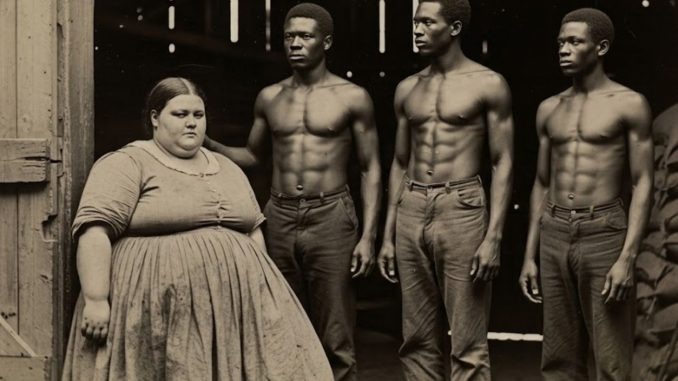
This historical narrative, set in the Antebellum South of 1843, explores themes of systemic control, the resilience of the human spirit, and the unexpected bonds formed in the shadow of institutional cruelty. It follows Catherine Kellerman and three resourceful men—Joshua, Samuel, and Daniel—as they navigate a world defined by rigid social hierarchies and hidden truths.
The Weight of Secrets
What Lucinda Kellerman never mentioned—what she perhaps could not admit even to herself—was that her daughter Catherine’s dramatic physical change began following the death of her father, Thomas, in 1839. The official records cited heart failure. However, a whispered truth known only to a select few was that Thomas had passed away in his study with an empty vial of laudanum beside him and a letter to Catherine clutched in his hand. It was a letter Lucinda had burned before any other eyes could decipher its contents.
The Kellerman estate operated with a chilling efficiency. Hundreds of enslaved individuals worked the cotton fields, the grand house, and the sprawling gardens. Among them were three men who would become central to Catherine’s journey, though none could have anticipated the roles they would be forced to play.
The Men of the East Barn
-
Joshua Fletcher (34): Born on the estate and trained as a blacksmith. His hands, scarred from years of labor, possessed immense strength. A man of few words, he kept a mental catalog of every injustice he witnessed, storing them away like currency for a future day of reckoning.
-
Samuel Hayes (28): Purchased at a Natchez auction in 1841. Having survived three increasingly harsh owners, Samuel’s true value lay in his literacy. A previous owner, a merchant, had taught him to keep accounts—a rare and dangerous skill. Lucinda utilized this “utility” to manage livestock records under her strict supervision.
-
Daniel Cooper (16): Purchased for his youth and stamina from a failing Louisiana estate. Though he bore the psychological scars of a traumatic past, he was observant in ways others missed, noticing patterns that would later prove vital.

The Architecture of Discipline
The barn where Catherine’s ordeal would unfold stood at the eastern edge of the property, isolated by a grove of live oaks. It was a massive structure, relegated to grain storage and equipment repair—a perfect location for activities requiring absolute discretion.
Lucinda’s private journals, discovered decades later, reveal the exact moment her plan solidified. An entry from March 1843 notes her observation of a neighbor’s daughter, once “unmarriageable,” now transformed through “unrelenting physical labor.” Lucinda mused: “Why should my own daughter remain a monument to indulgence when the remedy is so simple? I have the means. I have the place. I have the workers who will obey.”
What Lucinda omitted was the cost of such a transformation. The neighbor’s daughter had developed a persistent, incurable cough and a vacant gaze, suggesting a fundamental internal breaking. But she was thin, and in Lucinda’s social circle, that was the only metric of success.

The Conspiracy of Silence
Natchez society in 1843 operated on layers of silent agreements. To question a neighbor’s private family business was to invite scrutiny of one’s own. Lucinda exploited these unspoken rules, knowing which doctors would sign certificates without examinations and which ministers would praise “discipline” without asking for details.
On March 16, 1843, Lucinda summoned Joshua, Samuel, and Daniel. Standing uncomfortably in the opulent parlor, they listened as she described a “special task.”
“My daughter Catherine requires physical rehabilitation. She has become weak and unsuited for her future duties. You will oversee her daily labors in the east barn from dawn until dusk. You will speak of this to no one under penalty of… consequences.”
The threat was clear: disobedience meant the brutal sugar plantations of Louisiana or worse.
Labor and Resilience
The work was designed not for productivity, but for total exhaustion. Catherine was tasked with grinding corn by hand, hauling 50-pound sacks, and splitting wood until her hands were raw.
Samuel was most struck by Catherine’s silence. She did not plead; she simply worked as if she had detached herself from her own body. Lucinda arrived each afternoon at 3:00 PM, circling her daughter like a buyer inspecting livestock, recording measurements in a leather journal with clinical detachment.
The Expansion of the “Treatment”
Lucinda soon began hosting other plantation mothers who struggled with “problematic” daughters—those who read forbidden literature, wished to study medicine, or refused arranged marriages. She led these women to the barn to witness the “results.”
“The body responds to discipline just as the spirit does,” Lucinda would boast. By April, several other girls in the county were subjected to similar “rehabilitation barns.” However, information moved between estates through the enslaved workers. Daniel began hearing whispers of other girls working in isolation, looking just as haunted as Catherine.

An Unexpected Solidarity
Inside the barn, a shift occurred. Away from her mother’s constant criticism, Catherine found a strange sort of peace in the anonymity of labor. More importantly, she found a level of respect from Joshua, Samuel, and Daniel that she had never known. They did not mock her appearance. Joshua would quietly assist with heavy loads; Samuel brought rags for her hands; Daniel watched over her with quiet empathy.
In April, Catherine broke her silence. “Do you hate me?” she asked Joshua.
“Hate takes energy, Miss,” he replied carefully. “Energy better spent on surviving.”
This shared understanding of survival bridged a vast social chasm. Catherine began to see the men not as tools of her mother’s will, but as human beings trapped in the same cruel system. She learned of Joshua’s family, Samuel’s literacy, and Daniel’s dreams. In turn, they learned of the psychological imprisonment Catherine faced in the mansion—the isolation and the “shame” her mother projected onto her.
The Turning Point
By June, Lucinda’s journals grew frustrated. Catherine was losing weight, but she was also growing physically stronger and more resilient. She was not “wasting away” as intended; she was adapting.
Joshua began secretly supplementing Catherine’s meager rations with food from the quarters, risking his own life to keep her from malnutrition. As they worked side-by-side, the barriers of the plantation began to feel negotiable within the walls of the barn. “We both want freedom from the things that bind us,” Joshua noted.
In late June, a moment of physical support turned into a deeper connection. Their relationship developed in stolen moments, with Samuel and Daniel acting as lookouts. They chose connection over safety, a genuine affection transcending their impossible circumstances.
The Discovery of the Truth
By August, Catherine realized she was pregnant. The news brought a mixture of tenderness and absolute terror. A pregnancy would be impossible to hide from her mother and the inevitable doctor’s visits. “They will kill you,” Catherine whispered to Joshua.
Desperate, the group began searching for leverage. Samuel used his literacy to scour the plantation’s hidden records, finding a ledger of girls who had been “resolved”—names that simply vanished from history when they failed to “respond to treatment.”
Catherine provided the final piece of the puzzle. She knew the location of her father’s locked study. On a night when Lucinda was away, Catherine retrieved $300 and a cache of letters. These letters revealed a stunning truth: Thomas Kellerman had been planning to free everyone on the estate. His “heart failure” was a result of the guilt he felt, leading him to take his own life.
More importantly, Catherine found her father’s original, unprobated will. It left the plantation to her, with explicit instructions for the manumission of every enslaved person. Lucinda had suppressed the document and forged signatures to maintain control.

The Plan for Flight
The discovery of the will changed everything. They didn’t just have a reason to run; they had the legal proof to dismantle Lucinda’s power. However, they knew the legal system would never favor them in Mississippi. They had to reach the North.
“We leave tonight,” Joshua declared.
Catherine devised a plan based on her mother’s obsession with appearances. “We will not be running. We will be traveling. I will be a widow traveling with my servants to Kentucky. The money will pay for forgeries in Natchez, and my father’s letters will prove my identity.”
The preparation was a high-stakes dance of normalcy.
-
Samuel risked a trip into Natchez to find a forger.
-
Joshua gathered supplies and makeshift weapons.
-
Daniel took on the most selfless role: he would stay behind to provide an alibi, claiming Catherine had escaped alone to buy the others time, fully aware of the punishment he would face.
The Threshold of Freedom
As the sun set on August 17th, the four stood at the edge of the grove. The weight of the suppressed will and the hope of a new life hung in the balance. They were no longer just a “problem to be corrected” or “utility to be used”—they were a group bound by a shared truth, stepping out from the shadows of the barn into an uncertain but self-determined future.
The story of the Kellerman barn serves as a stark reminder that even within the most restrictive systems, the human desire for agency and connection cannot be entirely extinguished. It remains a testament to those who found the courage to see the humanity in one another when the world around them refused to do so.