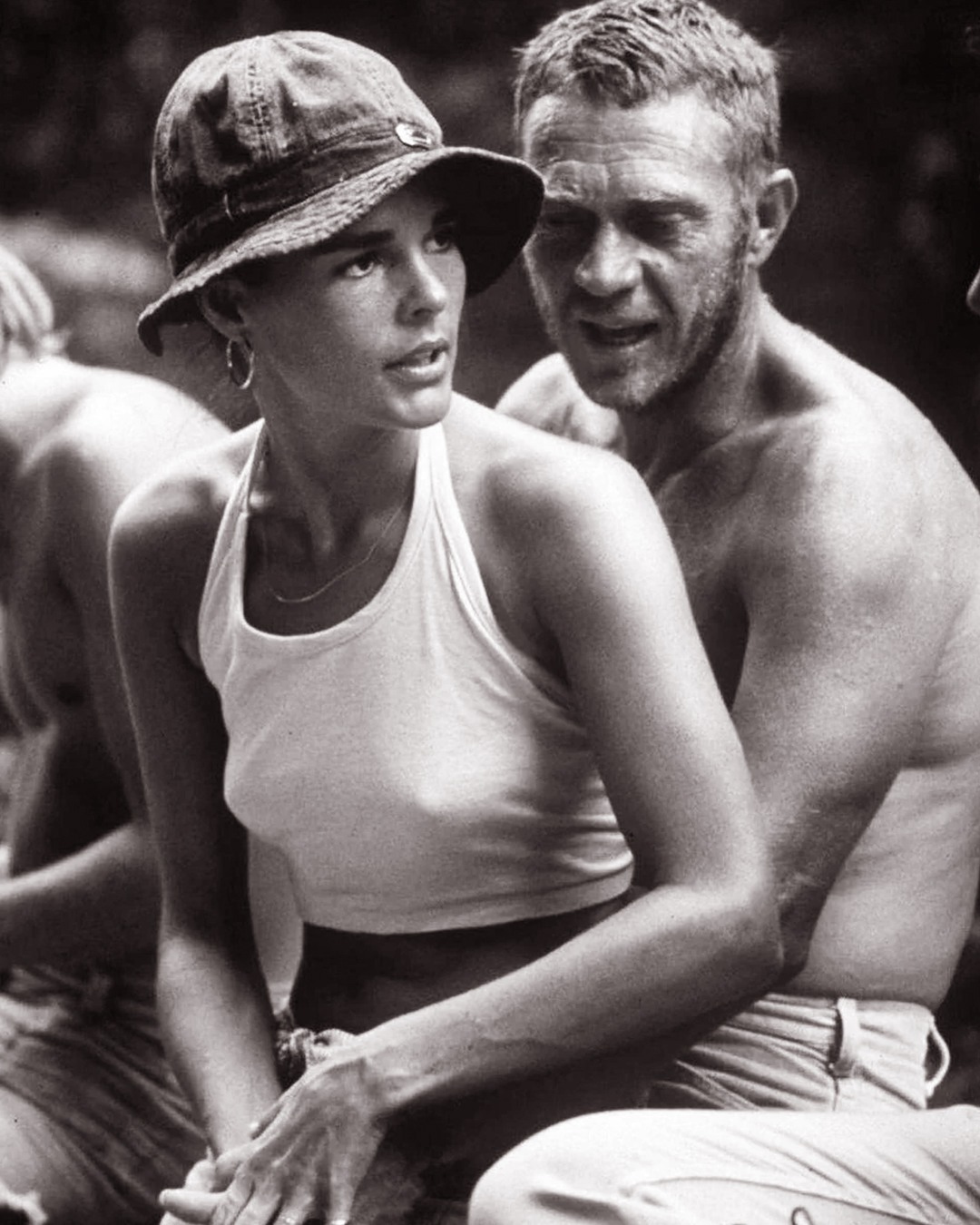
In 1972, Ali MacGraw and Steve McQueen were the very definition of a Hollywood power couple — and no single photograph captured their magnetic appeal more beautifully than one taken of them together on the set of Papillon in Jamaica. At first glance, it appeared to be just another glamorous image of two attractive people enjoying the warm Caribbean sun. But with the benefit of everything we now know about what was unfolding between them at that precise moment, the photograph takes on a meaning that is considerably deeper, more complicated, and far more emotionally resonant than any casual observer would initially suspect.
For those unfamiliar with the backstory, Ali MacGraw was not actually part of the film being shot in Jamaica at all. She had recently met McQueen, and their chemistry had been immediate and undeniable from the very first encounter. At that point in her career, she was riding the wave of enormous success following Love Story in 1970, a film that had transformed her into one of the most recognizable and celebrated actresses in the world virtually overnight. McQueen, already carrying the unofficial but universally acknowledged title of the “King of Cool,” was equally at the peak of his powers. His tough, rebellious screen image was complemented by a quiet, almost paradoxical personal charisma that seemed to captivate everyone who spent time in his company — men and women alike.
A Romance That Began on Set

Their romance truly found its footing during the filming of The Getaway in 1972, a project in which the two played romantic partners on screen. McQueen had personally come to Ali’s home to extend the invitation for her to join him in the film, and from that meeting forward, something between them shifted permanently.
“I looked into those blue eyes, and my knees began to shake,” MacGraw later recalled with characteristic honesty. “I became infatuated.”
Within a matter of months, the most celebrated young actress of the early 1970s made a decision that would define her public narrative for years to come. She left her husband — Robert Evans, one of the most powerful executives in the film industry at the time — and followed her heart directly into McQueen’s world. It is worth pausing on that detail, because Evans was not simply a private individual. He was a towering figure in Hollywood, a man whose professional reach and personal prominence made the situation far more charged and publicly visible than it might otherwise have been.
Looking back on that period of her life, MacGraw has spoken about it with a mixture of honesty and genuine regret. “These things happen,” she once remarked. “It wasn’t something I actively pursued. I feel very sad that fate and I caused Bob to go through some really tough times.” The acknowledgment speaks to a self-awareness that has characterized much of how MacGraw has discussed her personal life in the decades since — candid, undefensive, and unwilling to pretend that the people around her escaped without cost.
A Wedding Beneath a Cottonwood Tree

By 1973, MacGraw and McQueen had formalized their relationship, and the union of two of Hollywood’s most dazzling stars became the subject of intense fascination across the entertainment world. Their wedding, true to McQueen’s character in almost every respect, was anything but conventional.
After months of speculation about whether and when they might marry, the couple exchanged their vows beneath a cottonwood tree in a public park in Cheyenne, Wyoming. The ceremony was officiated by a local judge named Art Garfield, who had been interrupted mid-golf game to receive the request. The story of how that came about is one of those small but delightful details that makes the McQueen legend feel entirely authentic.
“At first, I couldn’t believe it, and I thought it was a prank, so I kept playing,” Garfield later recounted. “A few holes later, I received a message from the pro shop and returned — and it was Steve on the line.” Upon recognizing the actor’s distinctive voice, the judge set aside his clubs and drove directly to the park to officiate. The guest list was kept deliberately intimate: McQueen’s two sons, along with MacGraw’s young son from her previous marriage, were the only witnesses to the ceremony.
“Steve was this incredibly unique, principled individual who didn’t seem to fit into the system, and I adored that,” MacGraw once said of what drew her to him so powerfully. That quality — the sense of someone genuinely unwilling to conform to the expectations placed on him by the industry that had made him a star — was central to McQueen’s appeal both on screen and off it.
The Reality Behind the Glamour

Together, MacGraw and McQueen represented something that felt distinctly of their era — a particular strain of 1970s Hollywood glamour that was simultaneously polished and deliberately rough around the edges. Leather jackets, denim, oversized sunglasses, and an attitude of effortless cool characterized their public image. Every photograph seemed to confirm the idea that they existed slightly outside the ordinary rules that governed everyone else.
Their love story became the envy of much of the entertainment world and a significant portion of the public beyond it. Fans consumed every available photograph, every magazine profile, every rare glimpse into what their private life together actually looked like. They seemed to represent something larger than themselves — a vision of passion and freedom and self-determination that resonated deeply with an era that was in the middle of questioning many of its own assumptions about how people should live.
But photographs, as anyone who has looked carefully at enough of them eventually learns, are skilled at concealing as much as they reveal.
Beneath the surface of that celebrated partnership, there were tensions that grew steadily more difficult to manage over time. McQueen’s famously controlling temperament — rooted, those who knew him well have suggested, in a childhood marked by abandonment and instability — frequently came into direct conflict with MacGraw’s genuine desire to maintain her own career and her own sense of identity. His father had left when he was young, and the experience had left marks on him that shaped how he related to the women in his life in ways that were not always easy to live with.
MacGraw has been open about the specific nature of those tensions in various interviews over the years. She described an environment in which her husband was deeply uncomfortable with her working, with her having her own professional life, with her existing in any significant way outside the domestic sphere he preferred. For a time, she made the choice to step back from her career to be present at home. But the weight of those expectations, she has said, was ultimately something she could not sustain indefinitely.
“I couldn’t even attend art class because Steve wanted his partner to be home every evening with dinner ready,” she recalled in one particularly striking account of what daily life inside that marriage had actually felt like. The contrast between the glamorous public image and the private reality could hardly have been more stark.
By 1978, the couple had separated. The marriage that had captivated Hollywood and the broader public for the better part of a decade had run its course, brought down not by a single dramatic event but by the slow accumulation of irreconcilable differences in what each person needed from their life together.
The Jamaica Photograph, Revisited

Which brings us back to that famous image from the Papillon set in Jamaica — the photograph that, on the surface, seems to capture nothing more complicated than two extraordinarily attractive people enjoying themselves in a beautiful location.
Look more carefully. Notice how their hands rest near each other without quite touching. Consider the particular quality of McQueen’s gaze — the intensity in it that is almost too focused to be entirely casual. And observe MacGraw’s expression: the almost invisible smile that could be interpreted a dozen different ways depending on what context you bring to it.
There is an entire story embedded in that image — of unspoken feelings still in their earliest stages, of a connection that had not yet been fully tested by time and circumstance, of the particular kind of Hollywood enchantment that is almost impossible to sustain once the cameras stop rolling and ordinary life reasserts itself.
The Oscar Question That Still Lingers
Behind those famous set photographs lies yet another compelling thread to the McQueen story. While Papillon was widely praised by critics and audiences as containing one of the finest performances of McQueen’s career up to that point, he was conspicuously absent from the Academy Award nominations when they were announced in 1974. Neither he nor his co-star Dustin Hoffman, whose performance was equally celebrated, received a nomination at the 46th Annual Academy Awards — an omission that continues to be discussed in film circles to this day.
The reasons behind that snub, as it has come to be known, remain a subject of genuine debate. Some observers have suggested that McQueen’s highly public involvement with MacGraw while she was still married to Robert Evans — a man with deep connections throughout the film industry — may have generated a level of personal resentment in certain influential quarters that found its expression in the voting process. Others have pointed to widespread commentary at the time that McQueen, in his early forties, was simply too old for the role of Henri Charrière, whose story in the film begins when the character is just twenty-five years old.
There were also those who attributed the omission to McQueen’s own notoriously direct and undiplomatic personality — a quality that served his screen image magnificently but did not always endear him to the people whose goodwill mattered when awards season arrived.
Whatever the true explanation, the result is that one of the most widely discussed performances of McQueen’s career went entirely unrecognized by the Academy — a footnote in film history that adds one more layer of complexity to the story of a man who seemed to attract drama, fascination, and controversy in equal measure both on screen and off it. He remains, decades after his passing, one of the most singular figures the entertainment world has ever produced — impossible to fully understand, impossible to look away from, and impossible to forget.