The world’s most strategically sensitive maritime corridor has once again become the focal point of an international crisis. A commercial vessel attempting to transit the Strait of Hormuz — the narrow waterway connecting the Persian Gulf to the Gulf of Oman and one of the most consequential shipping lanes on the planet — came under assault in an incident that has sent immediate shockwaves through global energy markets, international shipping networks, and the diplomatic communities of nations whose economies depend on the uninterrupted flow of oil and trade through this critical passage.
The attack, reported by maritime monitoring organizations and confirmed by multiple shipping industry sources, represents a significant escalation in a region where tensions have been building steadily for months. Governments across Europe, Asia, and North America have responded with urgent statements. Shipping companies have issued emergency guidance to vessels in the area. Insurance underwriters have moved to reclassify the entire corridor as a high-risk zone. And analysts who monitor geopolitical flashpoints have begun openly discussing scenarios that, only weeks ago, were considered unlikely.
The central question now confronting international leaders, energy markets, and the global shipping industry is not simply what happened in the strait — but what comes next, and whether the mechanisms of diplomacy can contain a situation that is, by any credible assessment, continuing to deteriorate.
The Warnings That Preceded the Incident
To understand the context of what occurred, it is necessary to go back several weeks to a series of statements issued by Iranian officials regarding vessel transit through the strait. Those statements carried language that left little room for ambiguity: commercial ships with documented connections to the United States, Israel, or nations considered allied with those countries could, under certain circumstances, be treated as valid subjects of interdiction if they attempted to pass through the waterway without authorization.
The warnings were not delivered quietly or through back channels. They were public, forceful, and repeated. Iranian officials made clear that the country’s Islamic Revolutionary Guard Corps naval division had both the mandate and the capability to enforce these restrictions. International maritime organizations, the United States Navy’s Fifth Fleet — which maintains a significant presence in the region — and shipping industry bodies all took note. Some vessels responded by altering course or anchoring in safer waters pending clarification. Others, for reasons of commercial necessity or strategic calculation, proceeded.
It was those decisions to proceed that set the stage for what followed.
What the Maritime Monitoring Reports Showed
The incident itself unfolded in the compressed geography of the strait — a channel barely forty kilometers wide at its narrowest point, through which an estimated one-fifth of the world’s entire petroleum supply passes on any given day. Maritime monitoring systems, which track vessel positions and conditions in near real-time, began registering anomalies consistent with vessels coming under external interference.
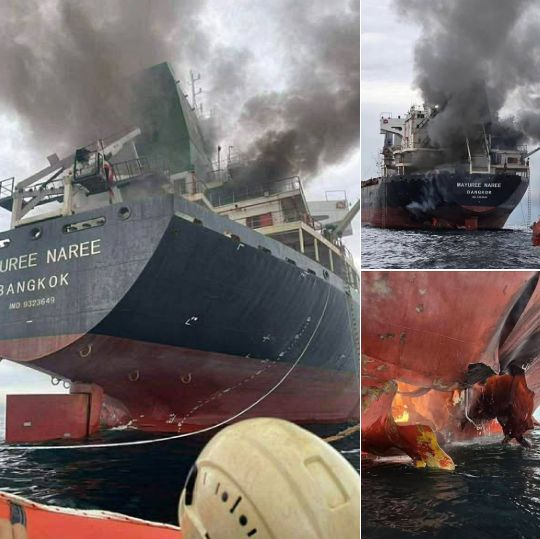
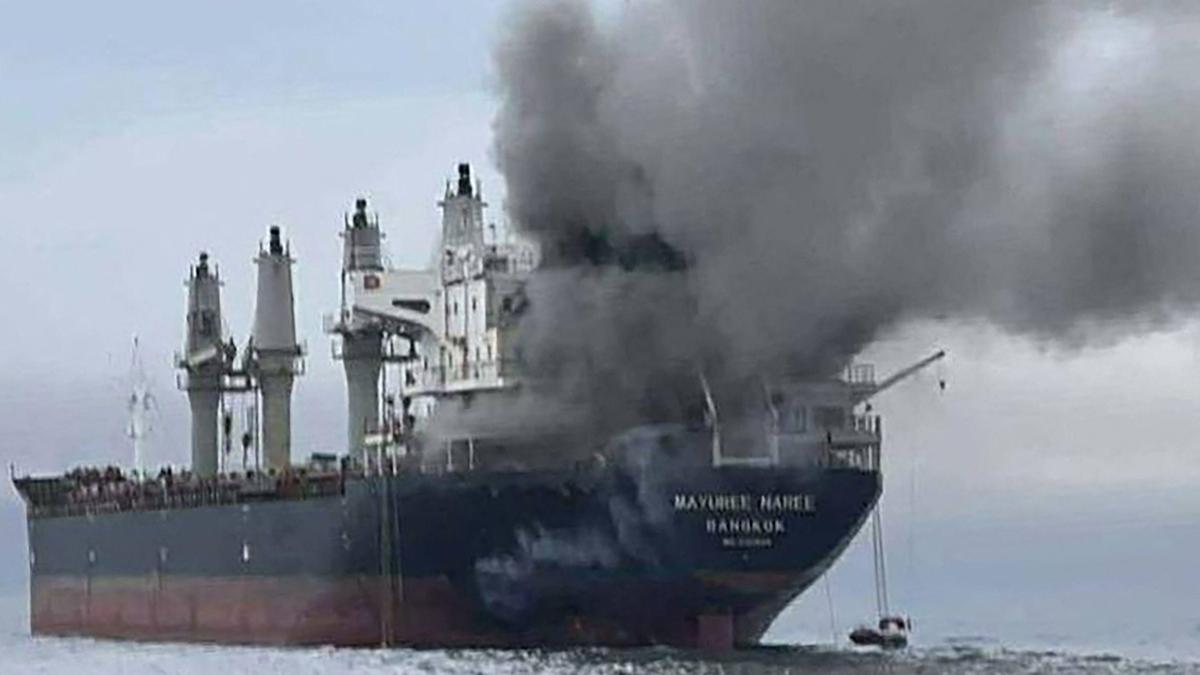
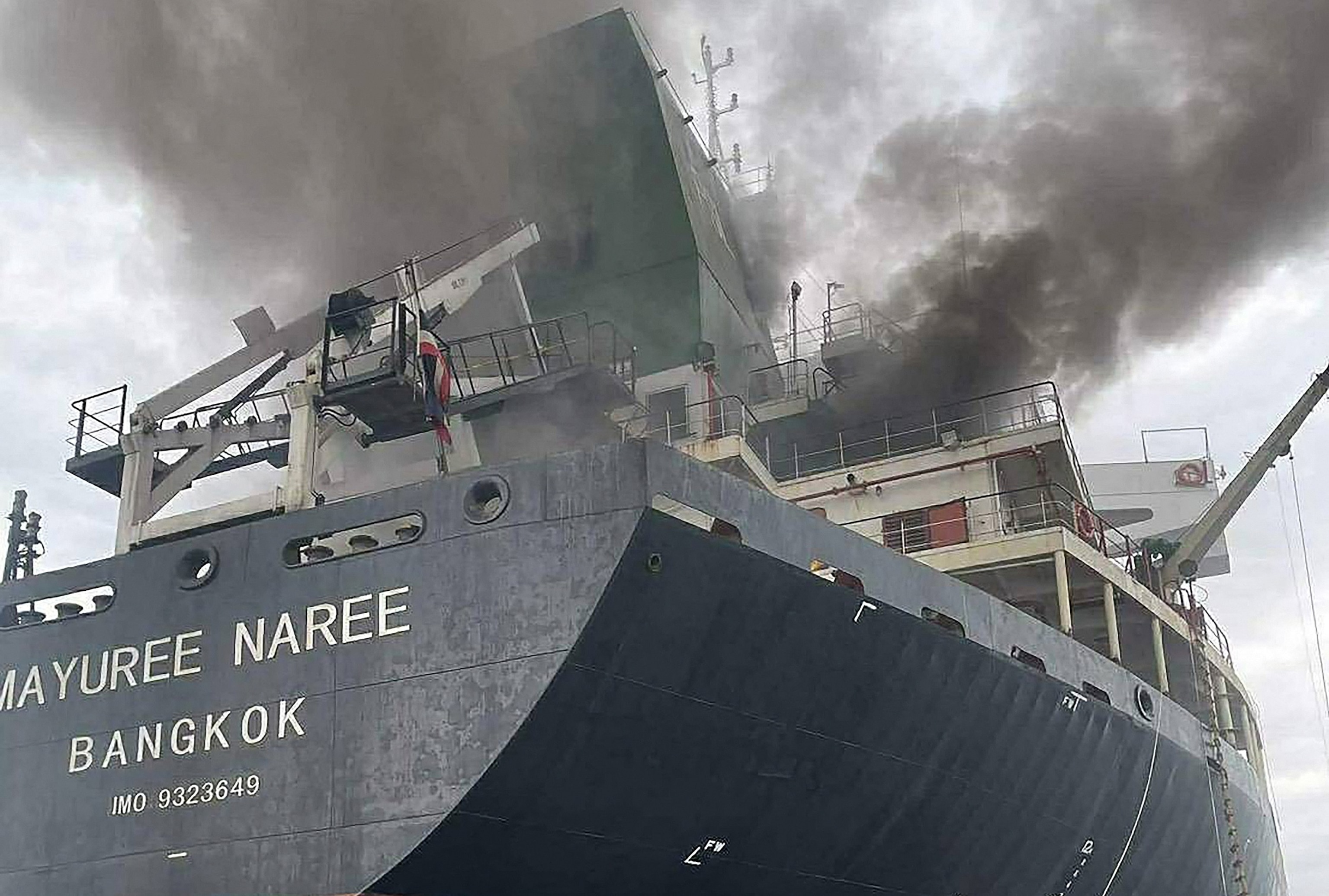
Initial reports indicated that multiple commercial ships were affected. The most serious situation involved a Thai-flagged bulk carrier, which sustained significant damage when its engine room was compromised and fire broke out in the lower sections of the vessel. The severity of the situation forced the crew to conduct a partial evacuation — a procedure that, in the confined and heavily trafficked waters of the strait, carries its own acute dangers beyond the immediate incident. Crew safety protocols were activated, emergency broadcasts were transmitted, and nearby vessels were alerted.
Two additional ships — one registered in Japan and another bearing Marshall Islands registry — also sustained damage in the same general timeframe, though the harm to those vessels was assessed as less severe than what the Thai carrier experienced. Structural integrity was maintained, crew members remained aboard, and both ships were eventually able to alter course and move toward safer anchorage.
Authorities confirmed that large-scale personnel casualties had not been reported in the immediate aftermath of the incidents, though investigations were described as active and ongoing. The full scope of what occurred — including the precise sequence of events, the nature and origin of the force applied to each vessel, and the chain of decisions that led to the confrontation — remained under active investigation by multiple parties simultaneously.
Regional shipping organizations moved quickly to issue guidance. All vessels operating in the area were advised to proceed with maximum caution, maintain heightened situational awareness, report any suspicious or threatening activity immediately through established maritime communication channels, and if possible, defer transit until the situation clarified.
Why the Strait of Hormuz Is Unlike Any Other Waterway on Earth

To anyone unfamiliar with the geography of global energy supply, the intensity of the international reaction to events in this relatively small stretch of water might seem disproportionate. It is not. The Strait of Hormuz occupies a position in the architecture of global commerce that has no parallel and no straightforward substitute.
At its narrowest, the strait measures roughly forty kilometers. And yet through that narrow passage flows approximately twenty percent of all the petroleum traded globally — a figure that translates, in practical terms, to roughly seventeen to eighteen million barrels of crude oil per day under normal conditions. The countries whose energy exports depend on this corridor include some of the world’s largest producers: Saudi Arabia, the United Arab Emirates, Kuwait, Iraq, and Qatar all route the overwhelming majority of their hydrocarbon exports through the strait.
For importing nations — particularly the large economies of Asia, including China, Japan, South Korea, and India, all of which are heavily dependent on Gulf crude to fuel their industrial and consumer economies — the strait is not merely a convenient route. It is the route. Alternatives exist in theory: pipelines that bypass the strait have been constructed, and some capacity to route oil overland exists. But the volume of petroleum that transits the strait daily far exceeds what any combination of alternative routes could accommodate if the primary passage were closed or significantly disrupted for an extended period.
The economic consequences of even a partial or temporary disruption are therefore immediate, significant, and global in their reach. When shipping companies slow vessels, anchor them in holding patterns, or reroute them entirely around the Arabian Peninsula — as some have begun doing in response to the current situation — the additional time and fuel costs are substantial. When insurers reclassify the corridor as high-risk and raise premiums accordingly, those costs are passed through the supply chain and ultimately reflected in energy prices at the consumer level in countries that may be geographically distant from the strait by thousands of kilometers.
In short: what happens in this forty-kilometer passage affects fuel costs in Germany, manufacturing competitiveness in South Korea, heating bills in Japan, and transportation expenses across virtually every economy in the world that relies on traded petroleum.
The Broader Military Context
The vessel incidents did not occur in isolation. They took place against a backdrop of significantly elevated military activity throughout the region — a pattern of escalation and counter-escalation that has been building across multiple fronts and involving multiple actors.
United States and allied military forces had recently conducted a series of operations targeting Iranian military infrastructure, including assets belonging to the IRGC naval division that operates in the Persian Gulf. Those operations were framed by the parties that conducted them as defensive responses to prior provocations. Iranian officials characterized them differently — as acts of aggression that required a proportional response.
That response, according to regional analysts and intelligence assessments cited by multiple international news organizations, has manifested in part through the increased assertiveness of Iranian naval and paramilitary forces in the Gulf, including the incidents now under investigation in the strait. Additionally, Iran has conducted missile and drone operations targeting military infrastructure associated with hostile parties in the broader regional conflict — a pattern of action that has kept military planners and political leaders across the region and beyond in a state of heightened alertness.
The particular concern raised by analysts in the context of the vessel incidents is not simply the immediate damage caused, but the precedent being established. Each successive incident raises the threshold for what counts as routine risk in the strait, gradually normalizing a level of danger that, if it persists, will fundamentally alter the calculus of commercial shipping through the region. At some point — and analysts disagree about where precisely that point lies — the commercial shipping industry may determine that the risks and costs of transiting the strait outweigh the benefits, and begin routing vessels around the Cape of Good Hope or making other major logistical adjustments on a sustained basis.
If that shift occurs, the consequences for global energy supply chains would be substantial and long-lasting.
Reactions from Governments and the International Community
The international response to the incidents has been swift and, in its broad outlines, consistent across a wide range of governments and organizations. The core message has been one of urgent concern combined with calls for restraint.
Multiple Western governments issued statements emphasizing that commercial vessels operating in international waters are protected under the principles of freedom of navigation — a foundational concept in international maritime law that holds that the high seas and recognized international straits are open to transit by all vessels regardless of flag. Any interference with that freedom, these governments argued, constitutes a violation of international norms with consequences that extend far beyond the immediate parties to any bilateral dispute.
The International Maritime Organization, the United Nations specialized agency responsible for the safety and security of shipping, issued guidance to its member states urging maximum caution and calling on all parties with influence over the situation to take immediate steps to reduce tensions and protect the safety of civilian maritime workers.
Asian governments — particularly those of Japan, South Korea, and China, whose dependence on Gulf oil makes them acutely sensitive to disruptions in the strait — expressed deep concern and called for diplomatic engagement to prevent further deterioration. Several governments indicated they were in active contact with relevant parties and monitoring the situation with the highest level of attention.
Energy analysts noted that oil futures markets had responded immediately to the news of the incidents, with prices moving upward as traders began pricing in the risk premium associated with potential supply disruption. Whether those price movements prove transitory or become embedded in longer-term energy costs will depend heavily on how events in the strait develop over the coming days and weeks.
The Economic Stakes That Make Resolution Urgent
The economic argument for de-escalation is, in some respects, more straightforward than the strategic or diplomatic one. The world economy is not, at this moment, well-positioned to absorb a sustained shock to oil supply. Many major economies are still managing the inflationary pressures that accumulated during earlier periods of supply disruption. Central banks in major economies have been navigating the difficult task of reducing inflation without triggering recessions. A significant and sustained increase in energy costs — driven by prolonged disruption in the strait — would complicate that task considerably.
For developing economies that are net energy importers, the exposure is even more acute. Countries in South and Southeast Asia, Sub-Saharan Africa, and parts of Latin America that import substantial quantities of petroleum would face immediate and painful increases in fuel costs if Gulf oil supply were meaningfully constrained. The cascading effects on transportation, food production and distribution, electricity generation, and industrial output in those economies would be severe.
The interconnectedness of global energy markets means that there is no comfortable spectator position from which any major economy can observe this crisis without stake in its outcome. The nations with the greatest diplomatic leverage — particularly those with strong relationships with both Iran and the Western alliance structure — face intense pressure to exercise that leverage actively and urgently.
The Days Ahead
As the investigation into the specific incidents continues and military forces in the region maintain elevated readiness, the immediate period ahead represents a genuinely critical juncture. There are credible paths toward de-escalation — diplomatic openings, back-channel negotiations, and precedents from earlier periods of tension in the strait that were ultimately resolved without broader conflict. There are also credible paths toward further escalation, each step of which carries the risk of triggering responses that make the subsequent step harder to avoid.
What is not credible, at this stage, is the idea that the situation will resolve itself without deliberate action from the parties with the ability to influence it. The Strait of Hormuz has been a flashpoint before. It has been managed, de-escalated, and returned to relative stability before. Whether the mechanisms of international diplomacy, economic self-interest, and strategic calculation can produce that outcome again — and how quickly — is the question that governments, energy markets, and the crews of commercial vessels navigating those waters are now waiting to see answered.
The strait remains open. It remains dangerous. And the world is watching very closely.