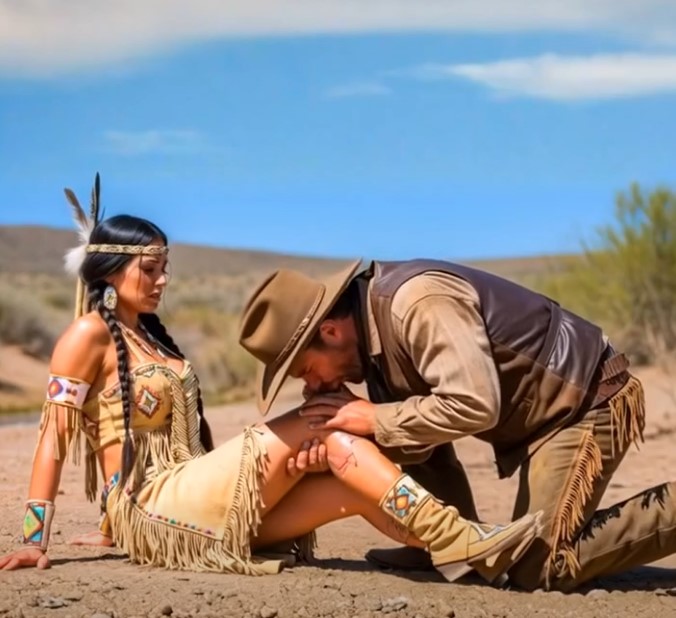
The desert at midday looked like an endless sheet of hammered copper. Heat shimmered above the sand, bending the horizon into wavering lines. Wind dragged thin veils of dust across the ground—soft at first, then sharp enough to sting. Everything about this landscape felt still and ancient, as if it were more accustomed to swallowing secrets than revealing them.
Beneath that punishing sun, half-covered by loose earth, lay a woman who should not have been alive.
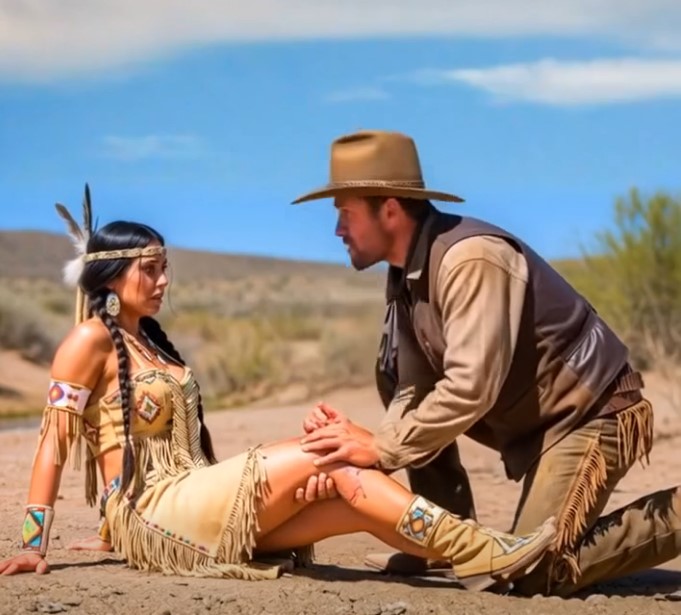
Her name was Da, an Apache woman raised among warriors, storytellers, and survivors. She had grown up learning that the desert was unforgiving—but also that it protected those who understood it. Now, with grains of sand pressed against her lips and ants crawling across her cheeks, she was suspended between consciousness and the pull of darkness.
Her breath was so shallow it barely lifted her ribcage. Her arms and legs were heavy, pinned by the weight of earth. She could not lift a single finger. But she could still remember.
And what she remembered kept her alive.
The echo of men’s voices returned first—taunting, confident, unhurried. She remembered rough hands lifting her, the scrape of shovels against dry ground, and boots shifting on loose stones. She remembered the moment when the world went dark as cold sand fell across her face.
Among those voices was one she recognized immediately: Silas Pike, a landowner whose influence reached farther than any frontier boundary line. His wealth, reputation, and force of personality shaped the region. Very few crossed him. Even fewer survived the consequences.
Da had overheard something she was never meant to hear—conversations beneath the floorboards of Pike’s hall, hushed negotiations involving land deals, missing persons, and payments that would expose him if ever made public. She hadn’t gone looking for secrets. She had simply been in the wrong place at the wrong moment.
For Pike, that was enough.
She had been taken into the desert while the sky still held morning light. She had struggled, pleaded, tried to reason—but the decision had already been made. And as Pike rode away, he left her with a final sentence:
“No one will question what happened.”
But the desert, in its own way, did.
When Da’s vision blurred into white light, she thought it was the sun. But the shape moved. The sound of hooves grew louder. A rider appeared through the haze—sun-browned skin, dust-covered coat, and a horse steady despite the heat.
Bryant, a seasoned bounty hunter, wasn’t accustomed to surprises. He had survived too many miles, too many ambushes, too many second chances to ignore his instincts. So when he saw a hand protruding from the ground, he didn’t assume fate was playing tricks. He dismounted, brushed sand away, and froze when a pair of exhausted eyes stared back at him.
“You’re alive,” he whispered.
She tried to speak. Only one word made it past her cracked lips:
“Water…”
He offered what little he had, tipping drops gently onto her tongue. Her throat burned, but she swallowed. The moment water touched her lips, something awakened inside her—stubborn, steady, almost defiant.
“Who did this to you?” Bryant asked.
Her voice barely carried, but the name she uttered shifted his entire expression.
“Silas… Pike.”
Bryant had heard that name before. Everyone had. He did not ask anything further.
He dug her out with his hands, lifted her onto the saddle, wrapped her in his blanket, and turned his horse toward shelter.
“You’re safe now,” he said quietly. “As long as I ride with you.”
That evening, they camped in a ravine where stone walls offered shade and silence. Da’s strength was returning in fragments. Her mind drifted between exhaustion and the sharp memory of Pike’s men laughing while they covered her in sand.
“Why help a stranger?” she eventually asked.
Bryant kept his gaze on the fire. “Some things you don’t leave behind, even in the desert.”
During the night, Da woke several times, reaching for air as if reliving the moment when sand filled her nose and mouth. Each time, Bryant reassured her—not with long speeches, but with quiet presence.

By dawn, they were moving again.
But the desert had carried their tracks far. Dust rose in the distance—Pike’s riders.
Da tensed. “They’ll keep hunting me.”
Bryant nodded. “Then we stay one step ahead.”
Yet Da wasn’t only fleeing. Simply surviving wasn’t enough. The wounds Pike had caused reached far deeper than her own. Her brother had disappeared on Pike’s land months earlier. She had suspected the truth but lacked proof.
Now she had motive. And she had the will to see justice done.
“I’m not leaving until Pike faces what he’s done,” she said.
Bryant did not question her resolve. “Then we ride together.”
A sandstorm hit before they reached Pike’s territory—sudden and fierce, blinding them with swirling grit. In the chaos, Da slipped from the saddle, shielding her face from the cutting wind. A silhouette emerged through the storm: a man armed and confident.
“Pike wants this finished,” he said.
Before he could raise his weapon, a rifle shot cracked. Bryant appeared through the storm, steady as stone.
“Let’s keep moving,” he told her.
By dusk, Pike’s ranch appeared—a sprawling estate fortified with guards, torches, and fences meant to intimidate more than to protect.
Da didn’t want to sneak in unseen.
“I want him to know I survived,” she said.
Her voice carried no malice—only certainty.
They slipped through a weak point in the perimeter and crossed the property until they reached the old well. Da descended with a torch, her movements tense but steady. What she found were remnants—scrap wood, metal fragments, cloth—and a golden medallion bearing Pike’s crest.
Proof not only of his dealings, but likely also of her brother’s fate.
When she climbed back up, gunfire erupted. Bryant drew Pike’s guards away, giving Da time to run toward the main hall. Upstairs, Pike stood surrounded by polished wood and lamplight, holding a glass as though he expected her arrival.
“You were supposed to disappear,” he said.
Da tossed the medallion. It struck the floor with a ringing sound.

“You buried my brother,” she said.
Pike stepped back. “You misunderstand—”
But there was no misunderstanding left.
Bryant entered behind Da. Pike reached for his weapon.
The confrontation ended—not explosively, but inevitably. A moment of choice. A moment of finality.
Justice, in its quietest form.
They left Pike’s ranch behind as fire consumed it. Not out of vengeance, but to ensure the truth couldn’t be hidden again.
At dawn, militia riders found them. They were taken to an outpost for questioning. But before decisions could be made, Pike loyalists attacked, intent on vengeance.
Captain Merrick, wounded but resolute, unlocked Da’s cell.
“Help us defend this place,” he said.
Da fought not for revenge, but because she would not allow another injustice. When the final rider fell, the outpost was quiet again.
Before Merrick died, he told her, “Now they’ll know what happened.”
And they did.
Da and Bryant traveled to the Salado River. She placed Pike’s medallion into the current, letting the water carry away the last piece of a painful history.
“I don’t need this anymore,” she said. “The truth is enough.”
That night, under a peaceful sky, Bryant spoke of leaving the frontier behind, searching for a place where conflict didn’t decide everything.
“If our paths cross again,” Da said, “it will be because the land chooses it.”
When morning came, Bryant had gone. He left only a note weighted by a smooth river stone:
The desert forgot nothing,
but it gave you back your life.
Ride forward.
Da folded the note and tucked it close. Then she mounted her horse and faced the rising sun.
The desert that once tried to bury her now carried her story—
not as a victim,
not even as a survivor,
but as a woman who turned the harshest place on earth into her witness.
A woman the desert refused to silence.